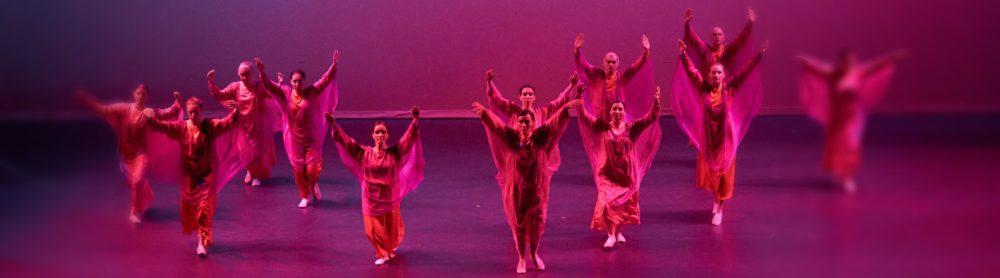
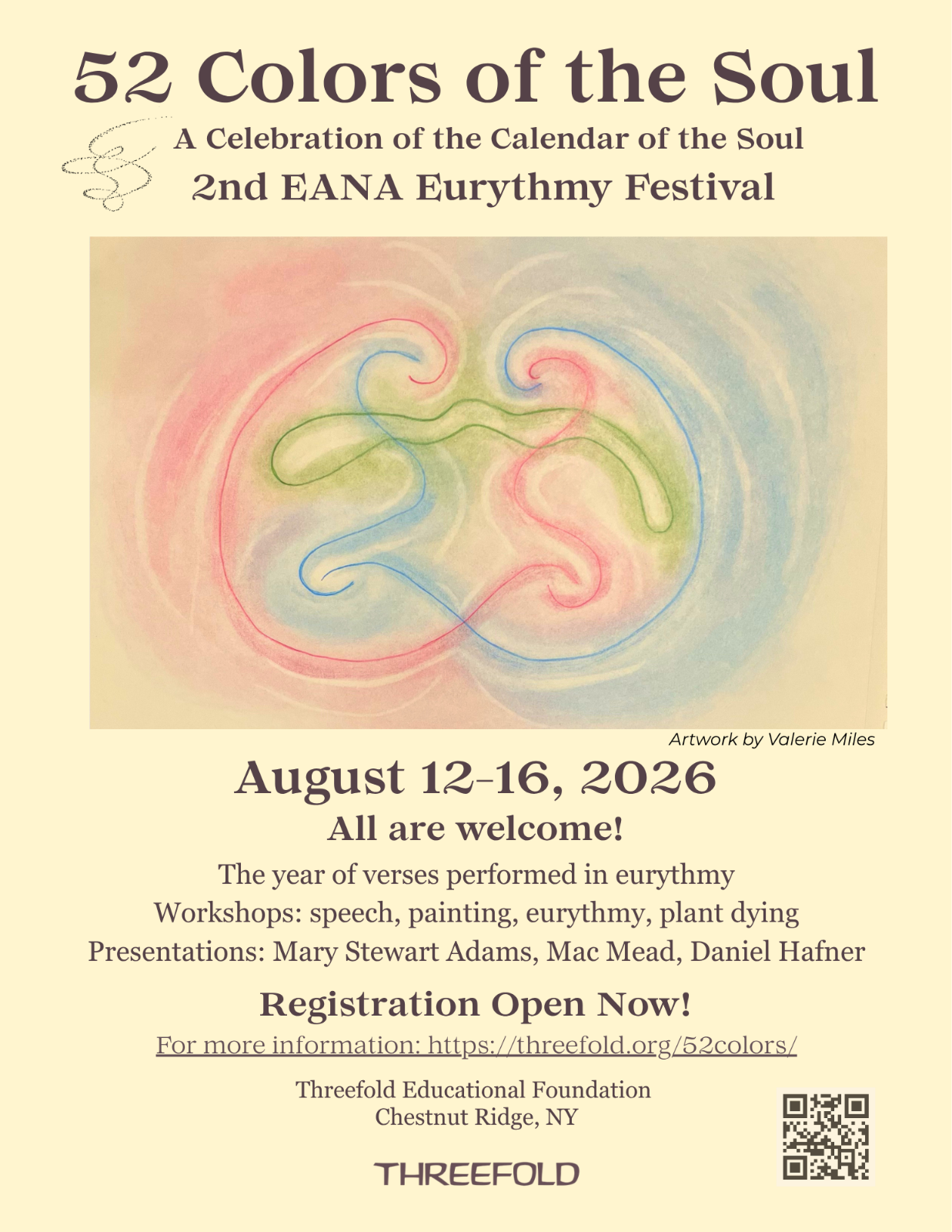
52 Colors of the Soul
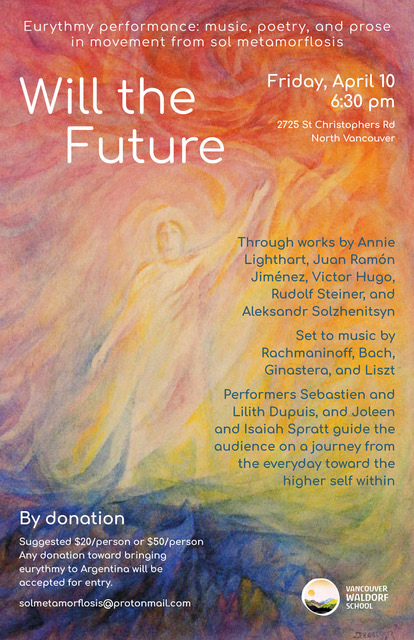
Eurythmist needed at the Vancouver Waldorf School
The Vancouver Waldorf School is looking to re-enliven its school with Eurythmy in the 2026-2027 school year.We are a small school close to the North Vancouver mountains, covering programs from Parent and tot, over Daycare until Grade Eight, reaching about 185 students yearly.Are you a eurythmist looking for a permanent or travelling position, and interested in connecting with our school?Please reach out to us Marlies De Ceuster via headofschool@vws.ca to set up a meeting and explore opportunities together.
The Joy of Collaboration: Grigory Smirnov’s Invaluable Compositions for the Eurythmy Stage By Virginia Hermann
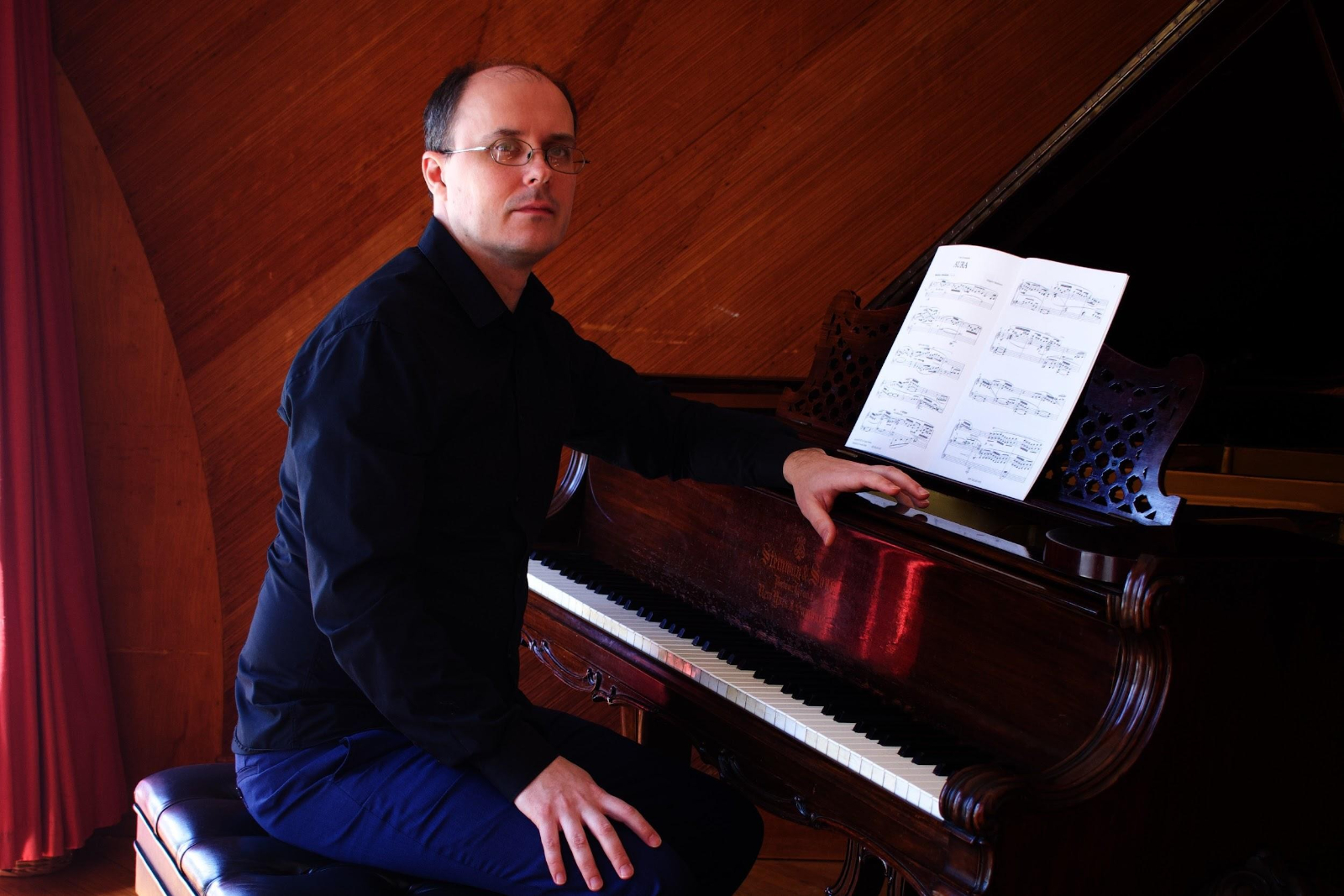
Grigory Smirnov
“Grigory!– what was that beautiful melody you were just playing?” is a question frequently heard in the presence of Eurythmy Spring Valley’s resident composer and pianist, Grigory Smirnov. “Oh, I don’t know, just something I was trying out,” he usually responds, followed immediately by exhortations of the listener to please not forget it, write it down, and hopefully turn it into a full composition.
Smirnov’s exhaustive and kaleidoscopic ability to generate, modulate, and blend melodies and harmonies sometimes seems like something more than just composing. Like a sculpture, he slowly coaxes and shapes the body of the music into form; like a painter he mixes hues, layering fine shades of color and luminosity; or like a poet he delicately hinges one note to the next as if they were each artfully chosen words. And then there are moments when the music simply appears out of his fingertips as if born out of nothing, from a world beyond, right into the moment, bringing something invisible and intuitive to life. A kind of modern romanticism, elements of Brahms, Sibelius, and Chopin, hints its way into the melodies and harmonic structure through which Smirnov’s music moves, all the while unfolding new territories within a contemporary musical lexicon. The space in and around Smirnov’s music, invites a ‘chamber’ collaboration between musician and the spatially-singing movement artists onstage.
Each time a composition of Smirnov’s is brought to visibility through eurythmy, the audience never fails to experience the music more poignantly. Captivated, people frequently want to know what the music is and who composed it. Among the regular audience goers in Spring Valley there is a growing excitement and appreciation for the privilege of witnessing a living composer’s work translated into movement before their eyes. Beginning with Grigory Smirnov’s Credo in 2020, a eurythmy solo by Vijayta Singulari, his works have been increasingly selected by eurythmists for solo or group pieces. In 2023, Sea-Anna Vasilas, long-time faculty and Ensemble member of Eurythmy Spring Valley, created the first group piece to Smirnov’s Aura, followed in 2024 by a brand new composition, Light and Dark. In 2025, eurythmist Juila Toro Schubert created a solo for Smirnov’s Elegy, which was also performed abroad in Dornach, Switzerland; and in 2026 Nadya Thompson, another member of the ESV Ensemble, performed one of Smirnov’s most recent pieces, Prelude No.10.
The results of this collaborative partnership have also produced a growing collection of programmatic compositions, specifically tailored for eurythmy stories and fairytales. In 2021 Smirnov embarked on composing for his first eurythmy fairytale, The White Dove. The composition entailed a comprehensive arrangement of musical themes, passages, interludes, and incidental fragments, to frame and flow throughout the entirety of the story. Smirnov has since created music for four more fairytales, each one a unique and similarly comprehensive world of musical accompaniment. In addition to The White Dove, Smirnov composed music for The Crystal Ball and The Frog Prince in 2022, for Mother Holle in 2023, and for Rapunzel in 2025. Two new fairytales with Grigory Smirnov’s music will be forthcoming in 2026 and 2027.
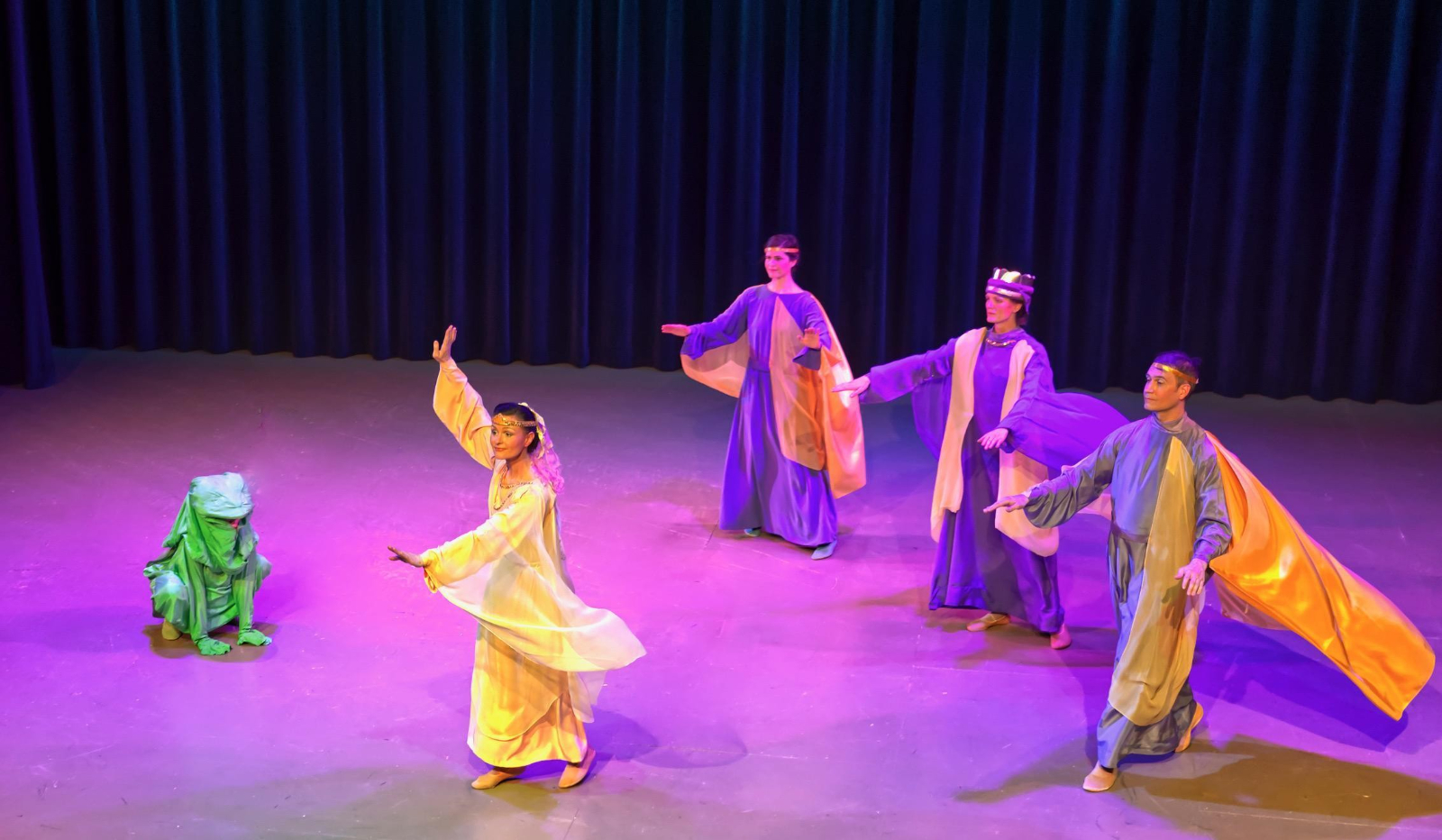
The Frog Prince, Eurythmy Spring Valley Ensemble
Each fairytale features a signature theme, which encapsulates the mood and inner journey of each story in a remarkable way, setting the stage for the unfolding of the story. Between scenes, Smirnov’s music helps create shifts and transitions, and is especially adept at elevating moments of magic, transformation, and dramatic tension. For instance, in the story of Mother Holle, the loaves of bread that call to be taken out of the oven, or the apples that beg to be picked from the tree, are accompanied by musical interludes which allow the eurythmists to show a living tableau of the activity that has just been spoken about. This revelation of the spoken, pictorial word suddenly coming to life through music greatly delights and inspires children, allowing their imagination to come alive with, for instance, the dancing bread or the falling apples.
Similarly, in Rapunzel, a eurythmist appears on stage each time the flowing locks of hair fall down from the tower, embodying the tumbling and cascading movement of the falling hair to a composition of enchanting arpeggios. In this case, Smirnov specially composed parts of this music from observing the movement of the eurythmists themselves. Then, rather brilliantly, when the witch cuts Rapunzel’s hair using it to trick the prince, the beautiful arpeggios become ominous and threatening. These tumbling hair passages, as well as Rapunzel’s opening theme music, were beloved by all, bringing so much more to the experience of the story.
Most recently, Grigory Smirnov and the Eurythmy Spring Valley Ensemble collaborated on a special project for middle school students: a rendition of Joan of Arc, with large sections told from a first person account in Joan’s own voice. Embarking on such a significant and historical program, situated in the pageantry of Medieval times, proved to be an exciting and fruitful stylistic exploration. As with the fairy tales, a signature theme was needed at the outset to frame and carry both the arc and essence of Joan’s life and deeds. The challenge was to find a balance between young girl and hero of war, between the gravity of the historical drama and the wish to bring an inspiring tale for adolescent children.
Once again Smirnov was able to draw out the essence of what was needed, capturing a melody that immediately transports the audience back in time. Along with tuning into an unmistakable flavor of the Medieval period, the slightly haunting melody wove together the innocence and depth of Joan, with a shade of the underlying tragedy of her death. A second motif, harkening to the bittersweet clanging of Joan’s beloved church bells, seems to further dole out the destiny we all know awaits her, and serves to remind us that the events in this story really happened.
Smirnov‘s themes for the appearance of the angels in Joan’s prayers, for her transformation into a soldier, and for the return of her angels when she is condemned to burn at the stake are similarly poignant. They all demonstrate Smirnov’s subtle and refined ability to translate the inner pulse of the story into a musical atmosphere that elevates and enlivens the whole production. Smirnov’s willingness to enter into a collaborative artistic process with the eurythmy director and eurythmists is part of what makes his music so integral and successful to each production: as his ideas evolve from abstract overview to concretely realized passages, the process gains creative momentum and the compositions emerge more and more out of the collaborative moment.
For some of Smirnov’s most beloved compositions in recent years, however, a very different approach was taken. Asked to compose a sequence of interludes for Eurythmy Spring Valley Ensemble’s 2023 debut evening program, ‘A Shovel of Stars Overhead– Where to, What next?’ Smirnov worked on his own to produce Interlude I for unaccompanied cello and Interlude II for cello and piano. These two compositions, used in various parts throughout the program, were crucial for the whole fabric of the production, creating important transition moments between poems and the other pieces of music being performed in eurythmy. Smirnov primarily drew inspiration from the words and moods of the program’s poetry, including the voices of Langston Hughes, Walt Whitman, Joy Harjo, and Denise Levertov. The results were exquisite. The compositions not only fit into the arc of the program with uncanny perfection, but infused the overall experience of the program with dimensions of meaning beyond words.
Over the past three years ‘A Shovel of Stars Overhead– Where to, What next?’ has been performed countless times around the United States and in Europe, with Smirnov’s compositions consistently garnering awe and great praise. By request, Interlude I has now been taken-up as a solo eurythmy piece to be performed in Spring of 2026, and both compositions have been reconfigured to great effect in The Storm, the Ensemble’s new story-based evening program.
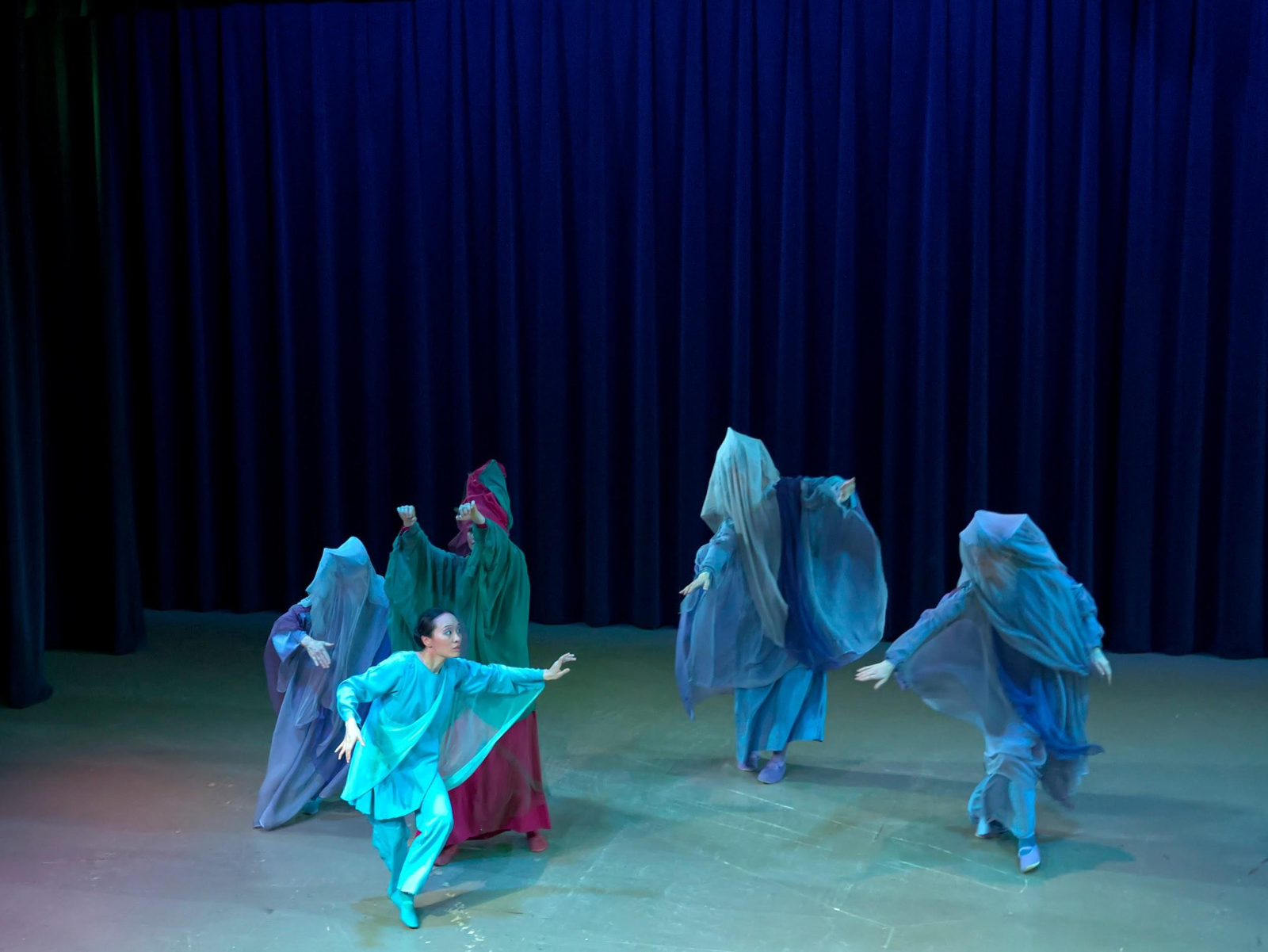
The Storm, Eurythmy Spring Valley Ensemble
Grigory Smirnov has been a resident pianist and composer for Eurythmy Spring Valley since 2019. He began performing for the professional eurythmy training, in classes and on stage, and became the Ensemble’s pianist the following year. In addition to Ensemble tours and year-round performances, Smirnov gives his own concerts regularly, showcasing both his own compositions and music from a vast array of other composers. In 2023, he both performed and premiered new pieces for the Eurythmy Association of North America’s national conference, ‘I Hear America Singing.’ New works are currently being prepared for the Association’s August 2026 conference, centered around Rudolf Steiner’s fifty-two Verses for the Calendar of the Soul; and in April 2026, a special event will be held in honor of Smirnov’s collaborative compositional work with eurythmy, featuring many of the eurythmy pieces thus far created for his compositions. Grigory Smirnov is a graduate in composition from The Juilliard School of Music in New York and originally hails from Siberia, Russia. In addition to composing and performing, he gives public lectures and presentations about spiritual aspects of music.
52 Colors of the Soul

Tone Eurythmy Therapy Course
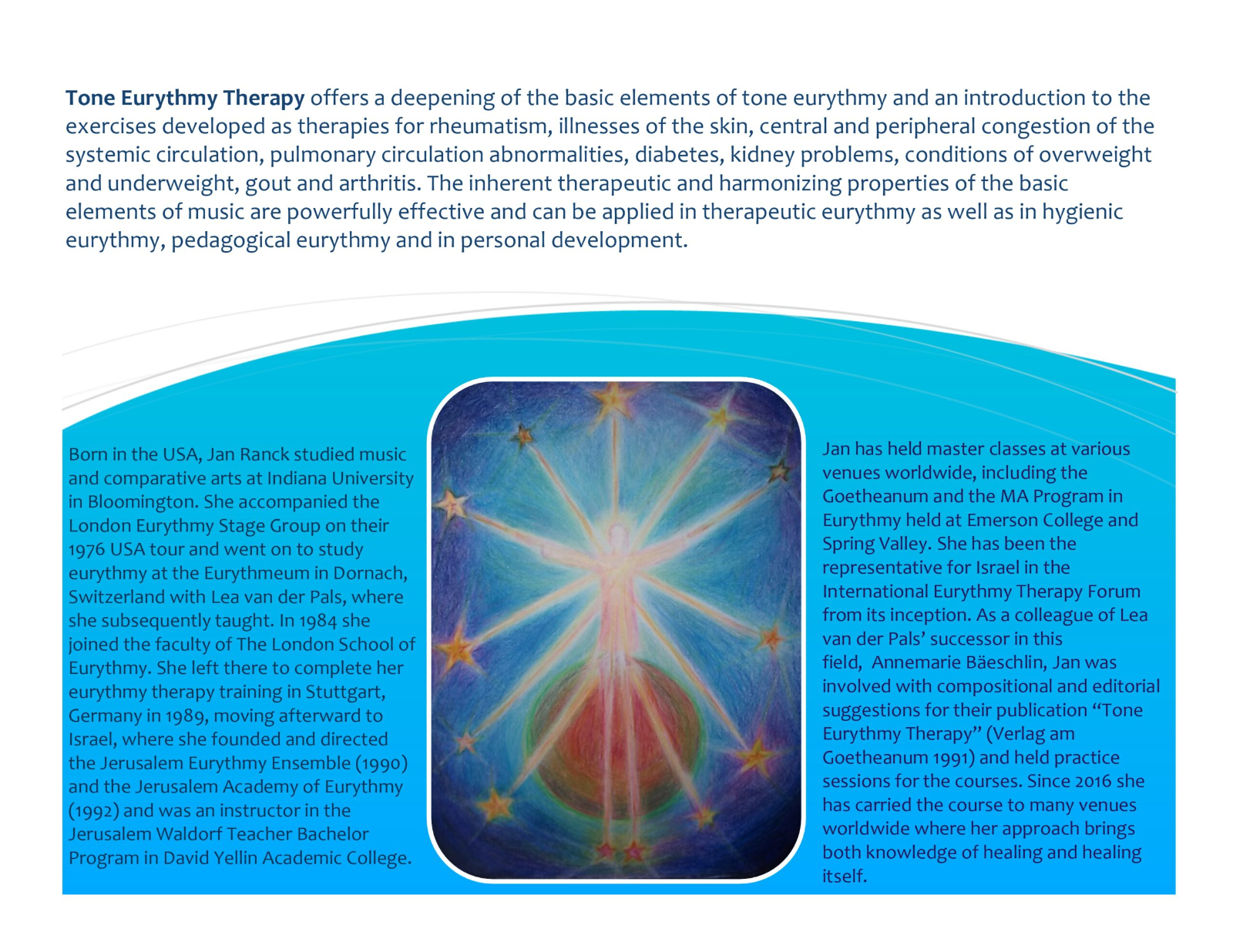
Auriel Eurythmy February workshop with Michael Leber

Eurythmy in the Working Life. Keene, NH
October 10-14,2025: Eurythmy in the Working Life. Keene, NH
The Center for Anthroposophy in Keene, NH. is opening its doors once again for a workshop for eurythmists to explore the introduction to social eurythmy, or also known as “Eurythmy in the Working Life”. This workshop is part of the Waldorf Leadership Development in-person seminar in Keene, NH. Eurythmy for the Waldorf Leadership Development and the Eurythmy in the Working Life is led by Leonore Russell, a practitioner of this approach to introducing eurythmy to the public as well as Waldorf Schools Faculties and businesses. She trained with Anne Marie Ehrlich and has practiced this method for the last 25 years.
This session is to introduce the principles for eurythmy in a social context for adults. We will explore the exercises, discussing adult learning principles and meet our fellow eurythmists as well as the leaders of the Center for Anthroposophy and administrators. We welcome experienced eurythmists and consultants interested in exploring a new approach to social awareness and eurythmy for adults.
This session is by invitation of the Center for Anthroposophy in Keene, NH. The Waldorf Leadership Development
The eurythmist then meet privately to address questions of adult learning and its application in eurythmy.
The schedule is : Opening at 7 -9 pm Friday evening the 10th of October 2025
Closing Tuesday the 14 at noon.
Location: The Gathering Waters Waldorf Charter School
S. Lincoln Street, Keene, NH.
For more information contact leonorerusssell@gmail.com or call 516-581- 5696.
Eurythmy Workshop – Explorations in the Musical Intervals & The TAO with Christina Beck
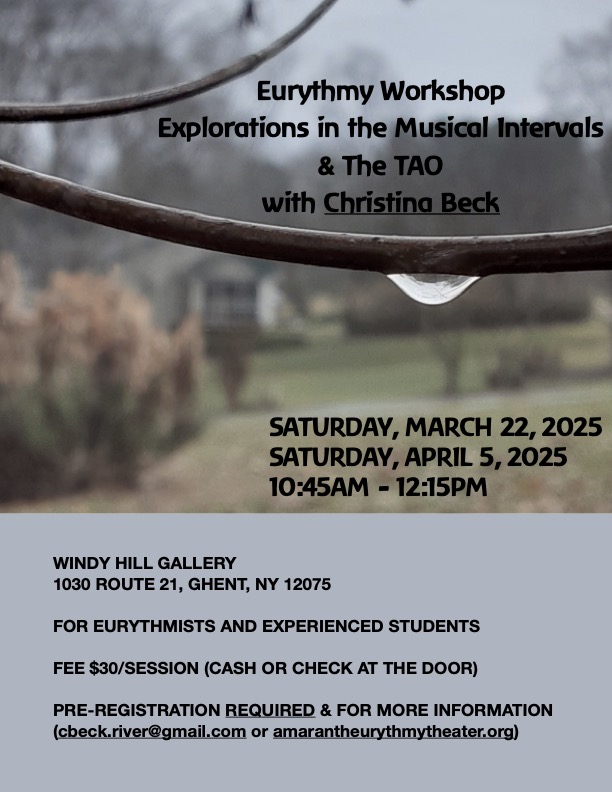
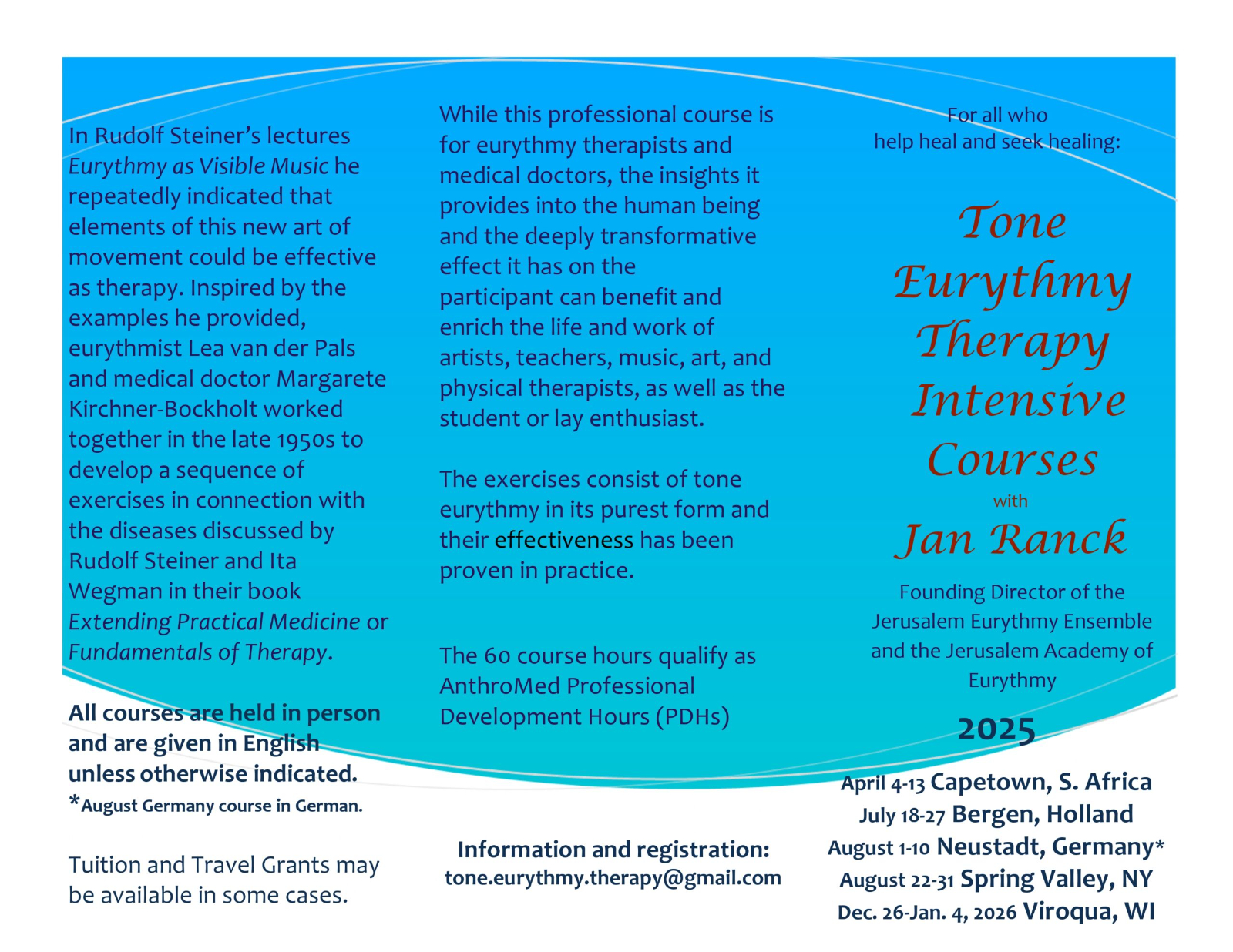
Tone Eurythmy Therapy Intensive Course with Jan Ranck
Founding Director of the Jerusalem Eurythmy Ensemble
and the Jerusalem Academy of Eurythmy
14–23 February, 2025
Spring Valley, NY
with Dr. James Dyson
April 4-13 South Africa
July 18-27 Holland
August 1-10 Germany
In Rudolf Steiner’s lectures Eurythmy as Visible Music he repeatedly indicated that elements of this new art of movement could be effective as therapy. Inspired by the examples he provided, eurythmist Lea van der Pals and medical doctor Margarete Kirchner-Bockholt worked together in the late 1950s to develop a sequence of exercises in connection with the diseases discussed by Rudolf Steiner and Ita Wegman in their book Extending Practical Medicine or Fundamentals of Therapy.
While this professional course is for eurythmy therapists and medical doctors, the insights it provides into the human being and the deeply transformative effect it has on the participant can benefit and enrich the life and work of artists, teachers, music, art, and physical therapists, as well as the student or lay enthusiast.
The exercises consist of tone eurythmy in its purest form and their effectiveness has been proven in practice.
The 60 course hours qualify as AnthroMed Professional Development Hours (PDHs)
All courses are held in person and are given in English unless otherwise indicated.
Tuition and Travel Grants may be available in some cases.
Information and registration:
tone.eurythmy.therapy@gmail.com
Tone Eurythmy Therapy offers a deepening of the basic elements of tone eurythmy and an introduction to the exercises developed as therapies for rheumatism, illnesses of the skin, central and peripheral congestion of the systemic circulation, pulmonary circulation abnormalities, diabetes, kidney problems, conditions of overweight and underweight, gout and arthritis. The inherent therapeutic and harmonizing properties of the basic elements of music are powerfully effective and can be applied in therapeutic eurythmy as well as in hygienic eurythmy, pedagogical eurythmy and in personal development.
Born in the USA, Jan Ranck studied music and comparative arts at Indiana University in Bloomington. She accompanied the London Eurythmy Stage Group on their 1976 USA tour and went on to study eurythmy at the Eurythmeum in Dornach, Switzerland with Lea van der Pals, where she subsequently taught. In 1984 she joined the faculty of The London School of Eurythmy. She left there to complete her eurythmy therapy training in Stuttgart, Germany in 1989, moving afterward to Israel, where she founded and directed the Jerusalem Eurythmy Ensemble (1990) and the Jerusalem Academy of Eurythmy (1992) and was an instructor in the Jerusalem Waldorf Teacher Bachelor Program in David Yellin Academic College.
Jan has held master classes at various venues worldwide, including the Goetheanum and the MA Program in Eurythmy held at Emerson College and Spring Valley. She has been the representative for Israel in the International Eurythmy Therapy Forum from its inception. As a colleague of Lea van der Pals’ successor in this field, Annemarie Bäeschlin, Jan was involved with compositional and editorial suggestions for their publication “Tone Eurythmy Therapy” (Verlag am Goetheanum 1991) and held practice sessions for the courses. Since 2016 she has carried the course to many venues worldwide where her approach brings both knowledge of healing and healing itself.
A Festival and Exploration of Eurythmy in Waldorf Education!
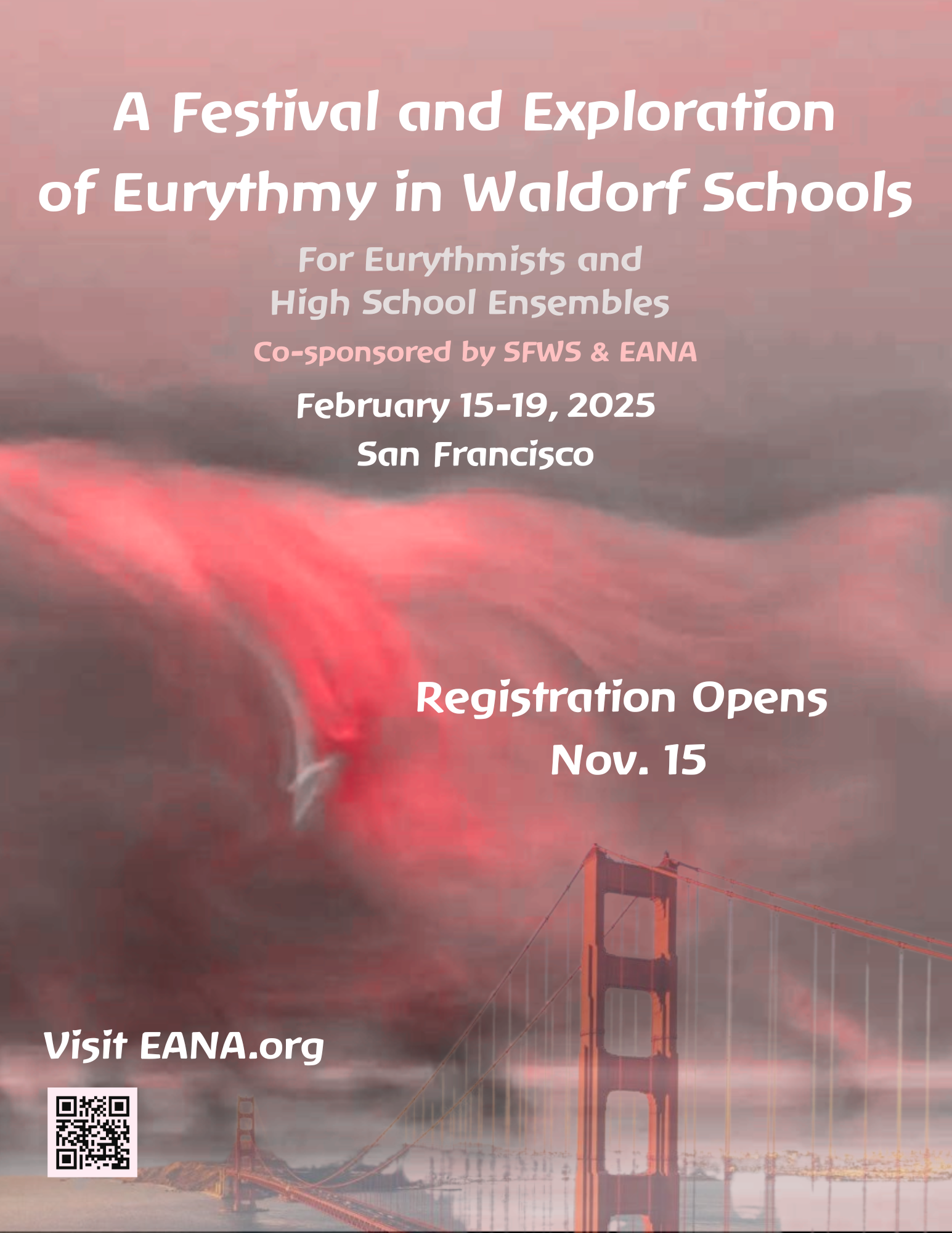
Are you looking for new ways to connect with other eurythmists and eurythmy teachers? Would you appreciate some eurythmy inspiration to share with your students and communities? Do you wonder how eurythmy will continue to grow and take shape in Waldorf Schools in the years to come?
All eurythmists are welcome to take part in this Festival specifically designed to build our sense of connection with fellow eurythmy teachers and high school eurythmy students.
Join us for
A Festival and Exploration of Eurythmy in Waldorf Education
San Francisco Waldorf High School
February 15-19, 2025
Saturday evening festive opening performance by Eurythmy Spring Valley,
Sunday – Tuesday Eurythmists and High School students will move together each morning. Then there will be workshops by North American eurythmy teachers – Rachel Schmid, Christina Geck and Maria Ver Eecke – who will share their pedagogical treasures and inspiration. Click her for their bio’s.
In order to strengthen our eurythmy community, we will have time in the afternoons to gather and share our own teaching gems and questions with one another.
Parallel to the teachers workshops, a lively group of 50 highschool students from both North and South America will work together to explore eurythmy with Alex Spadea NYC, Kleber Akama Brazil, Astrid Thiersch SF and Chelaine Kokos SD.*
On Tuesday evening, a studio program open to the public will offer an opportunity to see what the HS students have brought along and also see what they developed during the festival.
Wednesday we will bring eurythmy to various places in the city before we say goodbye.
Please join us for a lively and dynamic festival in the beautiful city of San Francisco.
Registration is now closed!
*Please note the HS troupe program is already full. We regret that there are no more spaces available to accommodate larger groups. If you would like to bring one or two students to attend, please contact eanaleadership@gmail.com to assess if we can accommodate you.
Reflect and Realign with Eurythmy Movement Therapy Hosted by Corinne Horan
This three-week online workshop is designed to help participants reflect on the past year, realign with intention, and start the new year with clarity, focus, and renewed energy.
Workshop Details:
- Dates: December 4–18, 2024
- Format: 3 live online sessions + lifetime access to course materials
- Cost: $120
Workshop Highlights:
- Learn gentle eurythmy movements to support inner balance and well-being.
- Explore how eurythmy’s artistic expression fosters clarity and renewed energy.
- Discover how this practice can inspire inner transformation.
Participants can learn more and sign up here: Workshop Link
Eurythmy in the Working Life
The Center for Anthroposophy, Wilton, NH, offers a Waldorf Administrators Leadership Program that has incorporated Eurythmy in the Working Life in the program. Everyone participates in two full eurythmy classes daily, as well as lectures, small group work, and lectures by visiting administrators. This year, we are inviting eurythmists, who are interested in social eurythmy to join the group. The dates are Oct. 4-8, 2024, in Keene, NH. There will be two long classes in Eurythmy in the Working Life, plus a private session with Leonore Russell. The eurythmists will attend one of the lectures daily.
The requirement to enter the course is at least five years of full-time eurythmy teaching, following receipt of a eurythmy diploma, and an interest in working with adults.
For those interested in more details, please contact me at leonorerussell@gmail.com or call 516 581 5696.
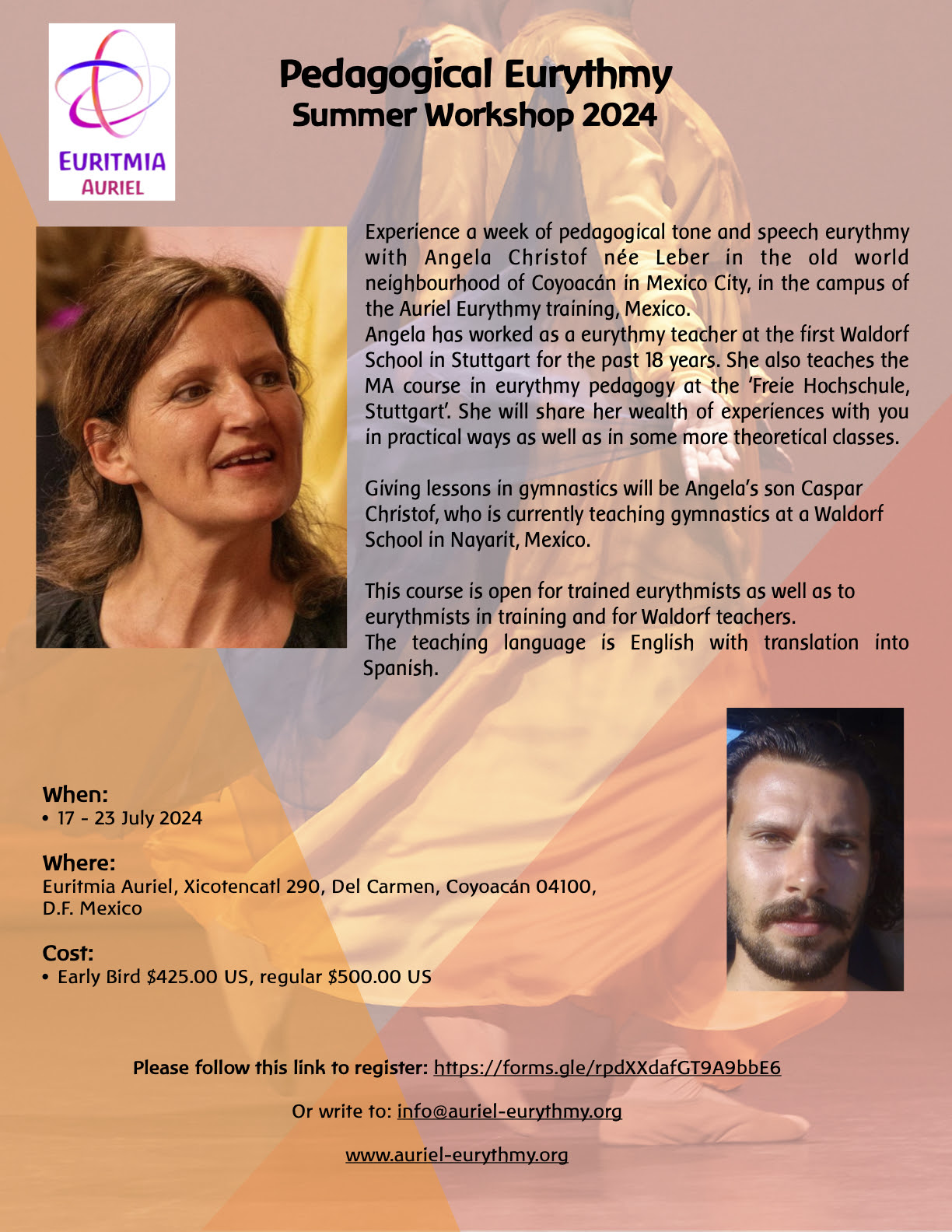
3-Day Pedagogical Eurythmy Workshop with Prosper Nebel
18-20 October 2024
LONDON
Venue: Rudolf Steiner House
£20 for non-members of Eu Assoc of GB & Ireland
Assoc. members & eurythmy students no charge.
Meals: RSH café and nearby local businesses.
Accommodation: Budget local hostels avail.
Payment: (online, or in cash on the day) to:
Account Name: Eurythmy Assoc of Gt Britain & Ireland (Pls note exact spellings and layout)
Account Number: 65221798 Sort Code 089299
Please include the reference: NEBEL WKSHP OCT 2024
‘Prosper is an excellent teacher for eurythmy education with masses of wonderful material to share for all the grades. He plays piano for his own classes and weaves the classes into a whole experience.
Taught at the London training and for me in Oslo.
Highly recommend.’
Coralee Frederickson, Professor @ Masters Eurythmy in English/ Alanus University.
Please confirm attendance by 1st week of Oct 2024
For more info contact: e.carlson@btinternet.com
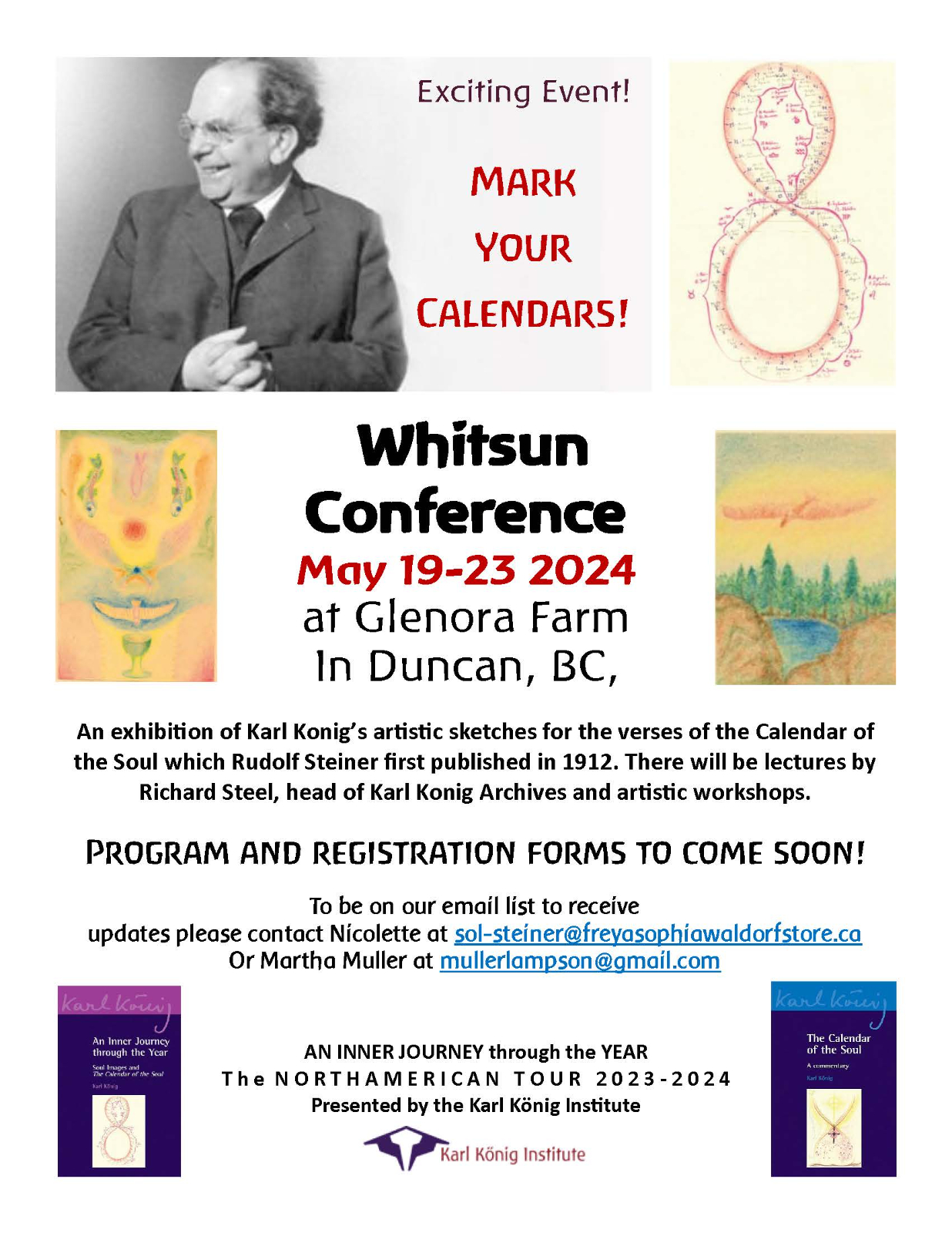
Whitsun Conference on the Calendar of the Soul
Including an exhibition of Karl Koenig’s illustrations for each verse.
May 19-22. 2024 at Glenora Farm, Duncan, BC, Canada.
There will be a eurythmy presentation of two Soul Calendar Verses, and daily artistic workshops of eurythmy, speech, singing, painting and nature observation.
Eurythmy Therapy Training in the UK
We are happy to announce that the next course will start on September 2nd, 2024. The training is offered through Alanus University and on completion provides an internationally recognized Master’s degree, in addition to a diploma from the Medical Section at the Goetheanum. It is necessary to have a eurythmy diploma recognized by the Goetheanum to take part in this course, but a Bachelor’s degree is not a requirement.
The training will take place at Emerson College in Forest Row and comprises five four-week blocks over a two-year period, which take place in the spring and summer (see more details on our website). In addition, there will be two one-week blocks online in the autumn. In the final phase of the course, which may be extended into a third year, you will complete the required practice placement hours and submit your thesis, which will be a Case Study.
Students should be able to master the English language at an appropriate level. The application process is completed online and there are guidance notes on the Alanus website with details about the documentation you will need to submit.
If you are interested, please get in touch so we can meet you on Zoom before applying!
Responsible for the Master of Arts – Eurythmy Therapy:
Shaina Stoehr, Katherine Beaven, and Brenda Newton. They are supported by Dr. James Dyson.
In addition, there are many guest tutors, including doctors and therapists with expertise in particular fields of medicine.
For more information, please refer to the website or email us.
https://www.eurythmytherapytraining.org.uk
Jan Ranck upcoming Eurythmy appearances in Viroqua, WI
Keith Hess has invited Jan Ranck to hold a lecture on Eurythmy, a series of Eurythmy lessons, and a Eurythmy performance during the Anthroposophy Festival taking place in Viroqua, Wisconsin on Oct. 27-Nov. 5, 2023
https://thecommonsviroqua.org/anthroposophy-festival/
The festival’s Eurythmy programming begins on Saturday October 28th at 2:30 PM with the introductory lecture and demonstration (including audience participation) by Jan Ranck, as well as demonstrations of pedagogical and therapeutic Eurythmy by Erin Erkelens, Joshua Ecklund and Keith Hess.
The Eurythmy lessons will take place every evening, from Monday (October 30th) through Friday (November 3rd) from 4:30 to 6:00 PM. They will include both Tone Eurythmy and Speech Eurythmy and are designed for beginners through advanced so all can profit from the experience.
The series will climax with a short Eurythmy performance on Friday, November 3rd at 6:30 PM accompanied by Sue Ellen Dubbert (Piano) and Keith Hess (Recitation).
All events will take place in The Commons on the basis of free-will donations with a suggested contribution of $25 per session.
For her preparation Jan is interested to know approximately how many are planning to attend these sessions. A simple RSVP to ladyofthelakeproductions@proton.me would be welcomed.
Please help spread the word, feel free forward this message or post it for anyone who might be interested in Eurythmy, and we look forward to this wonderful event!
Jan Ranck was a student of Lea van der Pals and a colleague of her successor in this field, Annemarie Baeschlin, and was involved with compositional and editorial suggestions for their publication “Ton-Heileurythmie”, Verlag am Goetheanum 1991, published in English in 2009 as “Tone Eurythmy Therapy” by the Medical Section at the Goetheanum. Born in the USA, she studied music and comparative arts at Indiana University in Bloomington. She accompanied the London Stage Group on their 1976 USA tour and went on to study eurythmy at the Eurythmeum in Dornach, where she subsequently served as a teacher. In 1984 she joined the faculty of The London School of Eurythmy. She left there to complete a training in eurythmy therapy in Stuttgart in 1989, moving afterward to Israel, where she founded the Jerusalem Eurythmy Ensemble (1990) and the Jerusalem Academy of Eurythmy (1992). She was an instructor in the Jerusalem Waldorf Teacher Bachelor Program in David Yellin Academic College, and a guest teacher in various venues worldwide, including the Goetheanum and the MA Program in Eurythmy held in Emerson College and Spring Valley. She is the representative for Israel in the International Department of Eurythmy Therapy (“Eurythmy Therapy Forum”) and has held the course in Tone Eurythmy Therapy at various venues throughout the world.
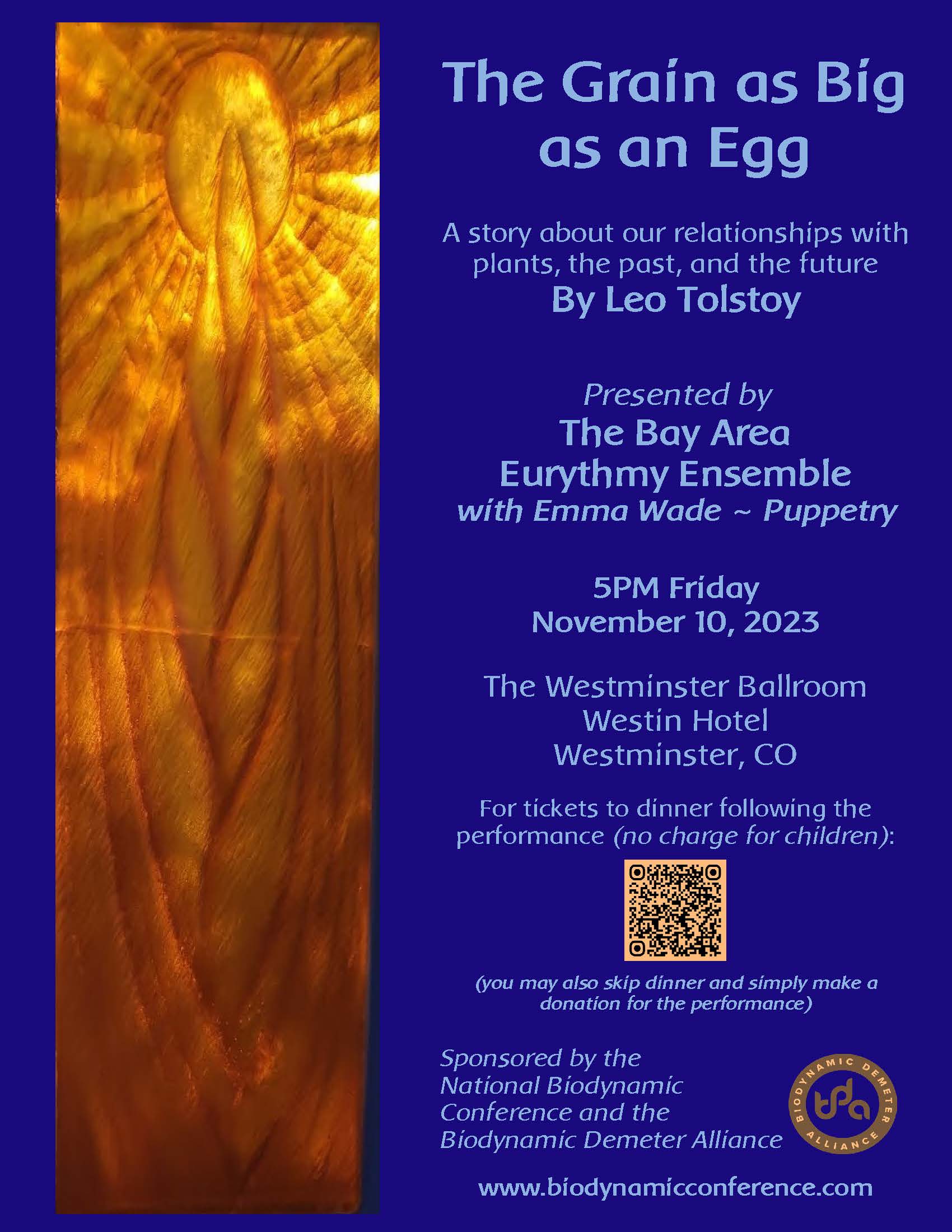
The Bay Area Eurythmy Ensemble is performing at the National Biodynamic Conference in Colorado on November 10, 2023.
https://www.biodynamicconference.com/2023/program
Come see “The Grain As Big as an Egg”, the story by Leo Tolstoy that premiered at “I Hear America Singing” in Spring Valley in August.
Workshop for eurythmists with Michael Leber
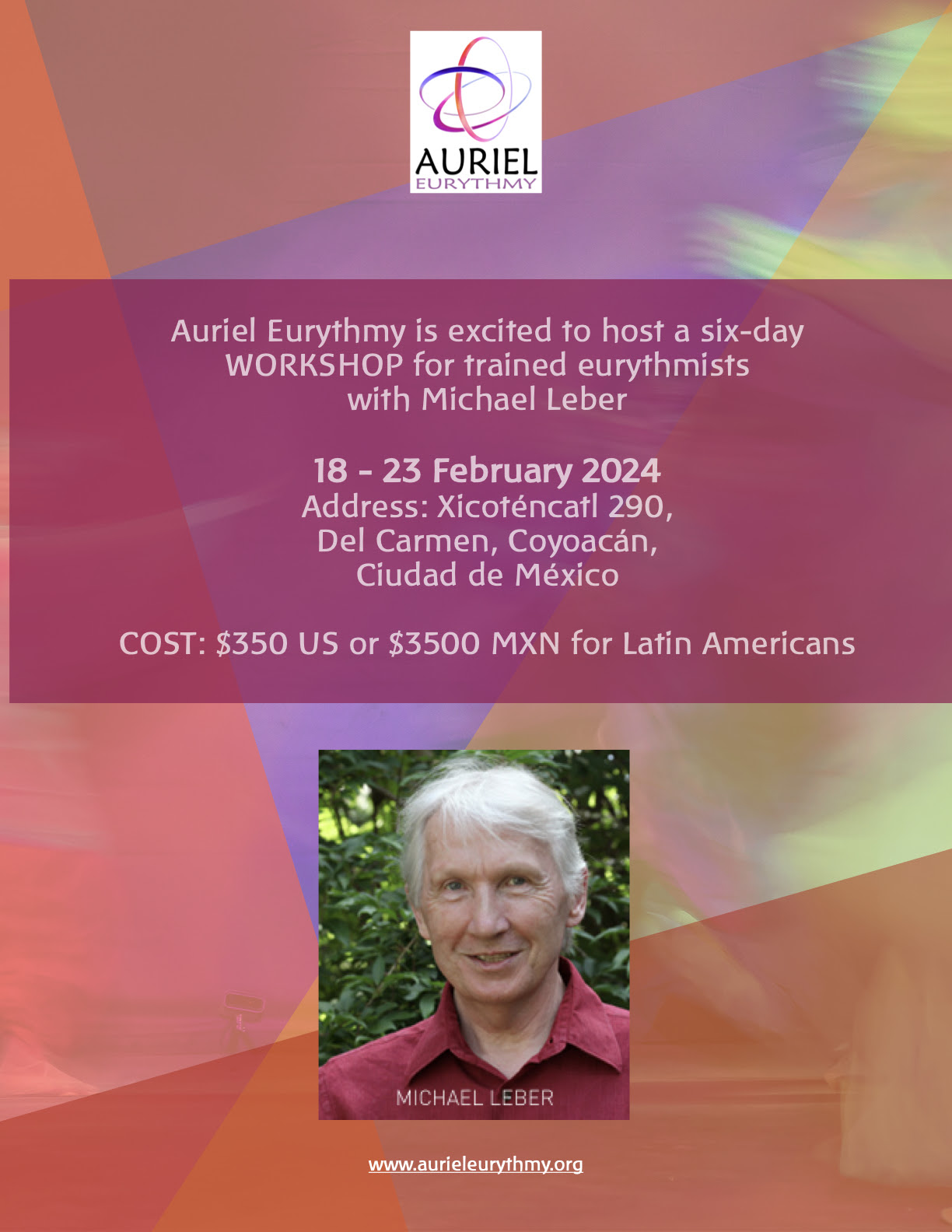 We are honored that Michael Leber will join us from Stuttgart, to give a six-day course at the Auriel Eurythmy training in Mexico City in February. Michael Leber has been giving courses for professional eurythmists in North America for three decades. This workshop with Michael Leber is an opportunity to be refreshed for our work as teachers and performers. Michael Leber brings to us his knowledge, his loving dedication to eurythmy, and his experience. He is always happy to share his anecdotes of meetings with the pioneers of eurythmy, like Lory Maier-Smits. As we will work for six days without a break, it would be good if you could bring a little extra time with you, to explore Mexico City either before or after the workshop. Auriel Eurythmy is located in the old-world heart of Mexico City, a neighborhood called Coyoacán, a few blocks from the Frida Kahlo Museum, colorful markets, parks and old churches. For more information on the conference, or help with finding accommodation contact Nina Wallace-Ockenden by email: auriel@lifelonglearningsociety.org or on WhatsApp: +52 984 132 0833 Please register by 15 November for the early bird discount Early bird: $300 US or $3000 MXN for Latin Americans Regular: $350 US or $3500 MXN for Latin Americans Register here We are very much looking forward to welcoming you to Mexico City. Michael Leber’s teaching language is English when he comes to Mexico City, but we will have translators available for Spanish speakers. Michael Leber likes to focus on tone eurythmy when he is not working in the German language, but he will also bring some speech materials. Michael Leber’s ingenuity in creating ever new warm-up exercises and challenging our flexibility is always delightful and offers many ideas for our teaching repertoire. February is a beautiful time in Mexico City. Nights are cool and fresh with temperatures down to as low as 5° Celsius or 41° Fahrenheit. The days are dry, bright and warm, with temperatures between 20°- 25° degrees Celsius or 68°- 77° Fahrenheit. Follow this link to read more about Mexico City in February:Tour by Mexico  |
Singing and Jumping Opens the Way to a Vital Music Eurythmy Foundation, Part III, first section
Fixed Do and Movable Do in Our Eurythmy: Does It Matter?
by Kate Reese Hurd
Here reposted is the enlargement, now updated, of my autumn 2021 article for our Eurythmy Association of North America Newsletter, “Fixed Do and Movable Do in Our Eurythmy: Does It Matter?” This document completes the first section of Part III of the Singing and Jumping Opens the Way to a Vital Music Eurythmy Foundation report. The second section of Part III will delve into the earliest records of the angle-gestures and consider how these gestures have been applied over the last century. The first half of “Part I: The Archetypal Scale and Its Disappearance” of the Singing and Jumping report was posted in December 2019 and updated in March 2023. And “Part IV: The Singing and Jumping Exercises – Real Sounds Lead to Real Gestures” was posted in March 2022. The rest of the report is in progress and will sooner or later come out as a book.
For the workshop on movable do and the 1915 angle-gestures which I led at the Eurythmy Festival this month (August 2023), I was immersed in the Arioso by J.S. Bach yet more deeply. Because of this, I’ve been able to describe its tonal journey – as well as the tonal journey of Bach’s Air on the G String – even more clearly, and I hope more helpfully. I’ve especially tried to open the doors into tonal music wider for those of you who work with these pieces in eurythmy. The two Bach manuscripts are now found right in the document at the end of it.
TABLE OF CONTENTS:
Concerning fixed do and movable do
The expression of the scale in eurythmy
Movable do in eurythmy expression
Fixed do in eurythmy expression
Real time consequences of fixed do
Moving toward a movable-do practice:
J.S. Bach’s Arioso
J.S. Bach’s Air on the G String
Expressing changes in tonal center in eurythmy
Closing
References, endnotes and about the author
With warm and cheerful greetings,
Kate Reese Hurd
karehuuu@gmail.com
The article for download (the second page is blank so that two-sided printing will come out correctly for the music manuscripts):
FixedDo-MovableDo+Bach,KateReeseHurd,082323,pdf
Summer Eurythmy Festival Registration is now open!
Registration is now open!
“I Hear America Singing!”
A North American Festival Celebrating the Performing Arts of Eurythmy, Speech & Music
August 1-6, 2023
Spring Valley, New York
We warmly welcome you to join us this summer to celebrate the Performing Arts of Eurythmy, Speech and Music!
This festival is for eurythmists and everyone who loves eurythmy and wishes to immerse themselves in the art of eurythmy. Eurythmists from across the continent will offer a variety of workshops for colleagues and for the general public. Special classes for youth participants (age 18-25) will also take place daily.
The schedule will allow for exchange through talks and demonstrations, informal sharing of works in progress, collaborations, practice sessions and other initiatives. Evenings will be filled with an array of performances by groups and individuals from across the continent.
Included in this festival are our sister arts of creative speech, poetry and music. Speech artists and musicians will support our workshops and performances, and will offer workshops and performances of their own for us to participate in and enjoy.
This is a unique opportunity to witness and support the depth and breadth of eurythmy as it lives on our continent as a life-giving force in the very challenging times in which we find ourselves.
For more information, including registration, follow this link https://threefold.org/event/i-
There are many costs in creating this festival and making it a success. Please consider contributing to the festival through the GoFundMe Campaign:
https://gofund.me/3cfd6185
Link to poster:
https://eana.org/wordpress/wp-
Please share with your contacts and community.
The Performing Arts Working Group,
Council Members of the Eurythmy Association of North America
Email: eurythmyfestival2023@gmail.com
Sponsored by the Eurythmy Association of North America & The Threefold Educational Foundation
Singing and Jumping Opens the Way to a Vital Music Eurythmy Foundation
A Detailed Report by Kate Reese Hurd
First posted in December 2019
Extensively revised in March 2023
First third of PART I
“The Archetypal Scale and Its Disappearance – A Memoir”
Accompanied by two music manuscripts introducing new methods for showing tonal relationships:
J.S. Bach, Chorale BWV 367
Jean Marie Leclair, Sarabande
This revision of the first third of this PART I memoir was made necessary because of the evolution of my understanding of the processes of modulation. It is not a matter of the 4th of the existing scale raising or the 7th lowering. Instead, a new role opens up which redefines all of the existing scale relationships and allows the music to move to a new tonal center. A pitch-tone which is not serving in a role in the existing scale enters for the sake of opening up this necessary role in the scale to which the piece is modulating. The roles are everything!
Also, my studies of the earliest records (available now in German) that were made by the eurythmists who attended Rudolf Steiner’s August 1915 presentations of the angle-gestures, have made it possible for me to address his use of the word ‘tone’ more effectively. I also realized that other sections of my PART I of the report were not yet clear enough. I certainly hope that I have done a better job of it now! My articles on the earliest records have come out in both the EANA and Performing Arts Section newsletters; so this revision and re-posting could not wait.
Our musical notation rightly focusses on the matter of showing clearly what the musician has to do to sound the correct pitch-tones, in order to play the music. But these notational conventions are the source of a great deal of grief for the art of eurythmy. For our responsibility is to bring the formative structuring of music to expression, which Steiner called the “Tongebilde” (note: the Compton-Burnett team translated this word properly where it appears in Eurythmy as Visible Singing at the opening of Lecture I). Never did he mean to encode individual pitches as angle-gestures. I can find no record of such an intention as that on his part. Only in the living, formative relationships between the pitch-tones is music to be experienced. But I would like to suggest that even this statement is not accurate. This livingness of music involves the qualities of relationship that arise in the tonal musical scale; and it is solely these qualities of relationship, which define and affirm each other, which constitute the scale-Gebilde in its entirety. When these relationships are directly experienced, there is no need for reference to pitch-tones at all; for the relationships which are holding sway in any given moment are all the musical grounding we ever need in tonal music. We can then let go completely of the material-audible aspect.
Great effort over many decades has been applied, to try to manage our art without placing the roles and relationships that belong to the tonal scale at the very heart of our expression of music. We have placed pitch-tone expression in the center, and have tried to compensate for this by incorporating references to the life-blood of tonal relationships, as a kind of apology for eclipsing these relationships so thoroughly. As our colleague Reinhard Wedemeier declared in the Performing Arts Section Newsletter, Nr 76 for Easter 2022, this is indeed “the primary catastrophe in tone eurythmy.” These angle-gestures as presented by Rudolf Steiner in 1915 are not tone angles. In their absolute gesture-essence, they are tonal angles: they express relationships. We must be moving toward really experiencing these remarkable relationships in the tonal pieces that we work with and present, so that we know where we are in this inaudible tonal-Gebilde at every moment and can grow to express it. The exercises which I provide in PART IV of this SINGING AND JUMPING OPENS THE WAY report can do much to help us to enter and experience these relationships clearly and securely. They are the life-blood of tonal music; and they need to be likewise the life-blood of our expression of that music. (PART IV was posted in March 2022.)
I hope that my articles and reports concerning our practice of music eurythmy and about the formative structuring of music, the music-Gebilde, will help to shine light on our plight and show us how to surmount this situation. I plan to establish a website for my work this year, where colleagues will be able find my articles, updates, additions and my writings on other topics more easily.
Dear reader, please remember to take your time and gently pace yourself with the body of work posted here, which aims to delve far below the surface of both music and eurythmy movement, in order to bring new understanding, healing and fresh impulses into our efforts now for the sake of our art.
Wishing you many blessings on your journey,
Kate Reese Hurd
karehuuu@gmail.com
MusicEurythmyReport,KRH,032823,FirstThirdPartOne,Disappearance,pdf
BachChorale367,KRH,032723,Annotated,pdf
BachChorale367,KRH,032723,Plain,pdf
LeclairSarabande,KRH,032723,Annotated,pdf
LeclairSarabande,KRH,032723,Plain,pdf
Eurythmy in Working Life: Course for Professionals with Leonore Russell
|
|
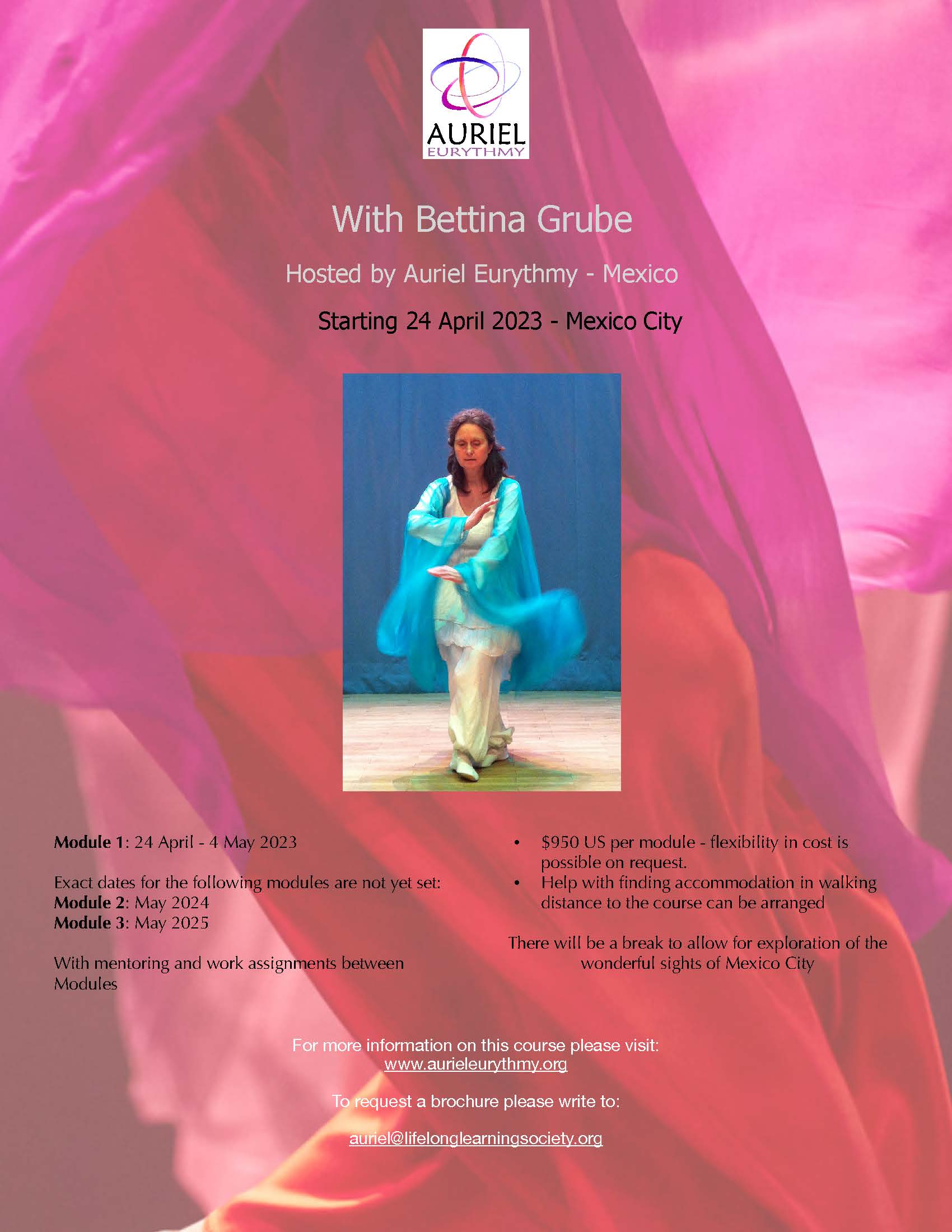
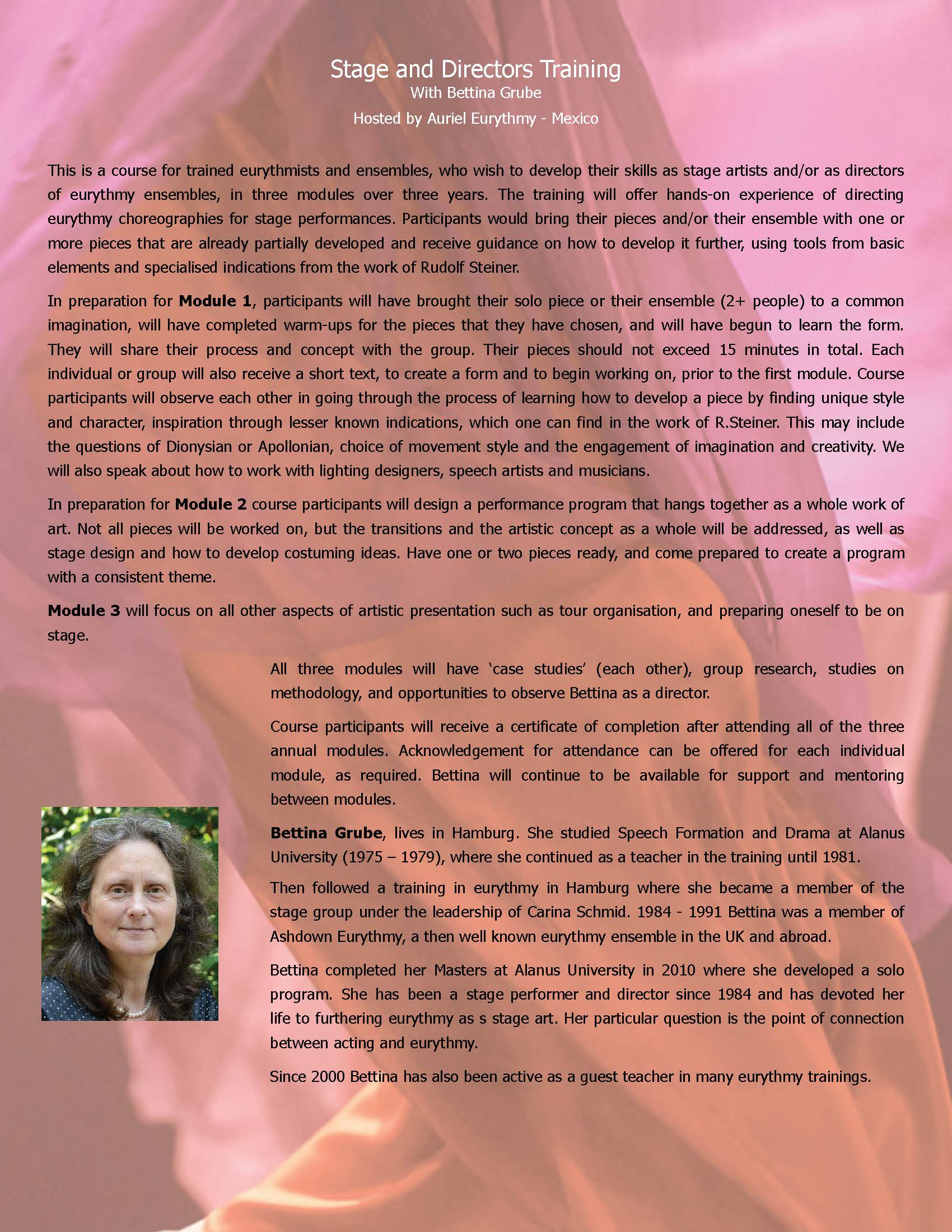
Stage and Directors Training with Bettina Grube in Mexico City
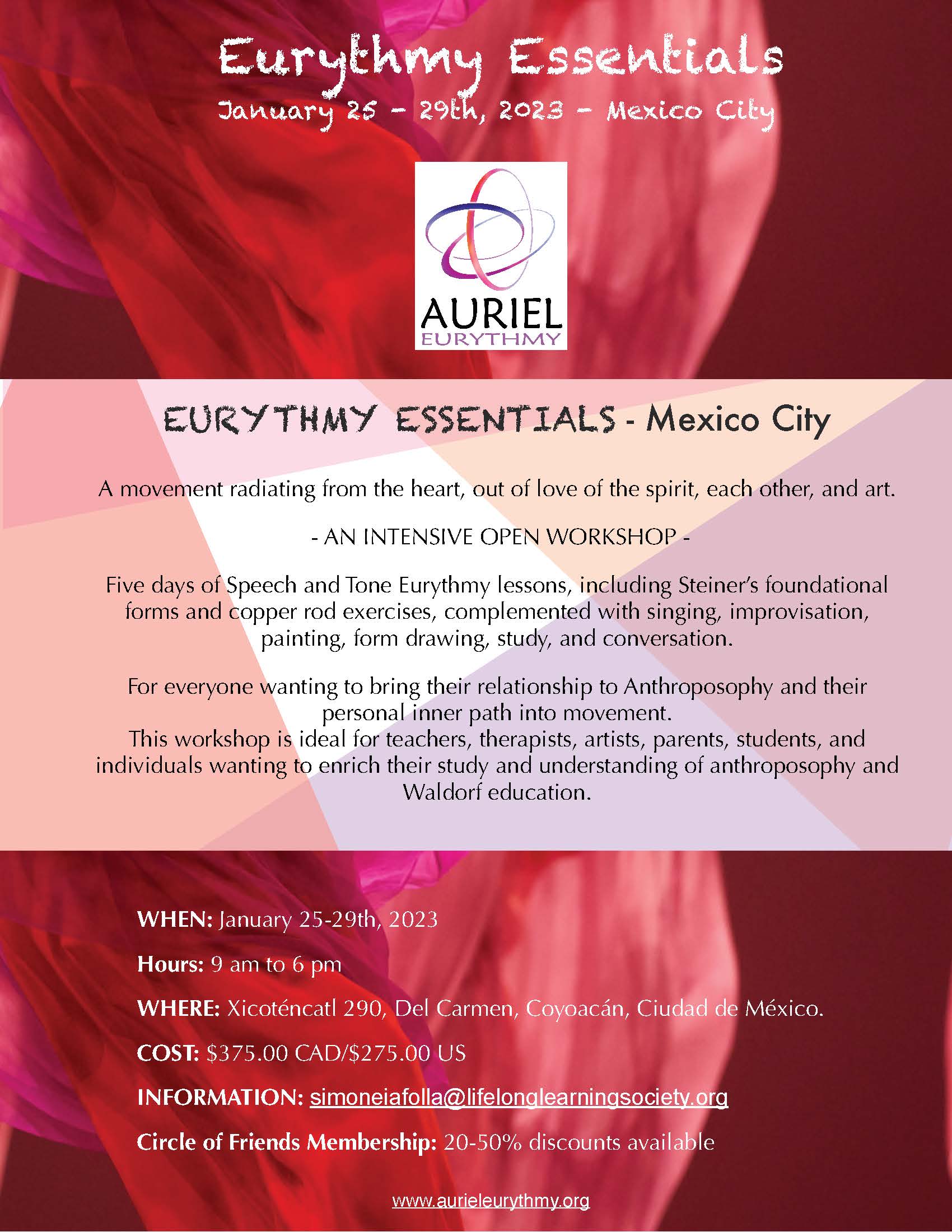
Eurythmy Essentials – January 2023 Mexico Workshop
Rudolf Steiner’s Eurythmy Figures
Michael Leber Workshop 16th to the 27th of August 2022
Dear Colleagues near and far,
You are invited to attend this year’s workshop by Michael Leber in Mexico City. You can register and also pay for the workshop by clicking on this link: https://www.aurieleurythmy.org/classes-and-events.html
The workshop will be held in English.
Warm greetings, Nina Wallace-Ockenden
Singing and Jumping Opens the Way to a Vital Music Foundation
Part IV: The Singing and Jumping Exercises – Real Sound-Experiences Lead to Real Gestures
by Kate Reese Hurd
In December 2019, the first half of Part I of my Singing and Jumping Opens the Way music eurythmy report was posted at our site. The brief article that is appearing in our spring 2022 Newsletter, “The Earliest Records Show the Angle-Gestures as Moveable Do,” will unfold much more comprehensively as Part III of this larger report. What is posted here now is the final section, Part IV. When the report is done and published, this final Part will no doubt have been revised somewhat, but I felt it important to post it without waiting.
TABLE OF CONTENTS of the Singing and Jumping report:
Preface
Basics for the Best Use of the Report
Prologue: Arriving at a Boundary in Music Studies and Performance
Part I: The Archetypal Scale and Its Disappearance – A Memoir
Part II: Contemplating More Carefully Our Fixing of the
Archetype to One Audible Pitch-tone and Scale
Taking Another Look at Our First Exercise
The Hexachord and the Process of Mutation
Our Notation… (and etc.)
Part III: Fixed Do and Moveable Do in Our Eurythmy
The Early History of Our Angle-Gestures
The Lectures
Developments Since 1924
Scale Degrees, ‘Tones’ and Intervals
Moving Toward a Moveable Do Practice –
Bach’s Arioso and his Air on the G String (and etc.)
Part IV: The Singing and Jumping Exercises –
Real Sound-Experiences Lead to Real Gestures
Introduction to Part IV
The Eurythmy Meditation
The Agrippa von Nettesheim Drawings Come to Life
Beginning to Sing
Entering the Scale Degrees
Entering the Melodic Intervals
Entering the Triads
Exploring Harmonic Progressions and Modulation
Entering Music With Fresh Sensibilities
Equal Temperament: Does It Change Things?
Atonal and Twelve-Tone?
Closing
Materials
References, Endnotes and About the Author
Appendix I, “The Scale Degree Intervals Give Rise to Our Tonal Music Gebilde”
Appendix II, “Fixed Do and Moveable Do in Our Eurythmy: Does It Matter?”
Wishing you a wonderful musical journey,
Kate Reese Hurd
karehuuu@gmail.com
Part IV for download:
SingingJumping,PartIV,Exercises,KateReeseHurd,031422,pdf
Why Do Our Schools need Eurythmy? An Introduction to Eurythmy and Its Healing Influence in Schools
By Leonore Russell
April, 2011
One of the first questions parents ask when they come to learn about a Waldorf school for their child is about the movement art taught in most Waldorf schools: eurythmy. What is it? Why does my child have to do this? After many years of working as a eurythmy teacher and in the administration of a Waldorf school, I find myself still answering these questions. Yet the answers grow and develop as the years pass and new knowledge both in science and education are bringing light to bear on the questions.
First of all, what is eurythmy? It is a movement art, living in the family of movement arts such as mime and ballet, yet standing midway between these two arts. It shares meaning and gesture with mime, yet it is married to sound rather than objects or recognizable actions, and shares the moving to music and words with dance, but seeks to follow the invisible movement within sound rather than move to it or juxtapose itself against it. It is the expression of the human soul through gesture and movement.
A student once asked: “Who thought this up?” after seeing the same gestures in the great art of the past. He had stumbled on the truth of the expressive gestures that artists such as Giotto and Michelangelo had mastered in their paintings. In the early part of the twentieth century, Rudolf Steiner pointed us toward these gestures to learn their meaning and to find a new art of human movement. He worked first with a young girl and then an ever growing group of interested artists to develop this new art of movement.
Eurythmy has developed over the years and has several unique qualities: it is an art form late to arrive; it is in its infancy, unlike music that has developed over thousands of years. Eurythmy, the hidden inner movement of the soul, emerged out of the work of a few individuals gathered around Rudolf Steiner and has become a worldwide art form practiced on the performance stage, in schools, in therapeutic settings, and in businesses and other social settings.
Eurythmy begins with human speech. The center of movement is in the heart/larynx area of the body and the gestures flow into the hands and arms primarily, but encompass the whole human form. Its name, “eurythmy” means beautiful rhythm, or harmonious movement.
Eurythmy began as a stage art, but soon people asked; this is beautiful and health giving, shouldn’t we teach it to children? And so school or “pedagogical eurythmy” was born. It found a home in the Waldorf schools in Europe and later in the Americas. Then the question was asked: Since this movement art expresses the whole human being, wouldn’t certain movements strengthen the internal organs and relate to illnesses? “Curative’ or “therapeutic” eurythmy was then developed with doctors and eurythmists collaborating and basing their work on Steiner’s work in curative education. Unlike pedagogical eurythmy, therapeutic eurythmy is usually one to one, rather than group activity. *
All three types of eurythmy are appropriate in the school situation. Adults and children alike need to see artistic performances. It is then that the adult really is able to comprehend the scope of this new art. Children see what they are learning in a whole experience. They light up with enthusiasm on seeing such performances and are motivated to learn. Teachers have found the presence of a therapeutic eurythmist on staff is the greatest help in understanding and working with challenges that more and more children face.
Eurythmy is a door to the human heart and all its expressions in poetry, music and drama, and a pathway from the inner world of the human being to the expression in outer life that carries meaning and purpose. In a time when much of education is moving to test driven, informational teaching, eurythmy offers experiential, artistic and social learning.
What role does eurythmy play in the school? Healthy children take great joy in movement. They experience:
- Movement, music, poetry and stories in an age appropriate and joyful way
- Support and strengthening of language development
- Musicality and the power to listen
- Integration; the coordination of hands, arms, legs and spatial movement combine with eye, ear and balance, as well as thought processes.
- Intentional movement that creates complex neural development*2
- They feel how good focused attention is.
- Joy and a sense of freedom in movement
- Confidence and balance of the inner and outer social capacities
- The ability to work on problem solving collaboratively in their group
- Creative thinking and action based on such
A student once said: “Eurythmy helps us to become more human.”
This is the best answer I know why eurythmy is needed in the schools. It meets the ever-increasing demands of children of today, in health of the body and the soul. Even when watching eurythmy performed, adults feel the harmonizing effect. Eurythmy strengthens the healing effects of its sister arts, music and speech, and brings the curriculum alive.
A last word again from one of a student:
“Eurythmy helps us breathe.”
It is the breath that gives us life. Eurythmy is the breath of the school. The human being as part of the whole creation is communicated to the community in eurythmy.
If your school does not have a eurythmy teacher or one nearby, all is not lost. It is important to develop what I call “suction”, where the faculty cultivates movement throughout the curriculum and the school. If the whole school comes into movement activities with joy, eurythmists notice this and are interested in working in such an atmosphere. How is this done? By including movement in the rhythmic part of the lesson, having two or three (minimal) recesses outside and a teacher present who can teach rhythmical playground games, teach folk dancing of all sorts, play party games for young children, and of course, create many movements, cooperative games, and life gestures for the little ones to imitate.
For more information on bringing eurythmy into your school, contact the author leonorerussell@gmail.com or contact Editor@EANA (Eurythmy Association of North America, www.eana.org). *3
* Another aspect of eurythmy, focusing on the social aspect of eurythmy, has been developed in Holland and is useful for groups who work together. Eurythmy-in-the-Workplace is sometimes done with school faculties, but discussion of this is beyond the scope of this article.
*2. See Carla Hannaford, Smart Moves, Great Ocean Press
*3. Available for eurythmy in schools
Kinestheictc Learning n Adolescence, by Leonore Russell, AWSNA Publications
Eurythmy, by Sylvia Barth, AWSNA Publications
Articles by Thomas Paplowsky, Renewal Magazine, AWSNA Publications
For more on eurythmy, go to the web; key word: eurythmy.
What is Eurythmy? Its Healing Influence in Schools
by Leonore Russell
Published in being human, Spring 2012 of the newsletter for the Anthroposophical Society in North America
Editor’s note: We begin where many readers will have first encountered eurythmy, in a school…
One of the first questions parents ask when they come to learn about a Waldorf school for their child is about the movement art taught in most Waldorf schools: eurythmy. What is it? Why does my child have to do this? After many years of working as a eurythmy teacher and in Waldorf schools’ administration I find myself still answering these questions. Yet the answers grow and develop as the years pass and new knowledge both in science and education bring light to bear on the questions.
First of all, what is eurythmy? It is a movement art living in the family of movement arts, such as mime and ballet, yet standing midway between these two arts. It shares meaning and gesture with mime, yet it is married to sound rather than objects or recognizable actions and shares the moving-to-music and -words with dance, but seeks to follow the invisible movement within sound rather than move to it or juxtapose itself against it. It is the expression of the human soul through gesture and movement.
A student once asked: “Who thought this up?” after seeing the same gestures in the great art of the past. He had stumbled on the truth of the expressive gestures that artists, such as Giotto and Michelangelo, had mastered in their paintings. In the early part of the 20th century, Rudolf Steiner pointed us toward these gestures to learn their meaning and to find a new art of human movement. He worked first with a young girl and then an ever growing group of interested artists to develop this new art of movement.
Eurythmy begins with human speech. The center of movement is in the heart/larynx area of the body and the gestures flow into the hands and arms primarily, but encompass the whole human form. Its name, “eurythmy” means beautiful rhythm, or harmonious movement.
Eurythmy began as a stage art, but soon people said, this is beautiful and health giving, shouldn’t we teach it to children? And so school or “pedagogical eurythmy” was born. It found a home in the Waldorf schools in Europe and later in the Americas. Then the question was asked, since this movement art expresses the whole human being, wouldn’t certain movements strengthen the internal organs and relate to illnesses? Curative or therapeutic eurythmy was then developed collaboratively by doctors and eurythmists basing their work on Steiner’s work in curative education. Unlike pedagogical eurythmy, therapeutic eurythmy is for a specific individual condition and is practiced usually one-to-one, rather than as a group activity.
All three types of eurythmy are appropriate in the school situation. Adults and children alike need to see artistic performances. It is then that the adult really is able to comprehend the scope of this new art. Children see what they are learning in a whole experience. They light up with enthusiasm on seeing such performances and are motivated to learn. Teachers have found the presence of a therapeutic eurythmist on staff is the greatest help in understanding and working with challenges that more and more children face.
What role does eurythmy play in the school? All healthy children take great joy in movement. They experience:
- Movement, music, poetry and stories in an age appropriate and joyful way
- Support and strengthening of language development
- Musicality and the power to listen
- Integration; the coordination of hands, arms, legs and spatial movement combine with eye, ear and balance, as well as thought processes
Intentional movement that creates complex neural development (see Carla Hannaford’s ‘Smart Moves’)
- Focus: they feel how good focused attention is
- Joy and a sense of freedom in movement
- Confidence and balance of the inner and outer social capacities
- The ability to work on problem solving collaboratively in their group
- Creative thinking, and action based on it.
A student once said: “Eurythmy helps us to become more human.” This is the best answer I know why eurythmy is needed in the schools. It meets the ever-increasing demands of children of today, in health of the body and the soul. Even as an audience watching a eurythmy performance adults and children alike feel harmonized by eurythmy. It strengthens the healing effects of its sister arts, music and speech, and brings the curriculum alive.
A last word, again from a student: “Eurythmy helps us breathe.” It is the breath that gives us life. Eurythmy is the breath of the school. The human being as part of the whole creation is communicated to the community in eurythmy.
For information on bringing eurythmy into your school, contact the author leonorerussell@gmail.com or email editor@EANA.org.
Eurythmy as Means to a World Conception
Seth Morrison
A selection of the senior thesis presented to Friends World College in 1977
“…The lawless leap of joy becomes a dance, the shapeless gesture a graceful and harmonious miming speech; the confused noises of perception unfold themselves, begin to obey a rhythm and weld themselves into song.” Friedrich Schiller, On the Aesthetic Education of Man, 1795
The art of eurythmy, as with every genuine occupation, has a transforming effect upon those who undertake it. Each occupation develops certain senses and mood of soul, as well as engaging the activity of the sense of self (ego) in a certain way. How does eurythmy educate the human being? All applications of eurythmy stem from its artistic nature.
The art of eurythmy enlivens the senses and transforms the living body into a genuine sense organ. Eurythmy disciplines the soul and vivifies its experience. It requires new relationships between its participants, a new social structure.
The sense of touch begins to perceive that which presses against it from the physical earth. The feet, which otherwise only carry the body, become sense organs that tell the soul of gravity and freedom from it in walking. The eurythmist is freed and then surrenders again to the earth in every step.
The sense of touch is joined in its activity by the life and movement. It is transformed for it begins to feel another force pressing against it, just as tangibly as the pressing of objects. Space becomes a sensible phenomenon, a mutable force that can be shaped by the movements of the body. The eurythmist senses how the living body determines space; just as the architecture of a dwelling determines an interior and exterior space, so does the eurythmist create space or as infinite numbers of possible spaces, for the eurythmist is both the architect and the architecture, alive and changeable, unlike the fixed materials used in dwellings.
As the artist learns to use space creatively, he or she must adjust the sense of balance. The forces of levity and gravity, right and left, in front of and behind reveal themselves as physiological and psychological realities. Every movement creates new relationships to these forces both within the body and in space. The way in which the soul can express itself depends upon these relationships, for body and space are its medium.
Through eurythmy the soul develops a new relationship to the body. It begins to reach into it and make it speak and sing. It begins to know the body as a living, moving, touching organ – a sense organ and an expressive organ of its invisible life. The body stands and moves in equilibrium amidst a world of viable forces.
When the body, through touch, life, movement, and balance, attains a harmony, the soul rejoices, for it feels its true relationship to the visible world. But the soul has a difficult task. It must become the stage for feelings greater than those of ordinary intensity. In speech eurythmy, the soul must become the poet’s soul; in tone eurythmy, the composer’s soul. Otherwise the poem or music will not speak or sing, but only the soul’s likes and dislikes, only personal feelings will become visible. The soul’s organs must be strengthened and enlivened so to aspire toward the true nature of verse and music.
This thriving for truth exercises the “consciousness soul. The harmonious interpenetration of body and soul yields a healthy sense of being. The sentient soul experiences this harmony that, by the way, is not always easily attained. The sentient soul must become an accurate organ, a true communicator of bodily sensations, as the positions of the body in space, to the I (ego). The effort to harmonize body, soul and spirit remains a goal for the developing eurythmist.
The senses of smell, taste, sight, warmth and hearing can only be discussed with regard to the soul. It is essential to remember that the soul is a unity in which three types of feelings interweave. These five senses take on new activities with regard to the soul. The eurythmist smells and tastes in a new way. These senses turn inward and expand into the soul. The atmospheres of soul life have a kind of smell and taste just as do gaseous physical atmospheres, only of a different nature. The soul experiences light, dark and colors; the eurythmist learns to see and to paint these. Also the soul experiences warmth and coldness of mood and feeling. The eurythmist must learn to sound within his or her soul, as has been indicated already. These five senses are metamorphosed into “soul senses” (in addition to their ordinary activities), for the eurythmist must awaken within and learn to discipline the life of the soul
The Ego sense undergoes a wonderful transformation through eurythmy. The cooperation and coordination of eurythmists, of truly intimate moods of soul, requires a true sense of community. The success of any eurythmical effort depends upon its social structure. The Ego sense must become a “Community sense;” the sense of self (through ego consciousness) must become a “We sense.”
The Ego is the instigator of conscious human activity. The Ego is a spiritual activity – and activity of pure will. The will force surges through the nervous system culminating in so-called motor impulses, causing movement. The eurythmist must learn to order the transformation of nerve activity to muscle activity. In learning the elements of which a eurythmical composition consists, the eurythmist must be able to think clearly, but during movement, all the will activity is fully in the body. The activity of the eurythmist is fully present in every moment of movement. The life-body, in time, develops memory and a metamorphosed thinking activity. Through eurythmy, the spiritual in Man embraces the whole the human being.
The educative value of eurythmy is not limited to its own sphere of activity. Through his or her own experiences of movement and form, the whole world reveals its own – for all things are moved by their own forces or by forces exerted upon them. The eurythmist experiences the life of the human being and then its life within nature. The eurythmist is able through enlivened sense, feeling and thought, through metamorphosed will to enter into creating a world conception.
“The art of eurythmy is one of the channels through which the spirit is again revealing itself to human consciousness. It is a path through which man may again find a way to that self-knowledge which is also knowledge of the universe.”
Raffé, Harwood, and Lundgren, Eurythmy and the Language of Dance (London 1979), p. 27.
Eurythmy: Meditation in Movement
RUTH TSCHANNEN
If you are a musician and you are asked to play, you pick up your instrument and you start to perform. What about the idea that one’s own body is an instrument and that life’s circumstances provide the music?
Or in words expressed by Novalis, a German poet of the Romantics: “There is only one temple in the world, and that is the human body. Nothing is more sacred than this high form.” Going back to the image of the instrument we might say that our bony structures serve as the frame for this most remarkable instrument, and the nerves provide the strings on which life’s mysteries are played.
The human body on the other hand can also be experienced as a trap if we feel pain or if we realize its limitations. How can we break through this wall that hinders us to go beyond the mere physical reality of the material world? We are often tempted to use drugs to break the walls of our own limitations, but only for a short time. What happens if the trip is over and we are faced once again with our own self?
In our time of the 21st century the understanding that there is something more than what the eye beholds is more and more spoken about. Meditation workshops, yoga classes and other forms of self development are offered everywhere in Western society.
What role does Anthroposophy play in this expanding awareness and how does eurythmy contribute to this? I am asked almost daily to explain what eurthmy is about. I have many different answers depending on who is standing in front of me. I might say: ”Eurythmy is a meditation in movement”, or “speech and music made visible”. Many listeners let it go at that, but those who want to know more might say: “show me something.”
Rather than demonstrating at first I might say: “lift your arm up above your head.” This seems fairly easy, anybody can do that. Now I say: “Try to do the same movement and experience as you move your arm up, that there is the same arm movement going down as an invisible counter stream.” So now when we lift our arm we try to pay attention to this space underneath the arm. We might notice that by doing this simple exercise our otherwise heavy arm can become almost weightless without using our physical muscles. Have you ever wondered how a conductor can lift his/ her arms for over two hours without feeling tired? Where is the buoyancy coming from? What is the secret? The secret is the life forces or etheric forces. The same forces which open the buds and blossoms in spring and are involved in all growing and becoming.Eurythmy works with these very same forces.
HOW DID EURYTHMY COME ABOUT?
In a lecture given in Wales in 1923 Rudolf Steiner sums it up in the following way: “Eurythmy within the anthroposophical movement has come about like a gift of destiny.” Because, much earlier, in 1912 he was asked the following question: “Would it be possible through certain rhythmic movements via the etheric body (the body which is the seat of all rhythms as well as health and illness) to work into the physical body in a healing, strengthening and regulating way?” Rudolf Steiner didn’t only enthusiastically affirm this question; he immediately offered to give instructions. And so from this one question asked at the right moment, it became possible to bring into being the new art form of eurythmy ( “eu”- well or good, “rhythmos” – rhythm, movement). I have lived and worked with eurythmy for a long time and have come to know the great power and strength which can break walls spiritually. If eurythmy sounds interesting to you, here are some exercises you could try:
Fix a sheet of paper to the floor and sit in a chair in front of it. Put a pencil or crayon between your big toe and second toe of each foot. The first thing to do is to place both feet at the top of the page on the midline of the paper and draw two parallel lines towards the bottom of the page. This movement can be done repeatedly until you feel that the lines become stronger.
The next step is to draw a circle by starting at the top of the paper and draw both halves simultaneously bringing the feet together again at the bottom of the page. The important thing is to work with both feet at the same time, always mirroring the forms on the midline. A fun thing to do next is to write the alphabet in this way, keeping in mind that the right half is as we know the letters but the left is mirrored.
WHAT IS THE PURPOSE OF WRITING WITH OUR FEET?
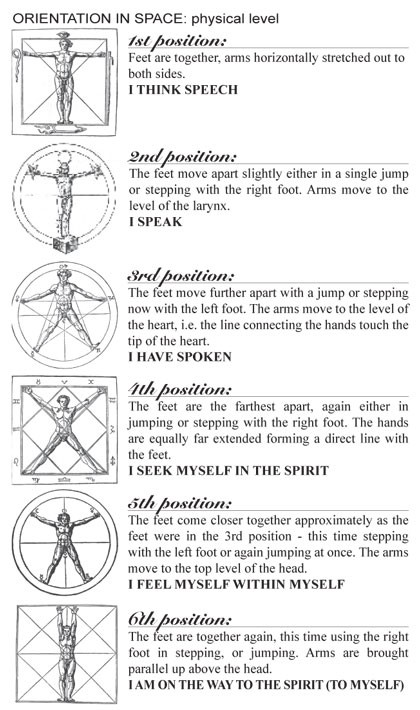
First of all we change our habits. We usually write with our hands, and now our consciousness has to reach down to our toes. Our hands are the expression of our soul. The feet on the other hand connect us to the earth: they carry us through life. We are mostly unaware of the work of our feet. The drawing with our feet helps to penetrate our own instrument to the most removed parts of our physical body, the toes. The next exercise involves the picture of the six figures below; called the six figures of Agrippa von Nettesheim (This meditation should be done silently. The capitalized words “I THINK SPEECH” etc, should be said inwardly.)
METAMORPHISIS: etheric level
When you become comfortable with these six positions, a next step could be to look at the metamorphosis from one position into the other and to pay attention to the stream/counter stream of the etheric. Compare the positions that are of the 1st, 4th and 6th form compared to the 2nd, 3rd and 5th. How different they are from each other! In the first three we have the metamorphosis of the cross (from the horizontal to the diagonal to the vertical). And it is in the 4th position where we most easily perceive the invisible stream of the arms made visible within the movement of the legs. In the second three we mark important places within our body: larynx, heart, top of the head. The forms related to the cross are within a square, the others within a circle.
SOUL: astral level
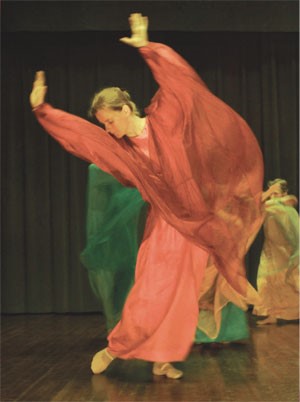
In the words of Rudolf Steiner on July 12th 1924: “If one teaches eurythmy to adults, and one starts with this exercise, they will be able to easily find their way into the eurythmical element. And furthermore when the gestures in this exercise are made one after the other, they belong to the soul harmonizing, healing eurythmical gestures. Especially if people are so inwardly fragmented, that it manifests itself in metabolic illnesses, this exercise will be of great help in all cases.”
Within this exercise we can find the three soul forces: Thinking expressed in the words of the meditation, feeling shown through the movements of our arms/hands and willing made manifest through the stepping of our feet.
The importance of this 6 step exercise can be understood when you realize that the “I” is working through each step at successive levels of awareness: physical (1st position), etheric (2nd), the astral (3rd), spirit self (4th), life spirit (5th) and spirit man (6th). If you practice these two basic exercises, you may have some interesting experiences of becoming conscious of your instrument, the temple of the human body, and to gain a different experience of your position in space.
This article was originally written for ILLUMINATING ANTHROPOSOPHY – Anthroposophical Prison Outreach Newsletter – Spring 2005. We are reprinting this article with their gracious permission – more at www.anthroposophyforprisoners.org
Ruth Tschannen works with members of the Cascadia Society in North Vancouver, is involved in activities at the local Rudolf Steiner Centre and has been a student of Anthroposophy all her life. We will continue this topic in the next issue and focus on local activities.
Movement Art Therapy – Eurythmy
When I did eurythmy for the first time, I felt that my soul could breathe. Then I noticed that I saw the world differently, for example, when walking down the street I would notice what looked like a sculpture, but on coming near, it would be a dead tree! I began to see the formative qualities in life around me. Now I wonder if this is how our Waldorf alumni perceive the world.
Eurythmy is a movement art and the name eurythmy comes from the Greek words ‘eu’ meaning harmonious and rhythm. The human form is the instrument and through eurythmy gesture and movement, one may achieve balance.
Moving together in eurythmy helps the students overcome many hindrances, establishing a sense of spatial relations and an inner sense of directionality. Movement is an activity of the will, and while moving together we round off our rough edges; one result is that social harmony is created among classmates. It is said that a school who sings together, breathes together. And it has been observed that eurythmy helps create social harmony on many levels within a school. Great transformations occur through the practice of anthroposophical arts.
For some time I have been interested in how children learn. After observing many children in Waldorf schools, it is apparent that the curriculum is inspired and truly meets the child at each stage of development. When hindrances to learning arise, the teachers meet to determine what special remediation or therapy is best appropriate. The therapeutic eurythmist works one on one with each student, who is asked to practice at home with parental help.
Constitutional Types of Children are helpful guidelines for the teachers.
A most helpful guide for child observations can be found in the material that Rudolf Steiner gave to the first teachers. The threefold human being (Anthropos) has a physical, soul, and spiritual nature. The forces of thinking, feeling, and will are aspects of the soul. As we live in a three-dimensional world, we can experience polarities that pull us into opposing directions. For example, gravity and levity can be expressed in an exercise, “Light stream upward; weight bears us downward,” an exercise given to his students even before eurythmy was created by Dr. Steiner in 1912. One can imagine stretching upward with the arms, while the feet are apart, keeping one grounded. Our likes and dislikes can be described as sympathies and antipathies, definitely a soul experience; this comes in eurythmy as contraction and expansion: “Joy and woe are woven fine, a clothing for the soul divine” (William Blake). Whoever has moved with a group, contracting in oneself, then all moving forward so that the circle of people contract, finding the moment when the movement shifts so that the gesture opens and then the circle of people expand, this is truly a breathing movement, a breathing of the soul. Isn’t that the first difference that people notice when seeing eurythmy performed for the first time, the developed back space of the eurythmists? Usually we do not confuse up and down or back and front, but right and left is so symmetrical, until a dominate side is strengthened. When asked, most people put their hands on their hearts when asked to find a center of their being. Although the heart lies in the center of the chest, it is tilted, so that we think of our heart-side as being on the left. (I have not been able to confirm the degree of the angle, but it is thought to reflect the tilt of the earth on its axis.) This heart-side is the feeling side, the more receptive side. The teachers of the early childhood classes move their circle games in the direction of the sun, clockwise for us in the Northern Hemisphere. Of course, exercises are given to help the children strengthen their dominate side, right or left. Thus we experience the three-dimensions through the width of space (right and left), through the fore and back space (as soul breathing of self with the world) and in the forces of gravity and levity (the heights and depths).
Teachers hone their observations of children, which informs us how they learn. When the child is in balance, learning comes naturally. When one pole or the other predominates, ways need to be found to rebalance. The ancient Greeks spoke of a virtue as having two opposing vices: courage is the virtue that holds the balance between fearfulness and fearlessness, while both extremes prove to be dangerous. Rudolf Steiner, in his observations of the human being, spoke of the constitutional types of children. He described gave seven different constitutional types, with the soul in-breathing and out-breathing between the polarities. One knows the feeling of being stuck, too fixed, and the opposite of being too loose, lacking form. Yet we seem to be able to swing between these polarities, as we try to maintain a fluid balance in life. When would therapy be recommended?
The active child will be in the midst of the play, but may have difficulty coming to quiet. The quiet child stands and observes without entering into the play. The teachers provide an altering rhythm between active play and restful activities throughout the school day. Both play and rest are important and every parent knows the struggle of transitions from one activity to another. Surprisingly, Dr. Steiner suggests that the active child would benefit from more fruit in the diet, to help the child take control of limb activity. And for the quiet, sedentary child…root vegies to help the digestion learn to assimilate salt. The doctor teaching in the Therapeutic Eurythmy Training in North America recommends eating the four parts of the plant (roots, stems, leaves, fruits, including grains and seeds) daily for a balanced diet.
Recently I worked with several kindergarten children, who had challenges (with much name calling and tender feelings) in the social realm with other classmates. After an initial evaluation, it became clear that these children were very sensitive, what could be called thin-skinned constitution. Our skin is the largest breathing organ we have and our soul breathes with the world. The eurythmy gestures create a protective sheath for the young child; however a few of them needed extra support. After therapeutic eurythmy, these children are socializing in first grade, happily forgetful of past insults or injuries. The other polarity would be a thick-skinned constitution; this is a child who will show boundary issues, as well, but in a more awkward manner, bumping into people and things. Therapeutic eurythmy helps these children become more aware of and sensitive to others in movement.
Imitation is how the child assimilates the world.
The young child learns through imitation, by doing what is seen, and through the activity, knows it. Imitation is not just a copy or simulation. We know that the young child is at one with the world, living in the soul state of wonder, as long as they are protected from too much sensory overload. The gesture for wonder is open, the eurythmy sound, Ah. A good example of this state of oneness can be observed while watching a parrot. When I move my finger, the parrot moves his head following my finger. The parrot does not seem free to not move his head, for how long I don’t know as I give up long before he is tired of this game. What is a better word than imitation, oneness? This is such a powerful force that allows one to learn to speak one’s mother tongue or even a second language before one can write it, to take in the world actively and to make it one’s own, to know the environment in every sense.
When a young child has difficulty imitating the gestures in eurythmy, a specific therapeutic eurythmy exercise has helped many children (in nursery/kindergarten through second grade). If we speak the Latin vowels, it is a progression from the back of the mouth with Ah and moving forward past the lips with U. Also it is a soul progression. As the young child lives in wonder (Ah), any sense of self-awareness gives another mood. As the open gesture of arms wide in Ah, the arms now cross and touch; any touching is an experience of self. To point or indicate with one arm extended, that is assertion of the self. The sounds of the Latin vowels are A, E, I. For the child who is unable to imitate, lead from one sound to the other and then move back in reverse. One may swing the arms from open, crossed to one stretched arm; switch to the other arm, cross arms and end with the open gesture. Then ask the child to jump these positions, three jumps forward and then three jumps back. I speak, “Ha, Hey, Hee; Hee, Hey, Ha.” It is important that they hear the sounds with the gestures. And as they gain agility, they may jump faster! Often the tricky part is crossing the legs moving back. After working with one there-year-old child, the nursery teacher remarked how his behavior changed, that he was able to imitate. And then I realized that this exercise leads the child back to wonder, Ah! As this hygienic exercise was given to teachers and not directly in the therapeutic eurythmy course for doctors and eurythmists, it is an exercise to be used by teachers.
Specific therapeutic eurythmy exercises are beneficial for all imbalances in the constitutional types of children. However the eurythmy teacher may offer hygienic eurythmy exercises for a class or a group of students presenting a similar condition, such as puberty. When the middle school students arrive for class in state of high excitement, the eurythmist senses that this is the time to introduce an exercise for puberty. As the legs kick high, with the energy of wild horses, the arms slowly create a balancing gesture to bring calmness to the turmoil erupting below. The image I give them is the Charioteer of Delphi, whose statue is exhibited in the Delphi Archaeological Museum, Greece. The large-eyed, far-seeing Charioteer stands upright, but one has to imagine the two-wheeled chariot with the racing horses. The intention is to bring calmness and a sense of order to the tumultuous forces arising. Many students have enjoyed this exercise, especially because it meets them right where they are in the moment.
Eurythmy as an art, as therapy, as meditation for the individual
It is important to recognize the role of arts in our lives. The arts were central to the Anthroposophical Movement from its earliest days. Eurythmy and speech formation came into existence through the collaborative efforts of Rudolf Steiner and his wife, Marie Steiner-von Sivers. It was a most creative time for those who were present at that time. In our age, unless one consciously pursues an art (visual or movement art, crafts, music, drama, etc.) it can seem a luxury, not necessary for life. Yet, developing artistic sensibilities is part of becoming truly human. Without artistic endeavors in their lives, many people today seek art as therapy. Waldorf Education is education as an art, on all levels, personal, social, and in the work itself. One only needs enter a public school to see how stressed the children are with too early abstract learning and testing; and how their breathing deepens and calms when they are given handwork. We come into the world to create, to build, to make an imprint and to bring about change. We are creative beings.
Eurythmy is visible speech and visible music, so the laws of language and music apply. What makes it therapeutic is to engage one’s imagination in the activity of forming consonants, picturing oneself in the activity, as consonants give us form. The vowels are soul expressions and when we speak vowel sounds, we intone healing vibrations; then listen, as this is the realm of inspiration. The therapist may give a sequence of eurythmy sounds to practice, and this arises from intuition.
I know many people who practice eurythmy daily. Eurythmy invigorates one’s etheric (life) forces. There are many verses and exercises from which to choose. Some may help us relax or helps us focus and feel more centered, but all strengthen the ability of the self to take hold and grasp this instrument of the human form. For example, “Light stream upward; weight bears us downward,” calms the autonomic nervous system. Instructions may be found at www.rsarchive.org under Lectures (Lecture given on the January 12, 1924, in Dornach, Collected Work GA0233a).
Another example is to practice the evolutionary sequence of consonants on the zodiac. It is an excellent remedy to jet-lag, if used as a preventative several weeks before take-off! Please ask a eurythmist.
Eurythmy Meditation
I seek within me
Creative forces working
Living powers creating.
It tells me
the earth’s weighty power
through my feet Word,
It tells me
the airy forming power
through my singing hands,
It tells me
the heaven’s light power
through my sensing head,
How within the human being
The Cosmos is speaking, is singing, is sensing.
Rudolf Steiner
There are therapeutic eurythmy exercises for all illnesses.
It is my experience that eurythmy is much more powerful than we have begun to realize. Eurythmy has its origin in the Cosmic Word, the language that gives us form. For individuals interested in therapeutic eurythmy, it takes a commitment to practice the exercises daily. It is a process that engages the entire person. I have been witness to those people who are set free from fear and worry, once they take their healing into their own hands. It becomes a blessing!
Maria Ver Eecke
Chestnut Ridge, NY
For more information: www.therapeuticeurythmy.org
Maria began teaching in 1975 at an English-medium preparatory school, Maseru, Lesotho, Africa. In 1980, she graduated with ‘D’ course from the School of Eurythmy, Spring Valley, NY, and began teaching eurythmy at the Green Meadow Waldorf School. In 2011 Maria graduated from the Therapeutic Eurythmy Training in North America and received her diploma from the Medical Section of the Goetheanum. Presently she practices eurythmy therapy at the School of Eurythmy, Spring Valley. She continues to perform eurythmy in the New York area. For seven years she participated in the Mystery Drama Productions, Spring Valley, New York.
An Ode to Eurythmy
Reflections on eurythmy in our schools and in teacher education programs
My first experiences with eurythmy occurred when I was three years old. A small group of children in Spring Valley, NY, were given the opportunity to enjoy some stories, verses and songs in movement with Lisa Monges. She taught us in her large living room (the space that is now the Fellowship Community for the elderly) and I remember the unusual experience of being in a larger group wearing red overalls and funny slippers, and meeting new children through movement. As a dreamy Waldorf student in the years that followed, I had eurythmy twice a week throughout the grades and into high school, even doing some additional individualized therapeutic work to help with back problems one year. I remember in particular the experience in seventh grade when we were asked to write poems and then the eurythmy teacher did them with us in class. Much to my surprise, my poem was better in movement!
Eurythmy classes continued in a European Waldorf high school, but often my peers and I took more joy in tormenting the instructor than anything else. I cringe when I look back on how we hid her watch, scarf, and other items…. driving her to distraction (that particular teacher had some personality traits that made our antics ever so tempting). Then there was a break from eurythmy during college, and it was with mixed feelings that I encountered eurythmy again in my Waldorf teacher training in Garden City, NY. Much to my surprise, here everyone loved our Friday afternoon eurythmy classes! This was in large part because our teacher charmed us with her joy and light-hearted approach. We did some amazing work, and the relationship with that particular eurythmist has since lasted a lifetime.
As a faculty member at the Great Barrington Rudolf Steiner School we often did eurythmy before our business meetings. Our discussions were much more successful when preceded by movement. Then, in my first decade at Antioch University supporting Waldorf teacher education, I started a Collaborative Leadership Program which we took to schools around the country. Two gifted eurythmist colleagues took turns leading a particular aspect called “Eurythmy-in-the-Workplace,” a social form of eurythmy that helps teachers, parents, administrators, and board members develop group skills, communication, leadership and much more. We did a series of three institutes in a half dozen schools in the 1990s. In 2014 we continued this work, now under the auspices of Antioch’s Center for School Renewal in a program for Waldorf school administrators and leaders.
Over the years, eurythmy has been a vital component of our Waldorf teacher education program at Antioch and Center for Anthroposophy. In fact, both the founder and the second director at Antioch were themselves eurythmists. Many, many students in our elementary and high school teacher education programs have become better teachers because of our inspired eurythmy instructors. Just recently we did an alum survey, and eurythmy ranked way up there as one of the most successful aspects of our teacher education program over 40 years.
During Renewal 2019, Eurythmy Spring Valley Ensemble came to our summer site in Wilton to share a marvelous program on the Pine Hill stage. It was exquisite, one of the best I have ever seen. But my joy was ever greater when I started to feel how the audience around me was moved. Laughter, sadness, tragedy through story-telling, poetry, music…..all transpired before us in living color with veils and amazing lighting. At the end, as with one accord, the entire audience gave them a long standing ovation. In a way that seldom happens any more in this cynical world, the audience was transported through the beauty of the art.
Of course I am not a eurythmist (although both my mother and sister-in-law were), but I have had an experience as a teacher educator over three decades that I wish to share here: When I teach my courses, mostly research, administration, and evolving consciousness, my classes are ever so much more successful when my students do eurythmy and the other arts before they come to me. It is hard to describe why. When they walk into the room without the artistic experience ahead of time, they are still good people seeking to learn, but the cognitive work only goes so far. Things can easily stay intellectual and abstract, and I have to work ever so hard to “warm them up” and lift them into imaginative, participatory spiritual work. But when they do eurythmy for an hour or so first, they are ready! They come in smiling with a healthy glow, they take up with work holistically, they seem integrated and truly open to new ideas. Learning after artistic experience is exponential rather than just summative.
Why does this happen? From the perspective of this one lay-person, I offer an observation: We each have a higher self that strives to move us forward in life. Our deepest intentions as an individual on this earth hover as potential within us, waiting to be realized. If we can connect with archetypes that are true, helped if we can recognize the ever-present reality of the spiritual world, and it can happen through music, painting, poetry, story-telling and many other ways even by those who are not overtly spirit seekers, there is an opportunity to let the spirit self work ever more actively with our more earthly oriented Self or “I”. In the experience of eurythmy, this growing incarnation of the self aware “I” can work more actively with our consciousness and begin a transformative process. There are many spiritual paths that work with the transformation of consciousness. But what happens in eurythmy, at least in my experience, is that through consciously willed movement, the experience does not just remain in the one sphere, but delves into the vast ocean of life forces and right down into the physical. In short, the whole human being in all dimensions is engaged when doing eurythmy! The deepest soul experiences become visible through speech and tone.
If teacher education is all about transformation, becoming the person our children need us to be, then I cannot think of any better way to accelerate the process than working with the arts, eurythmy, speech, music, painting, spacial dynamics, drama.
For decades now, may educators have been subjected to standardized testing, pre-packaged curriculum plans, learning outcomes, and more and more online instruction. Many have told me that they know these methods are not in the best interests of their children, but they feel they have to conform as “employees” in a hierarchical system that often fails to listen to teachers. Now out of necessity due to Covid-19, almost all children are at home doing lessons online week after week. Of course, as in times of war and famine and other catastrophes, one has to do certain things out of necessity. But I predict we will have a new challenge to deal with after this is all over: online deficit disorder. Yet that goes beyond the scope of this article….
As for Waldorf teacher education, there are of course areas where zoom and other tools can help. Valuable content and some methods work can be done reasonably well. If one has established a good working relationship with students, one can even do individual practice with virtual prompts (I recently did the allelujah in a webinar, led by a eurythmist). It was, at least for me, all front space but no “back space”. The totality of the experience of the exercise in the past was simply not there, not to mention the joy of experiencing others in the circle. Just as stay at home families can have fun playing monopoly and yet cannot bring those bills to the store to buy groceries, so one cannot pretend something is what it is not. We may watch movies about walking the Appalachian trail, but it is not the multi sensory experience of actually walking the Appalachian trail. In this time of “alternative facts” it is ever so important that we are truthful, truthful to ourselves and our students. Let us distinguish between reality and semblance, and let us not use the same name for both.
Also, as a scholar and writer, it is deeply ingrained in my being that the work of others needs to be fully acknowledged with accurate citations. It is a matter of integrity. The practice of eurythmy is also a matter of authenticity and professional standards. It is not to be overlooked that the training to become a eurythmist requires 4-7 years of work. If we do not hold to authenticity, the substance we offer (in any profession) becomes dissipated and may no longer have much value.
Our world needs fully integrated teachers who are able to work with multiple intelligences and teach holistically. Eurythmy develops social/emotional intelligence, helps us engage all the senses, helps with aesthetic judgment formation, lifts us to that which is noble through visible music and speech, and helps us become integrated, healthy human beings. These are the things humanity needs now more than ever. I urge all my readers to summon the courage to stand up for the arts as never before, and to stand for all that is beautiful, good, and true.
Torin Finser
Chair of the Department of Education and Core Faculty in the Waldorf Teacher
Education Program at Antioch University New England, Center for Anthroposophy
Jan Ranck TET Course San Diego July 2022
A Look at the Path of Professional Development in Eurythmy
Beth Dunn-Fox
Eurythmy Spring Valley
Stepping onto the path of becoming a eurythmist begins an unimaginable journey. As in earlier times, when an apprentice worked for years to build the myriad of skills under the tutelage of a master, so does the eurythmy student train rigorously to embody the skills that will allow them to bring eurythmy to others. This process must happen at every level, penetrating down to the limbs, beyond the fingertips, through the whole of the self.
The journey of development in eurythmy draws one progressively deeper into the substance that lives in human speech and song, the basis for eurythmy as an art. Each day one slips into the skin of sound – slowly discovering that each tone, vowel, or consonant is a universe, with a form that comes into being out of the movements of the creative forces from which all forms in the world arise.
One soon learns in the eurythmy training that the key for entering these sound worlds is found in the element of time; the time given to practice. Practice here means – making space (time) to be in the presence of what we want to know, continuously, so that it begins to speak to us. For the eurythmy student this encompasses the rich moments of learning with teachers, rehearsals with fellow students, and, critically important, the time regularly spent alone in the practice room. Through these different forms of practice a conversation is initiated with the ground elements of eurythmy that will progressively open the ability to embody them.
In this first phase of professional development that the student begins to work with the different qualities of time by the way that the training structured. Through the rhythmic engagement in classes, peer rehearsals and private practice, the student’s partnership with time builds different capacities. A wonderful, living clue that Rudolf Steiner gives about the transformative forces of time can be found in the Foundation Stone Meditation. In the first three panels of the Meditation we hear the call to engage in three practices:
Practice Spirit Recalling – Practice Spirit Sensing – Practice Spirit Beholding
Uncovering the wealth of guidance provided by the Foundation Stone Meditation is a life work, yet just looking at these three calls sounded there, can be of immeasurable value in professional and spiritual development.
In any process of research, meditative practice or eurythmic activity, we traverse the interpenetrating forces that these three distinct actions hold. In the eurythmy practice room, the student or eurythmist is constantly moving between sensing, reflecting, and beholding, as they work to embody the deeper substance of the content at hand. Recalling and working with the elements that form the piece or music or poetry paves the path from the known to unknown, to recognizing the core signature of the piece. For the eurythmist this includes coming to know not only the audible, but the inaudible sounding, the source of the piece.
Developing the capacity to hear/move this inaudible sounding requires that we learn practice spirit sensing, particularly in those moments when it seems we will not be able to uncover it. It asks us to face the threshold of not knowing over and over again by practicing the form, sounds and elements with new senses. This time process yields new experiences only by setting aside the premature judgments of, “I know that.” Or, “I can’t know that.” If we continually sustain rhythmic practice, working with the elements we know with new eyes, we have the chance to behold the deeper layers of music, language and life. The moment that this happens is beyond words.
In the three practices of the Foundation Stone Meditation, we have the fundamentally powerful, yet simple actions that we can take each day to access greater meaning and depth in our endeavors. They stand as resources that will sustain continual, life-long progress by deepening our ability to move beyond the countenance of the world and into its actual substance. When these calls sound in the Foundation Stone Meditation, it is clear that we must journey into each of their spheres in our daily work to engage in the profound process that Rudolf Steiner pictures in this meditation.
This partnership with time goes through a metamorphosis in each phase of eurythmic professional development. As one prepares for taking up a professional focus, the root elements of eurythmy are further developed into potent tools for teaching, providing therapy, or performing, through advanced professional trainings. Each discipline in eurythmy gives access to different forms of experience and development. The specialized skills gained in these trainings will provide the basis for the eurythmist’s future work; whether it is to serve the healthy development of the child, support the healing process in illness, further inner development in adults, or cultivate artistic capacities.
A true threshold is crossed when the eurythmist begins their professional life. Anyone who has experienced a first year of teaching knows this threshold. The time has arrived to actively share the health-giving movements of these sound worlds, the process of which will initiate a lifetime of research into the art of working with others. In this phase the focus of practice prepares the capacity to impart the substance of eurythmy to others through thorough preparation, a sense of living presence in the teaching or performing moment, and clear self-reflection, so essential to professional development.
Rudolf Steiner made a remarkable discovery when he recognized the profound healing effect of embodying the inherent forms within sound. Each eurythmist contributes to taking this insight further as they develop their daily eurythmic practices and are thereby increasingly able to bring eurythmy into all of the spheres where it can contribute to human development.
Time given to this work with the basic elements remains a life-long source for one’s development as a eurythmist.
A Report from the First Waldorf School in the USA
Alexandra Spadea
Published in the Newsletter for the Performing Arts Section Goetheanum
Easter 2020
I am happy to share with you some reflections and glimpses of my Eurythmy work at the Rudolf Steiner School, NYC.
“Steiner” the first Waldorf school in the United States, was founded in 1928 and in it’s 90 years the school has shown a steady and unwavering dedication to eurythmy, which is palpable!
The Steiner school owns two buildings located on the Upper East Side, one of the grandest neighborhoods of Manhattan, right next to Central Park, and one minute walk on Fifth Avenue from the Metropolitan Museum of Art; 10 minutes further north is the Guggenheim Museum. We are grateful for our beautiful buildings with Central Park as our school yard and friendly neighbors all around.
On their way to school, New York City children receive a full tableau of impressions, as they either travel by train and bus, by car or by foot, bicycle or skateboard. Sounds, smells, images, lots of people, stairs, elevators… transit life, and many different situations to observe, are a big part of the daily experience for New Yorkers. It is easy to imagine and see, how this daily practice of navigating through the city, shapes the growing human being. Our part as educators and parents in this shaping hopefully brings balance and harmony, content and meaningful encounters with each other.
It would be incomplete to speak about the work in the Steiner School community without acknowledging the backdrop of NYC and the very diverse backgrounds our students come from.
Upon arrival at school, our students enter a space held in calm and beauty, truthfulness and joy. The familiar mood and care that breathes in Waldorf Schools around the globe lives strongly in our school, and often parents and visitors describe our buildings as an oasis, a respite from the busy NYC live.
I have been teaching Eurythmy at Steiner to grades 7-12 for the last eleven years and have found the students overall very receptive to forms and choreographies, and a curiosity and desire to bring a part of who they are to our work, which makes my teaching and our eurythmy time together that much richer.
“As if they fill their inner spaces with good imaginations and ideas, and realizations and then this can manifest in all kinds of good results.”
I strive to offer my students a place where they feel safe, can relax and connect with each other through the art of Eurythmy and be elevated in the experience of space. It is also a place where we can connect with the invisible realities perceived by anyone who develops their senses in a certain way. It begins in the early childhood years and carries throughout the many wonderful lessons, from form drawing to gardening, all that is done and learned by hand and heart, the songs and speech, the plays and the writing and observations, the science experiments, and making sense of life, this is all contributing to a healthy eurythmy curriculum and school life. I was fortunate enough to have grown up this way myself at the Freie Waldorfschule Bexbach in the Seventies and Eighties and consider it one of the greatest gifts to have “grown up Waldorf” – at the age of 9, I promised myself to become a Eurythmist when grown up.
“I find myself often tapping into what moved me when I was young, and why I fell in love with Eurythmy – I still am – and why I dedicated my life to this art. “
When I am with my students,I feel asked to share from a place of deep understanding, vision, creativity, respect, clarity and heart. What becomes meaningful in my classroom is when together we enter the flow, when I can direct and move classic forms such as “Auftakte” with the students and together we revel in their geometry, lawfulness and freedom – when we “make them our own” and become creative with it. The “Auftakte” are forms of timeless truth and power – as all Eurythmy forms are – and when students learn them and become familiar with how they are in space, how to move all these formations, then they begin indeed to learn another language one that has the potential to be strengthening and harmonizing for all people, in and outside of the eurythmy room, including said adolescents.
In the last few years, our children and youth? along with their parents and teachers have gone through some intense experiences as a country and city, and I am sensing more and more a need for a place where equality, calm, and spirit is cultivated. My student’s thirst for a deeper understanding of the “invisible realm”, is real, and in conversation and movement we explore those realms. I have been teaching well over 20 years and noted in the last 3-4 years an increase of inquisitive questions and longing for a deeper explanation of what Eurythmy is drawing from and why it is a part of their school life. The sometimes unspoken questions my students carry begin to formulate and sometimes be answered in Eurythmy. One example is: how are we dealing with the almost daily news of yet another catastrophe?
I find myself sharing insights with my students in an age appropriate way, and they in turn contribute sincerely their own meaningful insights. I learn a lot from them.
Our room is not very large, so the maximum count of students to comfortably move with is 12 or 14. That said, I like to work with large forms so that ideally all can be moving together.
All Eurythmy forms, in particular the “Auftakte” as well as the pedagogical forms, circles, stars and beyond can offer the growing child a framework that supports healthy body and space coordination, and social soul awareness. As an example, The Halleluiah on the crown from has become a much beloved and a cultivated practice at “Steiner.” Especially the 8th grade students, are often asking for it- it helps them arrive with one another and send good intentions onto realms of life where people are struggling. It gives them a space no other activity does.
All classes love weaving circle forms and when they for example truly unlock the power of a harmonious eight, the room rejoices!
The gratification everyone in the room receives when the forms begin to appear in space and the students experience it, because they make it happen, together with the power of gestures and sound or silence, it always is soul nourishment. While performing eurythmy is a big piece of our work, and the students love to perform, I find that the most important moments happens when we are in a healthy movement space together.
It is for those moments that happen frequently enough that I continue to share my passion and love for eurythmy with teenagers. Eurythmy forms and strengthens their etheric bodies, just like navigating the NYC streets and subway system does in other ways. I think because my students live in this big city they live with forms, orientation and geometry in a very particular way. It would be beyond the scope of this letter to explore these thoughts further right now, but is certainly worth looking into.
Eurythmy has served me in my life tremendously well, and I am honored to be sharing my findings with my students, and their parents, who also practice with me. The spirit of support at Steiner also became evident at our Eurythmy flashmob for Hilma af Klint at the Guggenheim, in April 2019. The whole city was buzzing about Hilma (see the photo of my students on the subway track) and I went several times with classes to see the exhibit. On some visits we “spontaneously” positioned ourselves along the spiral rotunda and did Eurythmy, being joined equally spontaneously by other Guggenheim visitors…. This was the answer to my inner question: Will a flashmob for Hilma work? My students were on fire about the idea, as were my colleagues, parents and friends, and of course so was Hilma, and together we made it happen – it was remarkable!
Perhaps from a distance NYC may seem like a crazy place….and while that is also true, I experience this city and school filled with creative potential and willingness to make amazing and unusual experiences happen. As a community of colleagues and families we manage to create a space where learning and social life can indeed flourish and the arts hold a cherished and valued place.
I am happy to report that Eurythmy is well and thriving at the Rudolf Steiner School! Should you find yourself on a trip to New York City, I welcome you to visit our school, just reach out! aspadea@steiner.edu
Revealing the Music of Pentameter: Putting Shakespeare Through His Paces
An In-Depth Exploration Which Might Well-Resolve John Barton’s ‘Haunting’ Sense of Failure
Posted in September 2021
A Detailed Article with Four Sets of Companion Documents
by Kate Reese Hurd
In my writing for my fellow members of the Eurythmy Association of North America (EANA), I have mentioned several times the poetic-metrical structure of pentameter in Shakespeare’s sonnets and in the works of other poets, such as John Keats and Geoffrey Chaucer. The complex and subtle musicality of this poetic meter is truly amazing. If we really experience and understand the dynamics of this structure and its shaping forces, it will reveal to us how to speak lines of pentameter such that we bring their full poetic-musical quality to life. And this applies, of course, not only to the speaking of works in pentameter, but also to their expression in eurythmy – this art in which poems and music are to be expressed in movement as an objective reflection of the elements within the pieces themselves. Shakespeare not only wrote sonnets in pentameter: he also wrote the substance of his plays in it – the unrhymed pentameter known as blank verse. And the power of this poetic structure will guide us in unfolding these lines, too, with remarkable diversity, power, nuance, color and clarity.
John Barton – referenced here in the title – was co-founder together with Peter Hall of the Royal Shakespeare Company in England and was for many years associate director. Despite the wonderful success they achieved, in a series of films which Barton and the Company made between 1979 and 1984, he expressed “a bit of a sense of failure” in the outcome of their staging of the plays. And he went on to say, “I suppose I feel a particular sense of failure when I talk about Shakespeare’s poetry. It’s a problem that’s haunted me over the years, and which I’ve never really solved. When I read a Shakespeare text, I’m moved and stirred by the power and the resonance of individual lines.” He was referring to the text of the plays as well as of the sonnets.
When I began this article, I did not realize that what I was experiencing in the vibrant phenomenon of pentameter was in fact that special ‘something’ that John Barton himself had felt was lacking in his absolutely-devoted work with the scripts of the Bard. I did not know of his experience. But now I gently offer these findings to all Shakespeare enthusiasts as a resolution of his sense of lack, in the event that you share it. May you feel relief in what this poetic-musical structure confers upon the work. For when it unfolds and holds sway it gives a resounding Yes! in answer to the question, “Can this cockpit hold…?” (Henry V, Prologue to the play) – not just the ‘cockpit’ of the theatre and its stage, but of the verse itself. A fellow eurythmist said that this pentameter pulse-structure feels like the banks of a river for the speaking: it holds the living pictures and carries the ‘water’ of the lines of blank verse forward through the plays. I find that Barton’s use of the word “haunting” is quite appropriate; for this pentameter structure (Rudolf Steiner would in German call this its ‘Gebilde’) is not present on the page or in the words themselves, but informs them as an invisible, inaudible reality which can nevertheless be discovered, as I discuss in this article.
TABLE OF CONTENTS
Some Definitions to Set the Stage
Context and Background for the Exploration
The Beautifully Rich and Lawful Structure Emerges
Blank Verse, Too! Plus Other Considerations
Necessities For Success in Exploring and Expressing
the Complexities of the Pentameter Structure
Really Living and Moving in Pentameter
Why We Miss the Structure: Weight vs. Duration,
Prepositions and Conjunctions, Punctuation,
Run-ons, Pauses and Shared Lines
Confirmation: Signs of the Structure Breaking Through
Does Anything Need to Hold Us Back? No!
References, Endnotes and About the Author
Four well-known passages of Shakespeare’s blank verse from his plays, prepared in light of their poetic-musical pentameter structure, serve as follow-up companions to the article:
- Prologue, “O for a Muse of fire,” Henry V
- Gertrude, the Queen, “There is a willow,” Hamlet, Act IV:vii, l. 162ff
- Romeo and Juliet, “But soft, what light,” Romeo and Juliet, Act II:ii
- King Leontes, “Inch thick, knee deep… Go play, boy, play,” The Winter’s Tale, Act I:ii,l. 185ff
For each of these, three versions are provided: one is plain, with room to make your own markings when working with the script; one is annotated with the pulse and word-rhythms that I have settled on, and the third has speech sounds marked in addition – the end result of my work so far, offered as suggestions to compare with your own findings of the vowel and consonant repetitions, sounds of importance to the shaping of the lines, and reminders of the actual sound that is spoken regardless of the spelling. Markings for the vowels only point them up and are not intended to be phonetically-accurate. The actual soundings will of course vary according to one’s regional accent. The markings are also not meant to replicate Elizabethan English – may we each do our own research toward that!
Wishing you many blessings on your journey,
Kate Reese Hurd
karehuuu@gmail.com
The article for download:
MusicalPentameter,Shakespeare’sPaces,KateReeseHurd,091621
The four companion documents for download:
HenryV,Prologue,”O for a Muse of fire,”Annotated,KRH,091621
Gertrude,Hamlet,IV:vii,”One woe,”Annotated,KRH,091621
Romeo, II:ii,“But soft,”Annotated,KRH,091621
Leontes,Winter’sTale,I:ii,”Go play, boy, play,”Annotated,KRH,091621
Beethoven’s Fifth Symphony, but as a body percussion epic played by hundreds of schoolchildren
Hundreds of schoolchildren perform Beethoven’s Fifth Symphony, but with body percussion… From the amazing and talented students of Saint-Michel-Garicoïts de Cambo school.
Link: https://www.classicfm.com/composers/beethoven/fifth-symphony-body-percussion/
Tone Eurythmy Therapy Intensive Course
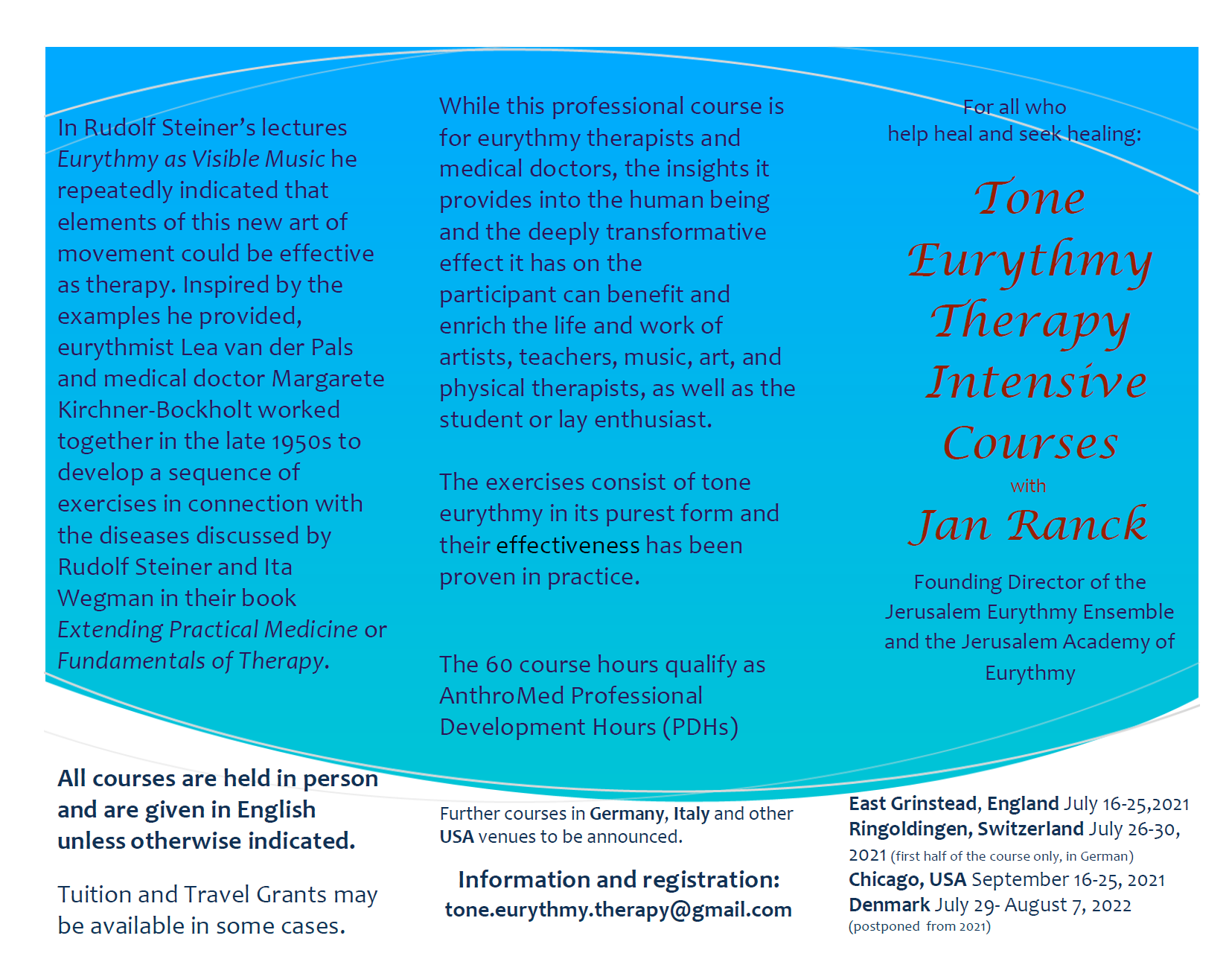

Earn a Master of Education (MEd) with a Transdisciplinary Focus on Healing Education
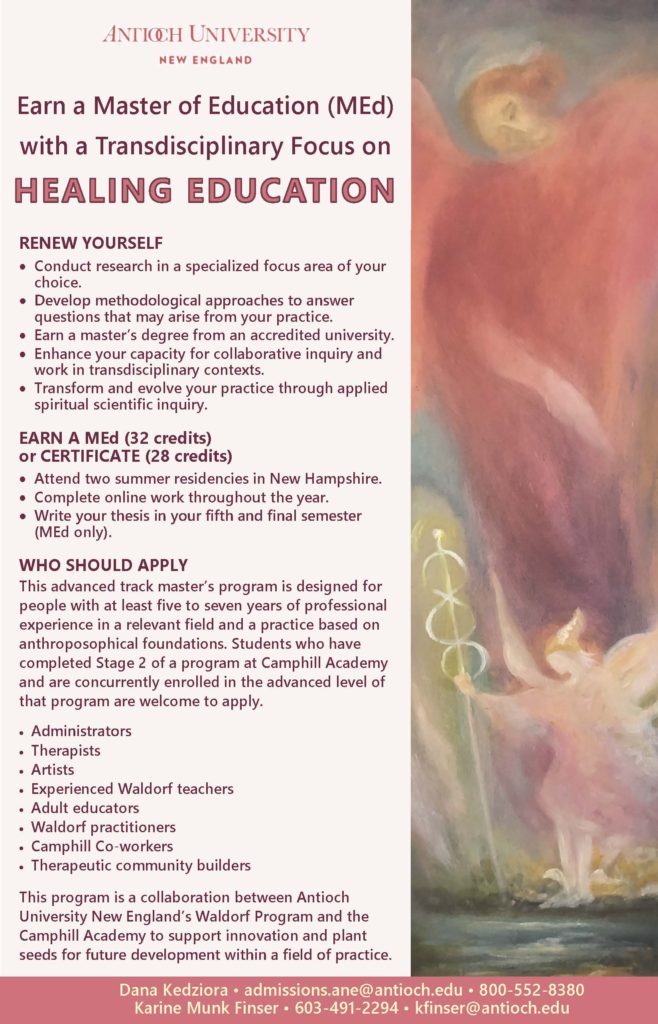
Eurythmy Spring Valley Ensemble’s Winter 2020 Tour
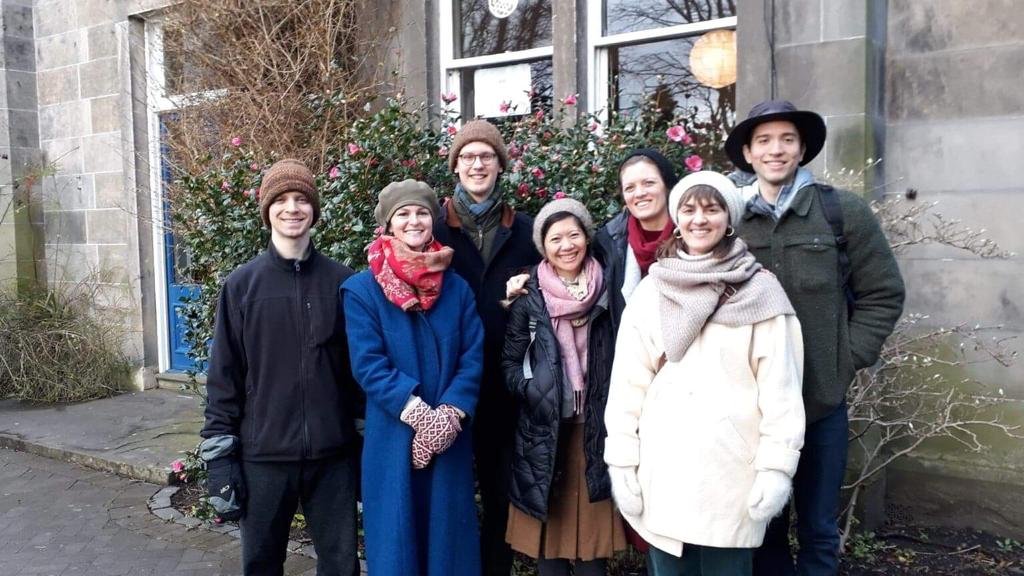
The Eurythmy Spring Valley Ensemble is embarking on a Winter tour this week. They will perform at anthroposophical communities in England, Scotland, Germany, and Switzerland. Some performances will be for the residents of the respective communities only and for the students at the Waldorf schools, and some will be open to the public.
Follow the links below for more information on individual public performances.
Please share with people you know in England, Scotland, Germany, and Switzerland. Thank you.
Evening Program
Into the Heart’s Unknown
How can we become beings more capable of love in our conflicted world? Do we dare to be refashioned, surrendered, ennobled? Through the resonant words of poets Mary Oliver, T.S. Eliot, Denise Levertov, D.H. Lawrence, and Antonio Machado, the main theme of Into the Heart’s Unknown brings us again and again to the threshold of transformation, inviting us to consider the harsh, unexpected, and ultimately divine elements at work in the passage of our becoming. From the first initiatory call to risk everything to the necessity of surrender in the face of powerlessness, this program leads us through an inner unfolding into a recognition of the heart’s high calling. Our theme is echoed and enhanced by music from Peter Sculthorpe, Samuel Barber, György Kurtag, Zoltán Kodály, and Jean Sibelius.
The nature of love is further elaborated in the second half through a whimsical charade of temperamental relationships—the requited, the unrequited, and the somewhat ridiculous—with an opening foray into Shakespeare’s fairy kingdom.
The program concludes with the grand and beloved Ballade in G minor by Frédéric Chopin.
15 February, 2020, 8 pm Ruskin Hall, Emerson College, Forest RowEast Sussex, England
21 February 2020, 7:30 pm Paul Allen Auditorium, Phoenix Centre, Newton Dee Camphill Community Aberdeen, Scotland
24 February 2020, 7 pm Edinburgh Steiner School Hall, 60 Spylaw Road
Edinburgh, Scotland
28 February 2020, 7:30 pm
Institut für Waldorf-Pädagogik, Annener Berg 15
Witten, Germany
1 March 2020, 4 pm
Aula der Freien Waldorfschule Bergisch Gladbach, Mohnweg 13
Bergisch Gladbach, Germany
4 March 2020, 7:30 pm Aula der Alten Universität, Universitätsplatz 1
Fulda, Germany
5 March 2020, 8 pm Freie Waldorfschule Frankfurt am Main, Friedlebenstraße 52
Frankfurt am Main, Germany
7 March 2020, 7 pm Goetheanum Grundsteinsaal Dornach, Switzerland
Children’s Matinée
The Lady and the Lion
In the fairy tale The Lady and the Lion by the Brothers Grimm, we are invited into the magical journey of the courageous Lady, whose quest to save her father’s life leads her to the castle of a fierce lion. After seven years of trials, her open heart and bright spirit free the Lion from his enchantment. This story is woven throughout with music by Marcus Macauley, accompanied by a verse for children by Paul King, and a short tone eurythmy piece by Mozart.
15 February 2020, 3 pm
Peredur Centre, West Hoathly RoadEast Grinstead, England
20 February 2020, 2 pm Paul Allen Auditorium, Phoenix Centre, Newton Dee Camphill Community Aberdeen, Scotland
Open Eurythmy Workshop
4 March 2020, 8:30 am Rudolf-Steiner-Schule Loheland, Schulhaus 3, Eurythmieraum
Künzell, Germany
About Eurythmy Spring Valley Ensemble
Founded in New York in 1986, Eurythmy Spring Valley Ensemble is one of the most active performing ensembles in the world. For over 33 years, the Ensemble has continuously connected to new audiences in America, Asia, and Europe, giving access through eurythmy to the ineffable dimension that lives beyond words, tones, and the visible world.
With a passion immersed in the essence and foundations of eurythmy, the Ensemble presents their continuously evolving evening and daytime performances not only in schools and theatres throughout North America, Europe, and Asia, but also on world stages in special projects like the New World Symphony Project in collaboration with Lemniscate Arts, the Haydn Symphony Project, and the 100 Years of Eurythmy Symphony Project.
Follow the links above for more information on individual public performances on the Winter 2020 Tour, or call Eurythmy Spring Valley at (845) 352-5020, ext. 113, or send us an email to info@eurythmy.org.
3-year Research Master’s for Eurythmists: in Education and Therapy (in German and English)
An international Master’s course offered by Alanus University in conjunction with Rudolf Steiner Høyskole, Oslo, will be available both in Germany and in England from September 2020. There are two main pathways: eurythmy in education and eurythmy therapy. The awarded degree from the university in Oslo will carry 120 ECTS (credit points) and have the title of Master of Education: Practice based research in educational and therapeutic fields.
This program is open to all eurythmists who have a Bachelor’s degree or a recognized eurythmy education (Dornach diploma) and practical experience.
Tone Eurythmy Therapy Course in Chicago, IL October 10-19, 2019
Jan Ranck, founding Director of the Jerusalem Eurythmy Ensemble and the Jerusalem Academy of Eurythmy will offer the van der Pals/Kirchner-Bockholt Tone Eurythmy Therapy Course in Chicago, IL October 10-19, 2019. Those interested in attending the course may inquire at tone.eurythmy.therapy@gmail.com
For those interested in combining the course with a more exotic venue, Jan will be holding it in Byron Bay Australia from July 13-22 and in Israel from Dec. 20–29, 2019
In Rudolf Steiner’s lectures Eurythmy as Visible Music he repeatedly indicated that elements of this new art of movement could be effective as therapy. Inspired by the examples he provided, eurythmist Lea van der Pals and medical doctor Margarete Kirchner-Bockholt worked together in the late 1950s to develop a sequence of exercises in connection with the diseases discussed by Rudolf Steiner and Ita Wegman in their book Extending Practical Medicine or Fundamentals of Therapy.
Tone Eurythmy Therapy offers a deepening of the basic elements of tone eurythmy and an introduction to the exercises developed as therapies for rheumatism, dermatitis, central and peripheral congestion of the systemic circulation, pulmonary circulation abnormalities, diabetes, albuminuria, conditions of overweight and underweight, gout and arthritis. The inherent therapeutic and harmonizing properties of pitch, rhythm, beat, tone, interval, major, minor, dissonance and concordance are powerfully effective and can be applied in therapeutic eurythmy as well as in hygienic eurythmy, pedagogical eurythmy and in personal development. The exercises consist of tone eurythmy in its purest form and their effectiveness has been proven in practice.
While this professional course is for eurythmy therapists and medical doctors, the insights it provides into the human being and the deeply transformative effect it has on the participant can benefit and enrich the life and work of artists, teachers, music, art, and physical therapists, as well as the student or lay enthusiast. Applicants who are not eurythmists will be admitted as space allows.
The 56 course hours qualify as AnthroMed Professional Development Hours (PDHs)
Born in the USA, Jan Ranck studied music and comparative arts at Indiana University in Bloomington. She accompanied the London Stage Group on their 1976 USA tour and went on to study eurythmy at the Eurythmeum in Dornach with Lea van der Pals, where she subsequently taught. In 1984 she joined the faculty of The London School of Eurythmy. She left there to complete her eurythmy therapy training in Stuttgart in 1989, moving afterward to Israel, where she is the founding director of the Jerusalem Eurythmy Ensemble (1990) and the Jerusalem Academy of Eurythmy (1992) and an instructor in the Jerusalem Waldorf Teacher Bachelor Program in David Yellin Academic College. Jan holds master classes at various venues worldwide, including the Goetheanum and the MA Program in Eurythmy held at Emerson College and Spring Valley. She is the representative for Israel in the International Eurythmy Therapy Forum. As a colleague of Lea van der Pals’ successor in this field, Annemarie Baeschlin, Jan was involved with compositional and editorial suggestions for the publication Tone Eurythmy Therapy (Verlag am Goetheanum 1991). Jan has held the Tone Eurythmy Therapy course in Australia, Britain and the USA and is currently the only eurythmist offering it outside of Switzerland and in the English language.
| Brochure Reviews |
West Coast Summer Eurythmy Intensive 2019
August 2nd through 11th will be the dates for the 2019 West Coast Summer Eurythmy Intensive. Led by Michael Leber and focusing on the Cultural Epochs, the conference will take place place in the Portland Waldorf School in downtown Milwaukie, Oregon. As in years past Besso Namchevadze will support the conference with his substantial artistic, pianistic abilities. Portland Eurythmy will be the hosting organization. As in years past we (Portland Eurythmy) will do our best to provide housing for participants at little or no cost for the duration of the conference. Morning and afternoon snacks will be provided. The Portland Waldorf School campus is located a short walk away from several restaurants and cafes and also a newly opened 10 cart food court. A low cost lunch option will also be available. Cost for the 10 day conference will be $500 per participant.
Mid week excursions to the Pacific Ocean, Mt Hood or the Columbia River George will also be arranged. For further details or to register please contact:
Carrie Mass carecare0@gmail.com or Don Marquiss 503-626-7606
Summer Retreat for Professional Eurythmists
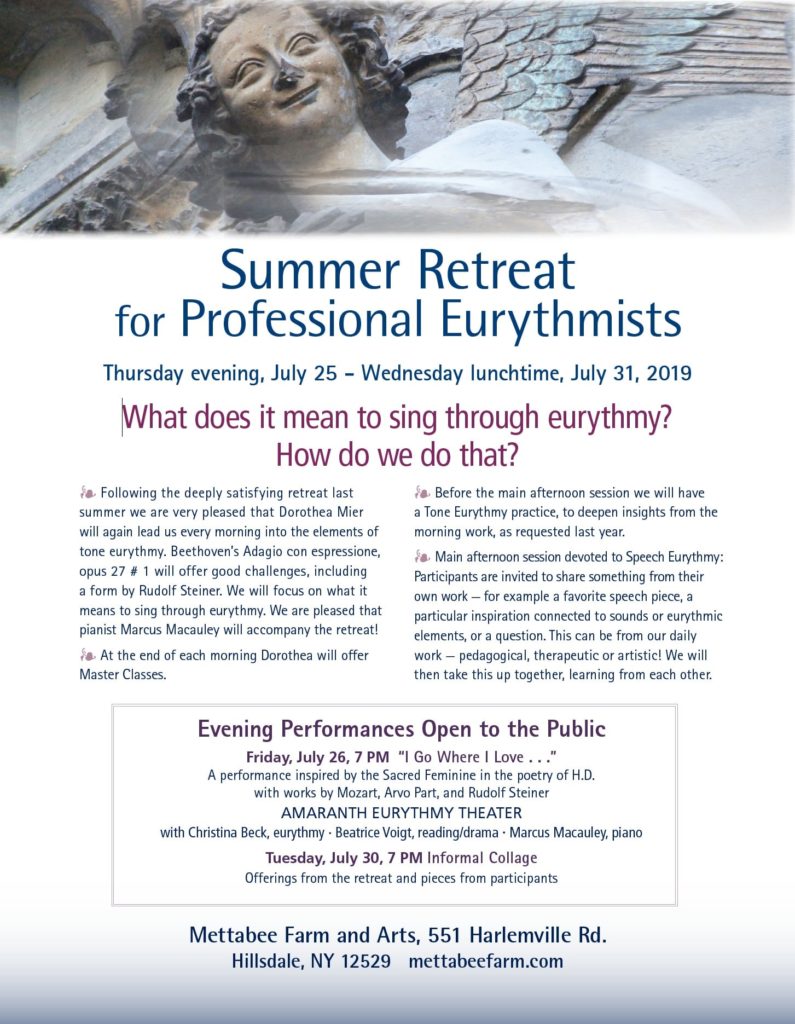
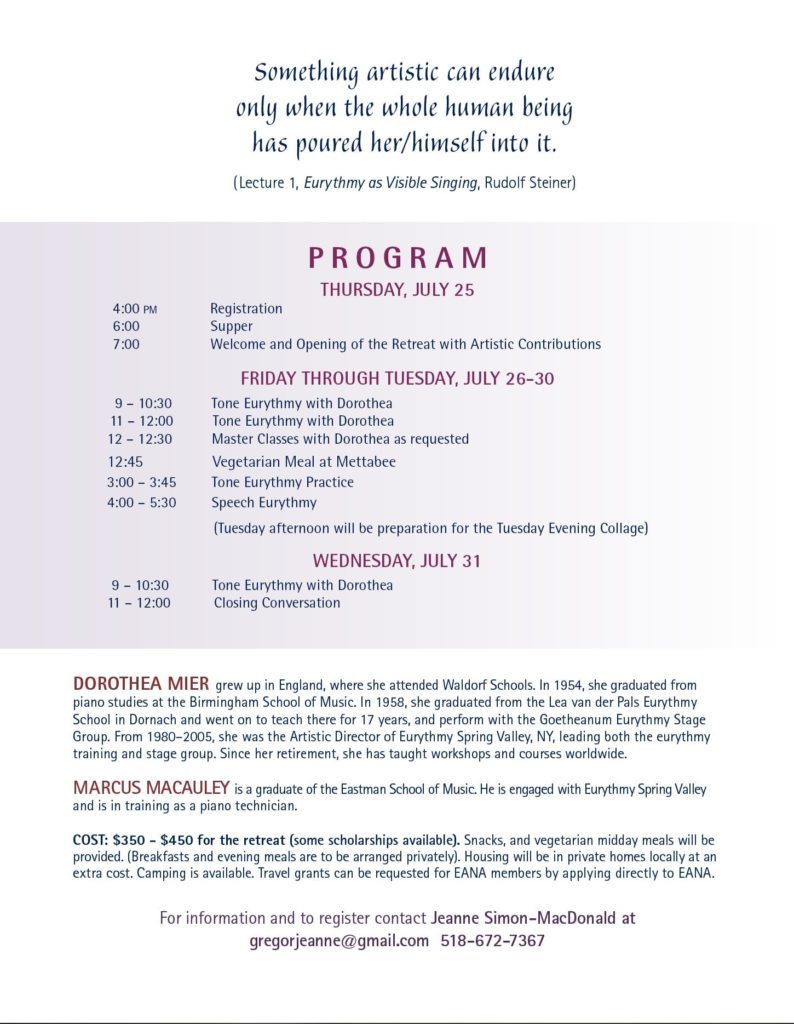
San Francisco Youth Eurythmy Troupe
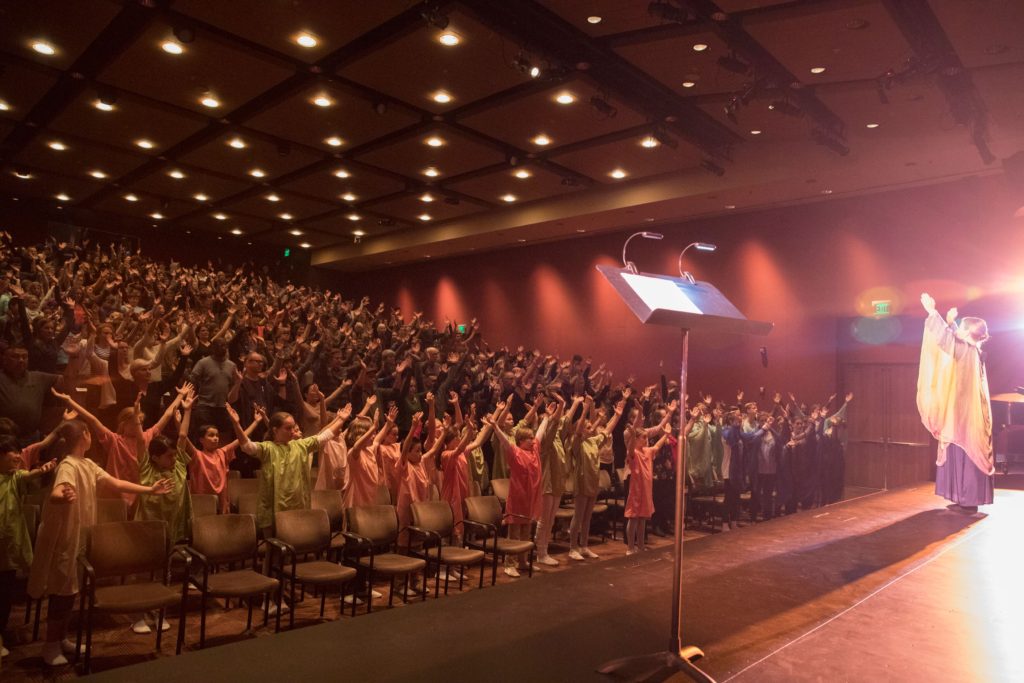
The San Francisco Youth Eurythmy Troupe for 2019 featured a new full-length program, created by Artistic Director Astrid Thiersch and premiered in three performances over two days on January 31 and February 1. The title, Awakening Within, was taken from a text by Rudolf Steiner that opened the program.Every year Astrid invites guest artists to join in the program; this year, in the spirit of Waldorf 100, it was students from sister Waldorf schools: our own seventh grade with Monika Leitz, Peninsula Waldorf School high school students with Michaela Bergman, Sacramento Waldorf School’s fourth grade with Julie MacArthur, and Sierra Waldorf School’s eighth grade with Susan Strauss. In addition to these students, with their parents and teachers, classes also came from Marin Waldorf School, East Bay Waldorf School, and Berkeley Rose Waldorf School. It was wonderful to welcome so many colleagues and friends, as well as our own students, teachers, and parents from nursery through twelfth grade, and also many friends and alumni. A festive atmosphere prevailed throughout, and we reached a new high for attendance: the San Francisco program was enjoyed by over a thousand people.
Photo credit by Scott Chernis.
Color and Gesture: the inner life of color
Color and Gesture: the inner life of color by Reg Down is now available in its third edition on Amazon (Lightly Press, $38.50). It has been revised, updated and expanded. There are a number of new eurythmy figures and deepened chapters. The main additions have been a further study of the dynamic chiaroscuro of gesture, an exploration of the eyes, their gesture-zones and the color chords behind them, and a further exploration of the chapter on the Color Cosmos. An addendum has been added to develop further various themes discussed in the book.
“I Go Where I Love…”
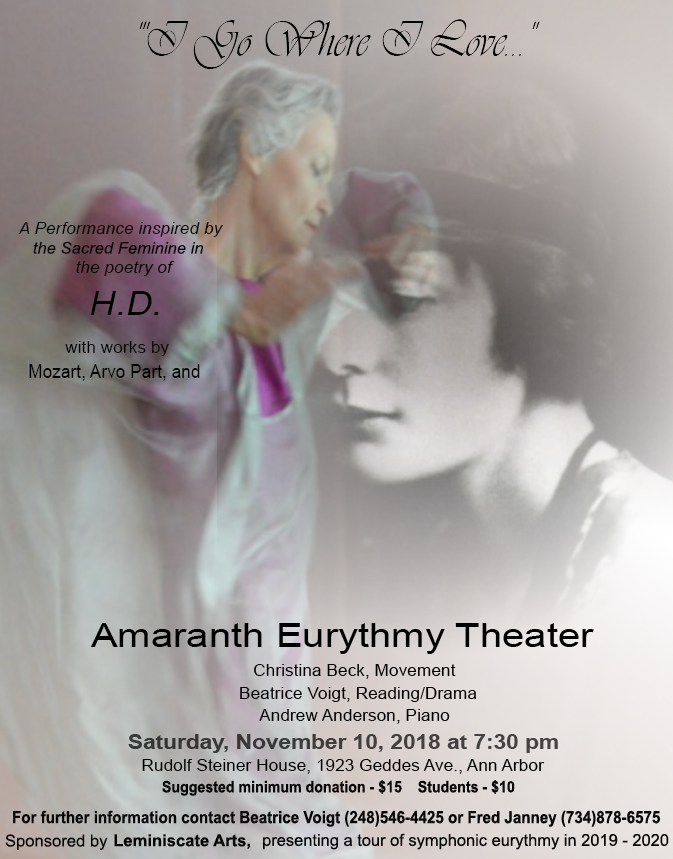
August Eurythmy Intensive with Michael Leber!
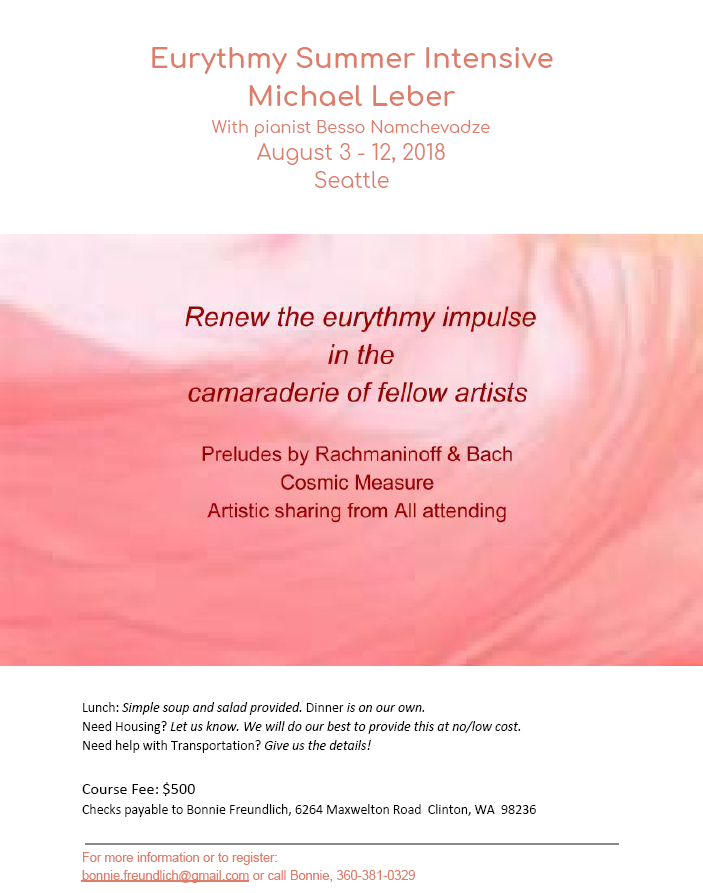
Eurythmy Position in Boca Raton, Florida

Sea Star Waldorf School in Boca Raton, Florida is seeking a part-time Eurythmy teacher for the 2018/19 school year. One block of eurythmy study is desired: six-weeks up to one semester-long period.
The sunny and diverse community at Sea Star is searching for an enthusiastic eurythmist to enrich our school’s program.
Job Description: Teaching twelve classes per week, including one nursery class, two kindergartens, 1st, 2nd, 3rd grades, combined 4th/5th grades, and combined 6th/7th grades. Faculty eurythmy would be provided once each week. Additional classes (such as parent classes) and yard duty positions could be added to the schedule, as desired. A large, open room with piano and an accompanist is available for the grades classes. Pay per class: $45. Transportation and housing costs are covered by the school.
Our ideal candidate will possess a eurythmy training certificate from a recognized and accredited eurythmy school. This includes completion of a pedagogical eurythmy training, and at least two years of classroom teaching. Skills in leadership, collaboration, and consensus work are expected as is an effective, positive manner of communication with parents, colleagues, and community members.
Our private school in Boca Raton, Florida is a state licensed school and a recognized member of AWSNA and WECAN. We serve all of South Florida, including Palm Beach, Broward and Miami-Dade counties. Classes include a Parent/Toddler group, Early Childhood Development, Kindergarten and Grades One through Eight.
Sea Star is in its 12th year with 104 students enjoying many vibrant programs: Puppetry, Gardening, Woodworking, Spanish, German, Music and Eurythmy. A strong administrative and executive committee guides us toward clear goals for our future. Sea Star’s faculty is an extremely dedicated group of teachers from diverse backgrounds, committed to working out of anthroposophy and the indications of Rudolf Steiner. A weekly study group meets on campus.
Boca Raton is a city on Florida’s southeastern coast, known for its golf courses, parks and beaches. Large, oceanfront Red Reef Park is home to the Gumbo Limbo Nature Center with trails, a butterfly garden and a sea turtle sanctuary. These treasure are just minutes away from Sea Star’s campus.
We would love to hear from you!
Please submit a letter of interest, including a brief biography, and a resume with three references to:
Olga Domokos E-mail: olga@seastarinitiative.com
http://www.seastarwaldorfschool.com
2450 NW 5th Avenue, Boca Raton, FL 33431
(561) 394-7674
An additional job awaits the adventuresome type: LifeWays Early Childhood program in Florida is holding its 2019 sessions near Boca Raton. They are seeking a eurythmy teacher for each session. For further information: barbara jimenez babster27@yahoo.com http://lifewaysnorthamerica.org/overview/
Tone Eurythmy Therapy Course
Van der Pals/Kirchner-Bockholt Tone Eurythmy Therapy Course
PORTLAND, OR JUNE 22-JULY 1 2018
with Jan Ranck, founding director of The Jerusalem Academy of Eurythmy
Inspired by indications from Rudolf Steiner that tone eurythmy therapy should be developed in addition to speech eurythmy therapy, the eurythmist Lea van der Pals and the medical doctor Margarete Kirchner-Bockholt worked together in the late 1950s to develop a sequence of exercises in connection with the diseases discussed by Rudolf Steiner and Ita Wegman in their book Extending Practical Medicine or Fundamentals of Therapy.
This course was taught for many years by Lea van der Pals in various eurythmy therapy trainings. The exercises consist of tone eurythmy in its purest form potentized through the intuitive insights of Lea van der Pals and carried forward by the artistic and therapeutic eurythmists Annemarie Baeschlin and Jan Ranck. The effectiveness of these exercises has been shown in practice. Jan Ranck is the only eurythmist offering this course outside of Switzerland and in the English language.
Tone Eurythmy Therapy offers a deepening of the basic elements of tone eurythmy and an introduction to the exercises developed as therapies for rheumatism, dermatitis, central and peripheral congestion of the systemic circulation, pulmonary circulation abnormalities, diabetes, albuminuria, conditions of overweight and underweight, gout and arthritis. The inherent therapeutic and harmonizing properties of pitch, rhythm, beat, tone, interval, major, minor, dissonance and concordance are powerfully effective and can also be applied in hygienic eurythmy, pedagogical eurythmy, and personal development.
While this professional course is for Eurythmy Therapists and Medical Doctors,
Eurythmists, Music and Art Therapists, Waldorf Teachers, students in these fields and enthusiasts are also welcome to join. In this course people go through a real transformation of their instrument that has a continuing influence in their lives.
Participant Reviews of Tone Eurythmy Therapy Course with Jan Ranck
Information and Registration: tone.eurythmy.therapy@gmail.com
(in the subject field please write “Portland Course” and your name)
ATHENA members can request Grant XV Category 4 through dale1022@sbcglobal.net
EANA members can request travel assistance through gfbver@gmail.com
The 56 course hours qualify as AnthroMed Professional Development Hours (PDHs)
If you would like to host a Tone Eurythmy Therapy Course or another Eurythmy Course offered by Jan in the future in your region please write to: tone.eurythmy.therapy@gmail.com
Born in the USA, Jan Ranck studied music and comparative arts at Indiana University in Bloomington. She accompanied the London Eurythmy Stage Group on their 1976 USA tour and went on to study eurythmy at the Eurythmeum in Dornach with Lea van der Pals, where she subsequently served as a teacher. In 1984 she joined the faculty of The London School of Eurythmy. She left there to complete a training in eurythmy therapy in Stuttgart in 1989, moving afterward to Israel, where she is the founding director of the Jerusalem Eurythmy Ensemble (1990) and the Jerusalem Academy of Eurythmy (1992) and an instructor in the Jerusalem Waldorf Teacher Bachelor Program in David Yellin Academic College. Jan is a guest teacher in various venues worldwide, including the Goetheanum and the MA Program in Eurythmy held in Emerson College and Spring Valley. She is the representative for Israel in the International Department of Eurythmy Therapy (“Eurythmy Therapy Forum”) and has held the course in Tone Eurythmy Therapy at various venues on the British Isles, Australia, and in the USA. A colleague of Lea van der Pals’ successor in this field, Annemarie Baeschlin, Jan was involved with compositional and editorial suggestions for their publication Ton-Heileurythmie, Verlag am Goetheanum 1991, published in English in 2009 as Tone Eurythmy Therapy by the Medical Section at the Goetheanum.
Summer Eurythmy Retreat In The Berkshires
During the last week of July (22nd through the 28th) 2018 we will be offering an artistic eurythmy retreat in Harlemville, NY. We will be based at Mettabee Farm and Arts here, a center with a beautiful large converted barn space with gardens and animals, (the donkey sometimes makes herself heard)! There are accommodations available here at Mettabee as well as kitchen facilities. Other rooms will be found locally.
We are excited that during the mornings we will work with Dorothea Mier on tone eurythmy. We will focus on Ave Verum by Mozart with a beautiful Steiner Form. Afternoons we will have just one more session – around the theme of how we support our artistic lives in the midst of our work, in order to keep ourselves at our creative best! We will experiment with some shorter texts trying out different forms and gesture possibilities, having also time for conversations.
Evenings will be free for Tanglewood concerts or Shakespeare and Co. or one of the many other summer offerings here in the Berkshires, like hiking and swimming.
Cost: Sliding Scale: $300 – $450
We hope to have some scholarship funds available as well.
Please be in touch with us for any questions:
Jeanne Simon-MacDonald 518-67-7367 gregorjeanne@gmail.com
Victoria Sander 518-672-4289 victoria3foldwalker@gmail.com
Sol-ETUDES, A Eurythmy Recital
Friday, April 27, 2018 @ 7:00 PM
Location: Napa Valley Performing Arts Center at Lincoln Theater, 100 California Dr., Yountville, CA
Tickets: 707-944-9900 or www.lincolntheater.org
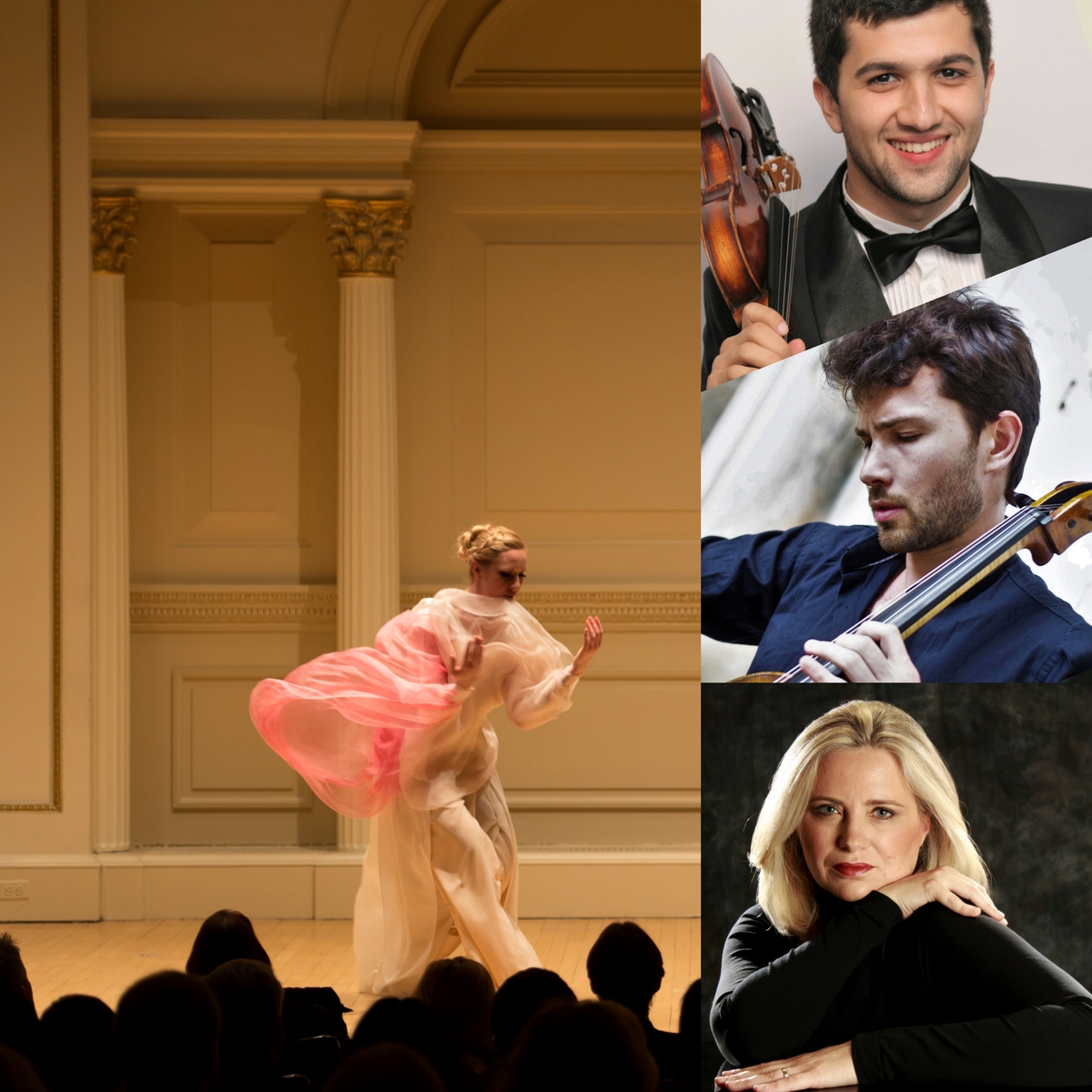
This performance features musicality paired with eurythmy, an art of movement choreographed from the score. Sol-Etudes is a recital which reinvents the dynamics of a classical Trio. From Brahms to Auerbach, Piazzolla to Wiprud and Stanhope, a juxtaposition of romantic and contemporary solos, duos, and trios also features a world premiere by cellist and composer Georgy Gusev.
Professional Workshop with Carina Schmid in Chestnut Ridge, NY
Indications by the First Eurythmist, Lory Maier-Smits:
Professional Workshop with Carina Schmid
 Friday, February 16, 2018: 7:30 – 9:00 p.m. and Saturday, February 17, 2017: 9:00 a.m. – 4:00 p.m., School of Eurythmy, Chestnut Ridge, NY.Workshop Fee: $100. Carina Schmid, who led the Hamburg Eurythmy School and stage group, followed by the Dornach stage group for many years, will be visiting Eurythmy Spring Valley in what may be her first professional visit to the United States. During her tenure as the director of the stage ensemble at the Goetheanum, Carina, together with Benedikt Zweifel from Stuttgart, created joint Dornach /Stuttgart symphony projects, which traveled extensively throughout Europe. We are very fortunate to have her working with the students for a few days and giving a professional workshop on the indications from the first eurythmist, Lory Maier-Smits. We are very grateful to Monika Leitz of San Francisco for initiating Carina’s visit. For information, or to register, please call Eurythmy Spring Valley at 845-352-5020 ext. 113, or email: info@eurythmy.org.
West Coast Eurythmy Teacher Conference
Earth Water Air Fire
The four elements as a portal to the four major composition styles in music.
February 20, 9 am –23, 4 pm, 2018
With Carina Schmid, Dornach Switzerland
Location: East Bay Waldorf School, El Sobrante, CA 94803
A four day professional conference in the beautiful Bay Area.
How does a piece by Bach call for a different treatment of our instrument than Chopin, Mozart or Beethoven? Carina Schmid will lead us in this stimulating exploration of the different musical and movement styles. In addition, Carina will teach a morning class to pass on the memories and insights of her work with Lory Maier-Smits. To round out the day, we will have a pedagogical sharing and colloquium in the afternoon.
Cost: $250 for workshop (includes lunch and snack).
Evenings are open for individual pursuits.
Please RSVP to reserve your space at eurythmyconference@gmail.com
A registration form will be sent to you with more detailed information.
Register early, space is limited
Van der Pals/ Kirchner-Bockholt Tone Eurythmy Therapy Course to be held in English by Jan Ranck
USA July 20 – 29, 2017 in Glenmoore, Pennsylvania at Camp Hill Beaver Run
AUSTRALIA Sept. 22 – Oct. 1, 2017 in Yarra Junction VIC at Little Yarra Steiner School
This professional course for Eurythmy Therapists and Medical Doctors is also warmly recommended for trained eurythmists, music and art therapists, Waldorf teachers, students in these fields and enthusiasts (latter space permitting)
The 56 course hours qualify as AnthroMed Professional Development Hours (PDHs)
Download PDF for reports of course participants
USA: The course is sponsored by ATHENA and therapeutic eurythmists who are members are eligible to apply for grants via dale1022@sbcglobal.net
Members of EANA may inquire about travel grants through Gino Ver Eecke at gfbver@gmail.com
Information and Registration for USA only: abdalma@gmail.com
(in the subject field please write “Beaver Run” and your name)
Australia: members of ETZNAZA receive a tuition discount.
Information and Registrtion for Australia only: lsarah@netspace.net.au
Inspired by Rudolf Steiner’s indication that tone eurythmy therapy should be developed in addition to speech eurythmy therapy, the eurythmist Lea van der Pals and the medical doctor Margarete Kirchner-Bockholt worked together in the late 1950’s to develop a sequence of exercises in connection with the diseases discussed in Rudolf Steiner and Ita Wegman’s book “Extending Practical Medicine”. The areas covered include rheumatism, dermatitis, central and peripheral congestion of the systemic circulation, pulmonary circulation abnormalities, diabetes, albuminuria, conditions of overweight and underweight, gout and arthritis. This course, which includes a review of all of the elements of tone eurythmy, was taught for many years by Lea van der Pals within various eurythmy therapy trainings, and the effectiveness of the exercises was shown in practice. Evening piano concerts and a eurythmy presentation are also part of the program.
Jan Ranck was a student of Lea van der Pals and is a colleague of her successor in this field, Annemarie Baeschlin, and was involved with compositional and editorial suggestions for their publication “Ton-Heileurythmie”, Verlag am Goetheanum 1991, published in English in 2009 as “Tone Eurythmy Therapy” by the Medical Section at the Goetheanum. Born in the USA, she studied music and comparative arts at Indiana University in Bloomington. She accompanied the London Stage Group on their 1976 USA tour and went on to study eurythmy at the Eurythmeum in Dornach, where she subsequently served as a teacher. In 1984 she joined the faculty of The London School of Eurythmy. She left there to complete a training in eurythmy therapy in Stuttgart in 1989, moving afterward to Israel, where she is currently the founding director of the Jerusalem Eurythmy Ensemble (1990) and the Jerusalem Academy of Eurythmy (1992). She is also an instructor in the Jerusalem Waldorf Teacher Bachelor Program in David Yellin Academic College, and a guest teacher in various venues worldwide, including the Goetheanum and the MA Program in Eurythmy held in Emerson College and Spring Valley. She is the representative for Israel in the International Department of Eurythmy Therapy (“Eurythmy Therapy Forum”) and has held the course in Tone Eurythmy Therapy at various venues on the British Isles and in the USA.
*Jan is a profoundly patient teacher… With her stringent guidance in attending to our experiences in the instrument and a healthy dose of humor she led us through specific focus to intensive engagement and new experience. Her artistry always tended towards clarifying the soul within the instrument and she guided us to mastering ourselves in the movement. -Glenda Monash, Eurythmy Therapist
*I definitely recommend to any physician who is interested in practicing anthroposophical medicine to partake in such a course. All physicians present…felt that we were much closer to being able to understand both our patients in their suffering and anthroposophy …as a consequence of the course. -Ross Rentea, MD
*I cannot remember when I have laughed so much, possibly as a result of not only Jan’s wonderful inclusion of humor in her teaching, but also of the health-giving effect of the exercises. -Elizabeth Carlson, Eurythmist
Eurythmy Position Available in Sonoma, CA
Woodland Star Charter School is a Waldorf Charter School located in Sonoma, California. We have approximately 250 students from kindergarten through 8th grade. Our dedicated, experienced faculty is supported with a faculty/college, education director, administrator and staff. We have a strong, diverse parent body that is focusing on increasing the feeling of community in the school. We are looking for a eurythmy teacher to teach one 5 to 8 week block that will include grades k through 8. If possible we would like to give the whole school the experience of eurythmy during the block including classes for the faculty/co-workers and parents.
Sonoma, California is a small city with a small town ambience. It is located in the scenic wine country of Northern California with easy access to San Francisco and many beautiful natural sites. If you are interested please view our web site http://www.woodlandstarschool.org/ and contact Robert Bucher robert@woodlandstarschool.org curriculum director to discuss the possibility.
Eurythmy Teacher Needed in Wasatch Waldorf Charter School, Salt Lake City UT
Full-time position for an enthusiastic eurythmist who is committed to bringing eurythmy to children.
Wasatch Waldorf Charter School opened its doors in August 2016 to 540 students. In this foundational year, the school has been blessed with visits from Eurythmy Spring Valley, Kim John Payne, Jack Petrash and other inspiring individuals. All of the teachers are trained or in the process of training. Teachers receive ongoing mentor support and professional development opportunities throughout the year.
We are looking for a committed eurythmist to join our faculty. Responsibilities include teaching grades one through five, serving on the festival committee, assisting with parent meetings, leading faculty eurythmy in tandem with the two other eurythmists at the school and collaborating on artistic eurythmy projects.
The school building houses a beautiful large eurythmy room with a sprung floor. The auditorium is connected to it and has the possibility of opening up to transform the space into a stage for eurythmy.
There is a pianist on the staff that will accompany every eurythmy class.
Teachers at Wasatch Waldorf enjoy a competitive salary and generous benefits that include health and dental insurance, professional development opportunities and a retirement savings plan.
To apply, send resume and letter of intent to Prairie Adams at padams@wasatchwaldorf.org
Copper Balls
Dear Friends,
I am excited to announce that my copper products are now conveniently available from Amazon in case you need one immediately. I would greatly appreciate if you could visit the page and leave some customer feedback on the Amazon product page.
I continue to accept orders from my page where Copper Rods are available. I especially like that because I can interact with you and make new friends.
On Amazon
Large Copper Ball:
Small Copper Ball:
Hoping you are all well,
All the best,
Leonore Russell
Eurythmy Performance at Carnegie Hall
Gabrielle Armenier Eurythmy Agency Presents
WEILL RECITAL HALL at CARNEGIE HALL
Lee-Chin Siow Violin
Svetlana Smolina Piano
Gabrielle Armenier Eurythmy
February 8th, 2017 – 8 PM
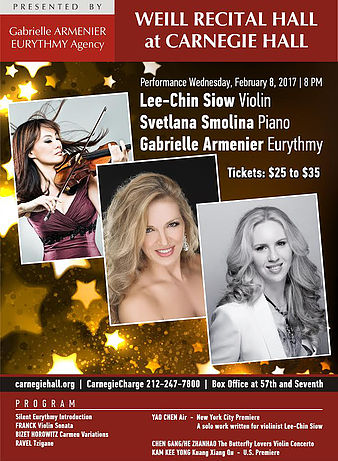
Featuring a U.S. Premiere and a New York City Premiere, East touches West in this exciting new program which explores the gestural qualities of French and Chinese music through the movement art of eurythmy, the artistry of Singaporean violinist Lee-Chin Siow, Russian pianist Svetlana Smolina and French eurythmist Gabrielle Armenier.
With the concept of polarities of touch as meeting ground, Franck’s Violin Sonata will speak to the romanticism of the Butterfly Lovers Violin Concerto, while Ravel’s Tzigane encounters its counterpart in Singaporean composer Kam Kee Yong’s Kuang Xiang Qu, affectionately nicknamed the ‘Chinese Tzigane’.
Program
Silent Eurythmy Introduction
FRANCK Violin Sonata
BIZET HOROWITZ Carmen Variations
RAVEL Tzigane
Intermission
YAO CHEN Air – New York City Premiere
A solo work written for violinist Lee-Chin Siow
CHEN GANG/HE ZHANHAO The Butterfly Lovers Violin Concerto
KAM KEE YONG Kuang Xiang Qu – “Chinese Rhapsody” – U.S. Premiere
The Speech Sound Etudes: Feeling the Gestures and Finding the Figures
First posted on 10-13-14
Revised January 2017
A DETAILED RESEARCH REPORT
BY KATE REESE HURD
ORIGINALLY SUBMITTED IN HONOR OF MICHAELMAS 2014
In this report, I share the fruits of my re-approach to eurythmy after having put it aside for over two decades. I have been laying a fresh foundation for my artistic activity by means of the intensive speech-work I’ve been doing in response to one of Dr. Rudolf Steiner’s first advices to Lory Maier-Smits, our first eurythmist. He had suggested to her that she write sentences focussing on single vowel sounds. As she recorded it, “I should do speech exercises. Speak sentences which had only one vowel, and observe exactly what was happening in my throat, and this I should then … dance! As an example he wrote: ‘Barbara sass stracks am Abhang’ [Barbara sat directly on the slope].” But it is clear by Lory’s further report that she was not able to find speech sound gestures through doing this. Therefore, Dr. Steiner began to give her suggestions for how to do gestures for the sounds.
However, I have discovered that through following his first advices to her – and with proper preparation – one can in fact feel and find the gesture-impulses of the sounds directly and with ever-greater definition and certainty. This applies to all of the speech sounds, both vowels and consonants. This report shares in detail my unfoldment of this work and the magnificent treasure that has emerged from it. A secure foundation for the work of speech eurythmy can be laid “from within” – just as The Eurythmy Meditation directs us to do. Dependence on mental imagery and being shown how to do gestures can be eliminated through firsthand perception and cognition of the speech sound gesture-impulses in the way I describe, as objective facts.
As a graduated eurythmist, I taught lay speech eurythmy; but although I knew that I was a good teacher, I wasn’t able to embody eurythmy at all well enough to command the respect for it that I felt it deserves. I set it aside. Two questions ached in me all these years: What is missing here? And even if I knew what is missing, what would satisfy that need? I always carried the idea that if eurythmy was lost we could find it again. Since the ‘eurythmizing’ of our own larynx is what we are supposed to lead over into the movement of our limbs, we would always have the means of recovering eurythmy from within and of discovering ever-fresh possibilities. My recent work confirms this. Everything we need can be found from within.
This report is firstly for eurythmists, but what I reveal provides speech artists with the means to seek and find a fresh foundation for their work, too. I invite you all into the effort! Speakers might also want to see my article on poetic recitation, “Etheric Bodies are Moving to the Speech Sound Etudes,” in the Spring 2016 EANA Newsletter. A revised version of it with an enlarged log of the poems I have presented so far – along with their respective sound-moods which I evoke through speaking etudes – is contained in my booklet, A Quartet of Articles on Eurythmy and Speech-Work.
Weekend Eurythmy Workshop in Kingston, ON
Soulful by Design, presents…
Dynamic Name™ Mandala:
Exploring Relationships through Harmonious Movement
A weekend eurythmy retreat with Soulful Wizardess Marta Stemberger
When: October 14-16, 2016
Where: Soulful by Design retreat, Kingston, Ontario, Canada
Investment: $359 CDN
Space is limited to 10 people. Register early.
Register before October 1st + save: $325 CDN
(includes shared accommodations, meals & snacks)
For more info and to register visit ssi.hamoves.net/soulful-by-design
Your name holds a key to who you are and a secret to your purpose in this lifetime. Uncover the astrology hidden in your name and its immense potential for self-inquiry, relationships, conflict resolution, and team building. Connect deeper with yourself, the spiritual world, and with each other.
Explore the dynamics of relating through harmonious movement art of eurythmy. Discover how to untangle conflicts into awareness and understanding. Transform the flow of energy into conscious kinesthetic perception in the body, a valuable tool for harmonious relationships.
Move your song, feel your Soul. Dance your name, know thyself.
World Eurythmy Day

Van der Pals/ Kirchner-Bockholt Tone Eurythmy Therapy Course to be held in English by Jan Ranck
October 21 – 30, 2016 in Chicago Illinois at 2135 West Wilson Avenue
(note change of date from July)
The course is warmly recommended for trained eurythmists, eurythmy therapists, medical doctors and music therapists (see report below from Ballytobin, Ireland).
Information and Registration: abdalma@gmail.com
Some free accommodation available on a first-come, first serve basis.
Inspired by Rudolf Steiner’s indication that tone eurythmy therapy should be developed in addition to speech eurythmy therapy, the eurythmist Lea van der Pals and the medical doctor Margarete Kirchner-Bockholt worked together in the early 1970s to develop a sequence of exercises in connection with the diseases discussed in Rudolf Steiner and Ita Wegman’s book “Extending Practical Medicine”.
This course, which includes a review of all of the elements of tone eurythmy, was taught for many years by Lea van der Pals within various eurythmy therapy trainings, and the effectiveness of the exercises was shown in practice. When for health reasons Lea van der Pals was prevented from continuing to teach, she passed the torch to Annemarie Baeschlin, who took over holding the course and assisted Lea van der Pals in bringing the material into book form.
At this time Jan Ranck held the practice sessions within Annemarie Baeschlin’s courses, and was also involved with compositional and editorial suggestions for the publication “Ton – Heileurythmie”, Verlag am Goetheanum 1991, published in English in 2009 as “Tone Eurythmy Therapy” by the Medical Section at the Goetheanum.
Jan Ranck was born in America, where she studied music and comparative arts at Indiana University in Bloomington. She accompanied the London Stage Group on their 1976 USA tour and went on to study eurythmy in Dornach with Lea van der Pals. She was a faculty member of the Eurythmeum in Dornach and The London School of Eurythmy. After completing a eurythmy therapy training in Stuttgart in 1989 she moved to Israel and is currently the founding director of the Jerusalem Eurythmy Ensemble (1990) and the Jerusalem Academy of Eurythmy (1992). She is also an instructor in the Jerusalem Waldorf Teacher Bachelor Program in David Yellin Academic College, and a guest teacher in various venues worldwide, including the Goetheanum and the MA Program in Eurythmy held in Emerson College and Spring Valley. She is the representative for Israel in the International Department of Eurythmy Therapy (“Eurythmy Therapy Forum”).
Besides the material mentioned above, Lea van der Pals’ book “The Human Being as Music” (Robinswood Press 1992), published in German in 1969 as “Der Mensch Musik”, is highly recommended as background reading for the course.
Report from the course held in Ballytobin, Ireland:
English Speakers Take Note!
This spring, a unique event took place in English for eurythmists from all over the world. In Camphill Ballytobin, Ireland, eighteen eurythmists came together from 1-10 April under the invigorating guidance of Jan Ranck, founding director of the Jerusalem Academy of Eurythmy, to learn and experience the Tone Eurythmy Therapy Course as developed by Lea van der Pals and Dr. Margarete Kirchner-Bockholt. Long held in German by Annemarie Bäschlin, this is the first time since the 80’s that it has been accessible in English. There were eight eurythmists from Ireland, five from Australia, two from Japan and one each from Taiwan, Sweden and England. Jan put us through our paces by bringing us back into contact with the basics of Tone Eurythmy—beat, rhythm and pitch, major/minor triads, ethos/pathos, scales, intervals….If one had been listening at keyholes, one might have thought we were in training for the circus as we ‘swallowed our rods’, swung on trapezes, and held acrobats on our arms (we even attempted to become Octopi!)—all images calling for great inner – outer activity! Having laid the basic foundations, Jan then brought us through nine sequences of tone eurythmy exercises developed in relationship to specific illnesses, emphasizing the importance of our own skill and mastery of the elements of eurythmy in order to convey them to the patient.
In addition to Jan’s demanding yet entertaining approach, we had the privilege of having the concert pianist Michael Zelevinsky at the piano, also from Jerusalem. It was a great joy, especially for the many of us who work without accompanists, to move to music so beautifully and sensitively played. Every evening Michael gave a recital on the Steinway grand, a rare opportunity to feed one’s soul!
We are indebted to Gina Poole for having the idea of bringing the training to English-speakers and to Camphill Ballytobin for their generosity in giving us the free use of Castalia Hall for our work. Thanks also go to the Anthroposophical Society in Ireland for their generous donation towards covering costs. Most especially we thank Jan for bringing this training to the English-speaking world. It was the deep feeling of all of the participants not only that the course be repeated one day in Ballytobin, but that others may imitate Gina’s initiative in other locations world-wide. Jan confirmed that she is open to the idea.
Thank you Jan!
Roxanne Leonard
WHAT MOVES YOU is the largest Youth Eurythmy Event worldwide.
Join us and become part of an unique community for a summer full of energy, music and movement. This year´s project in Berlin, Germany will be the last one, so don´t miss it!
Sign up for this grand eurythmy event until 30 April 2016. Applying is easy, check it out at: http://www.whatmovesyou.
More questions? See our FAQ at http://www.whatmovesyou.de/
Best Regards,
André Macco
WHAT MOVES YOU
the international youth eurythmy event
the international youth eurythmy event
World Eurythmy Therapy Conference
Dear Eurythmists,
herewith we would like to send you information about the World Eurythmy Therapy Conference.
All eurythmists are invited to this conference!
www.goetheanum.org/Welt-
With many regards,
Hanna Koskinen
Sektion für Redende und Musizierende Künste
Hanna Koskinen
Goetheanum
Postfach
CH-4143 Dornach
Tel. 41 (0)61 706 43 59
srmk@goetheanum.ch
srmk.goetheanum.org
Music that Moves Me
by Truus Geraets
Brings together
The human voice in singing and
The singing of the whole body in movement
Truus Geraets created this book, based upon her deep love for music, and especially for singing.
All inspired by a life time working with Eurythmy as an Art and as Therapy.
51 Pages Text, 41 Songs in Musical Notation
Demonstration video, Showing how the materials can be used working with individual children as well as with groups of younger and older people or just as a self-help book
Cost $ 34 + sh/h Payment possible thru PayPal
or send check to 782 E. Mariposa St. A, Altadena, CA 91001
Also available: “The Healing Power of Eurythmy” as an E-book ($43 +sh/h)
Orders to truus.geraets@gmail.com or by phone 626 219 6010
Van der Pals/ Kirchner-Bockholt Tone Eurythmy Therapy Course
to be held in the USA by Jan Ranck
for trained eurythmists, eurythmy therapists, medical doctors, students of medicine and music therapists
July 24th – August 2nd, 2016 — Venue TBA
Inspired by Rudolf Steiner’s indication that tone eurythmy therapy should be developed in addition to speech eurythmy therapy, the eurythmist Lea van der Pals and the medical doctor Margarete Kirchner-Bockholt worked together in the early 1970s to develop a sequence of exercises in connection with the diseases discussed in Rudolf Steiner and Ita Wegman’s book “Extending Practical Medicine”.
This course, which includes a review of all of the elements of tone eurythmy, was taught for many years by Lea van der Pals within various eurythmy therapy trainings, and the effectiveness of the exercises was shown in practice. When for health reasons Lea van der Pals was prevented from continuing to teach, she passed the torch to Annemarie Baeschlin, who took over holding the course and assisted Lea van der Pals in bringing the material into book form. At this time Jan Ranck held the practice sessions within Annemarie Baeschlin’s courses, and was also involved with compositional and editorial suggestions for the publication “Ton – Heileurythmie”, Verlag am Goetheanum 1991, published in English in 2009 as “Tone Eurythmy Therapy” by the Medical Section at the Goetheanum.
Jan Ranck did her eurythmy training in Dornach with Lea van der Pals, and her therapeutic eurythmy training in Stuttgart. She was a faculty member of the Eurythmeum in Dornach and The London School of Eurythmy and is the founding director of the Jerusalem Eurythmy Ensemble (1990) and the Jerusalem Academy of Eurythmy (1992). She is also an instructor in the Jerusalem Waldorf Teacher Bachelor Program in David Yellin Academic College, and a guest teacher in various venues worldwide, including the Goetheanum, and the MA Program in Eurythmy held in Emerson College. She represents Israel in the International Department of Eurythmy Therapy within the Medical Section (“Eurythmy Therapy Forum”).
Besides the material mentioned above, Lea van der Pals’ book “The Human Being as Music” (Robinswood Press 1992), published in German in 1969 as “Der Mensch Musik”, is highly recommended as background reading for the course.
Information and Registration: tali.wandel@gmail.com
Professional Eurythmy Conference
February 14-17, 2016
with Maren Stott of Eurythmy West Midlands
at East Bay Waldorf School in El Sobrante, CA (San Francisco Bay Area)
The conference begins Sunday evening with a performance of J.S. Bach’s Chaconne
and other pieces by Maren Stott. The daily schedule includes: 2 sessions of Tone
Eurythmy, Solo Masterclass, Pedagogical Sharing (5 grade levels per day
[pK-12/adult], bring your best pieces to share!), a Tea Break with snacks provided,
an optional Plenum, and time in the evening to explore the Bay Area. Wednesday
evening concludes the course with a collective performance of our work.
Conference fee $250. Limited to 23 participants.
Please RSVP to reserve your space with Isabella or Jazmin. A registration form and
more detailed information will be sent to you. Housing and meals are not included.
Scholarship/Work Study and local inexpensive housing is available as well as
catered lunches if there is enough interest. Please indicate your need when
registering.
Isabella: nijinska@hotmail.com
Jazmin: jazminmeilan@gmail.com
Michael and the Being of Eurythmy – A Christmas Imagination
 |
| The Anthroposophical Society in America is pleased to collaborate with the Kolisko Institute in offering a free webinar in December
Michael and the Being of Eurythmy – A Christmas Imagination Wednesday, December 9, 2015 at 8:00 p.m. EST with presenter Ross Rentea, MD Rudolf Steiner considered eurythmy to be one of the core principles of anthroposophy, and anticipated that along with meditation, it would become an intimate part of one’s daily life. Since anthroposophy is so closely connected with Michael, a key question becomes – what is the connection of Michael with eurythmy? In this webinar, Ross will share his thoughts and insights with the hope to intensify – or rekindle – our understanding and appreciation for this special movement activity given to help us connect with the spiritual world and support our efforts in becoming truly human. The webinar is free, and donations to support these collaborative efforts will be gratefully accepted! To make a donation, please visit www.koliskoinstitute.org and click on the donate button. All donations are tax deductible and will be shared between the Anthroposophical Society and the Kolisko Institute. Thank you! Marian Leon |
The Bay Area Eurythmy Ensemble presents:
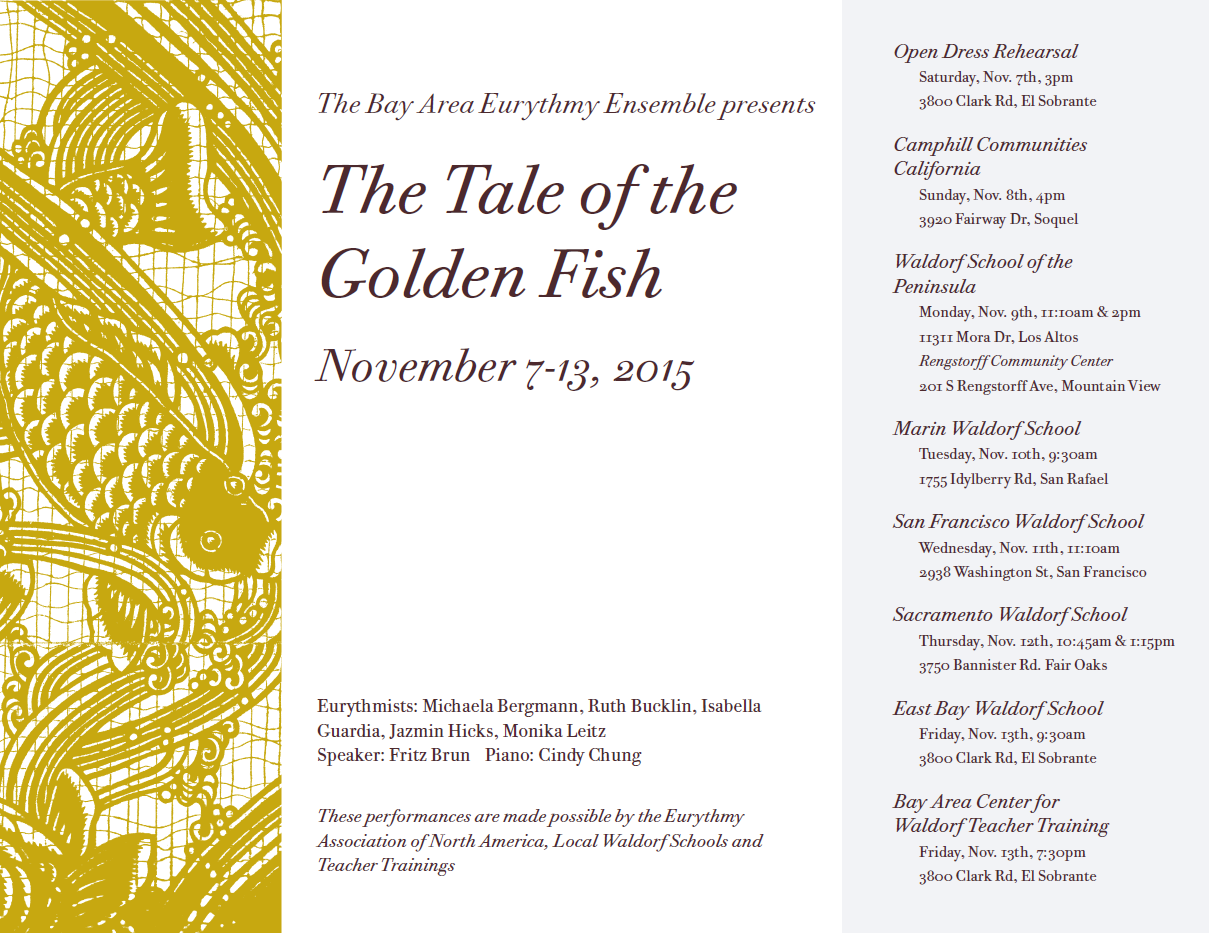
The Tale of the Golden Fish
November 7-13, 2015
Open Dress Rehearsal
Saturday, Nov. 7th, 3pm
3800 Clark Rd, El Sobrante
Camphill Communities California
Sunday, Nov. 8th, 4pm
3920 Fairway Dr, Soquel
Waldorf School of the Peninsula
Monday, Nov. 9th, 11:10am & 2pm
11311 Mora Dr, Los Altos
Rengstorff Community Center
201 S Rengstorff Ave, Mountain View
Marin Waldorf School
Tuesday, Nov. 10th, 9:30am
1755 Idylberry Rd, San Rafael
San Francisco Waldorf School
Wednesday, Nov. 11th, 12 noon
2938 Washington St, San Francisco
Sacramento Waldorf School
Thursday, Nov. 12th, 10:45am & 1:15pm
3750 Bannister Rd. Fair Oaks
East Bay Waldorf School
Friday, Nov. 13th, 9:30am
3800 Clark Rd, El Sobrante
Bay Area Center for Waldorf Teacher Training
Friday, Nov. 13th, 7:30pm
3800 Clark Rd, El Sobrante
Eurythmists: Michaela Bergmann, Ruth Bucklin, Isabella Guardia, Jazmin Hicks, Monika Leitz Speaker: Fritz Brun Piano: Cindy Chung
These performances are made possible by the Eurythmy Association of North America, Local Waldorf Schools and Teacher Trainings
Eurythmy Courses at the Goetheanum 2016
Dear Eurythmists,
Please find enclosed (see PDF below) our program for eurythmy courses within the Section for Performing Arts. During some of the courses there is a possibility to have a short translation into English, even if the courses principally take place in German.
If you have any questions to these courses (or translation), please contact the Section: srmk@goetheanum.ch
With warm regards, Hanna Koskinen
Van der Pals/ Kirchner-Bockholt Tone Eurythmy Therapy Course to be held in English
by Jan Ranck
April 1-10, 2016, at Camphill Ballytobin, Ireland
The course is warmly recommended for trained eurythmists, eurythmy therapists, medical doctors and music therapists.
Information and Registration: ginapoole@outlook.com
As space is limited, early registration is recommended.
Inspired by Rudolf Steiner’s indication that tone eurythmy therapy should be developed in addition to speech eurythmy therapy, the eurythmist Lea van der Pals and the medical doctor Margarete Kirchner-Bockholt worked together in the early 1970s to develop a sequence of exercises in connection with the diseases discussed in Rudolf Steiner and Ita Wegman’s book “Extending Practical Medicine”.
This course was taught for many years by Lea van der Pals within various eurythmy therapy trainings, and the effectiveness of the exercises was proven in practice.
When for health reasons Lea van der Pals was prevented from continuing to teach, she passed the torch to Annemarie Baeschlin, who took over holding the course and assisted Lea van der Pals in bringing the material into book form.
At this time Jan Ranck held the practice sessions within Annemarie Baeschlin’s courses, and was also involved with compositional and editorial suggestions for the publication “Ton – Heileurythmie”, Verlag am Goetheanum 1991, published in English in 2009 as “Tone Eurythmy Therapy” by the Medical Section at the Goetheanum.
Jan Ranck did her eurythmy training in Dornach with Lea van der Pals, and her therapeutic eurythmy training in Stuttgart.
She was a faculty member of the Eurythmeum in Dornach and The London School of Eurythmy.
She is the founding director of the Jerusalem Eurythmy Ensemble (1990) and the Jerusalem Academy of Eurythmy (1992), and represents Israel in the International Department of Eurythmy Therapy (“Eurythmy Therapy Forum”).
She is also an instructor in the Jerusalem Waldorf Teacher Bachelor Program in David Yellin Academic College, and a guest teacher in various venues worldwide, including the Goetheanum, and the MA Program in Eurythmy held in Emerson College.
Besides the material mentioned above, Lea van der Pals’ book “The Human Being as Music” (Robinswood Press 1992), published in German in 1969 as “Der Mensch Musik”, is highly recommended as background reading for the course.
Anyone interested in initiating such a course in their own country may contact Jan directly at: jranck@012.net.il
West Coast Fall Tour Itinerary – Eurythmy Spring Valley Ensemble
Tuesday, October 13 – Tuesday, October 27, 2015. The Ensemble is heading west this fall to California, Oregon and Washington states! It’s been quite a few years since we traveled to this region, so we are very excited to share our work and get to know the children and faculties in the different communities there. We hope you will pass the word along to anyone you know in these areas that we will soon be traveling their way. For more information about the tour, contact: Sea-Anna Vasilas, ESV Tour Coordinator, esvtour@eurythmy.org. Here are the stops on our tour:
San Francisco Waldorf School, San Francisco, CA:
October 13 – Daytime performances for children
7:30pm Public Evening Program: The Tide Is Turning
Summerfield Waldorf School, Petaluma, CA:
October 15 – Daytime performances for children
October 16 – Daytime performances for children
3:30-4:30pm Public Pedagogical Workshop
7:30 pm Public Evening Performance: The Tide Is Turning
Grass Valley Center for the Arts, Grass Valley, CA:
October 17 – 7pm Public Children’s Performance: The Donkey
8pm Public Evening Performance: The Tide Is Turning
Camphill Communities California, Soquel, CA:
October 19 – 4pm Public Children’s Performance: The Donkey
7:00 pm Public Evening Performance: The Tide Is Turning
Brightwater Waldorf School, Seattle, WA:
October 22 – Daytime performances for children (To be confirmed.)
7pm Public Evening Performance: The Tide Is Turning
Seattle Waldorf School, Seattle, WA:
October 23 – Daytime performances for children
6-9pm Potluck and Public Eurythmy Workshop(To be confirmed.)
Cedarwood Waldorf School, Portland, OR:
October 25 – 1pm Public Children’s Performance: The Donkey
4pm Public Performance: The Tide Is Turning
Portland Waldorf School, Portland, OR:
October 26 – Daytime performances for children (To be confirmed.)
Eugene Waldorf School, Eugene, OR:
October 27 – Daytime performances for children
7:30pm Public Evening Performance: The Tide Is Turning
*All times are subject to change, please check with each venue for specific details
Why Do Our Schools need Eurythmy? An Introduction to Eurythmy and Its Healing Influence in Schools
By Leonore Russell
One of the first questions parents ask when they come to learn about a Waldorf school for their child is about the movement art taught in most Waldorf schools: eurythmy. What is it? Why does my child have to do this? After many years of working as a eurythmy teacher and in the administration of a Waldorf schools, I find myself still answering these questions. Yet the answers grow and develop as the years pass and new knowledge both in science and education are bring light to bear on the questions.
First of all, what is eurythmy? It is a movement art, living in the family of movement arts such as mime and ballet yet standing midway between these two arts. It shares meaning and gesture with mime, yet it is married to sound rather than objects or recognizable actions, and shares the moving to music and words with dance, but seeks to follow the invisible movement within sound rather than move to it or juxtapose itself against it. It is the expression of the human soul through gesture and movement.
A student once asked: “who thought this up?” after seeing the same gestures in the great art of the past. He had stumbled on the truth of the expressive gestures that artists such as Giotto and Michelangelo had mastered in their paintings. In the early part of the twentieth century Rudolf Steiner pointed us towards these gestures to learn their meaning and to find a new art of human movement. He worked with first a young girl and then an ever growing group of interested artists to develop this new art of movement. Continue reading
Rudolf Steiner’s 1918 Project with Jan Stuten
for a New Colored “Light-Play-Art,” Metamorphoses of Fear
by David Adams
Eurythmy with Therapeutic Eurythmist Rachel Ross, M.Ed.
This excerpt was taken from the Summer 2013 Waldorf Teacher Preparation Course, sponsored by Prairie Moon Waldorf School in Lawrence, KS. The workshop on eurythmy, by Rachel, comprised nine 30-minute lectures over two weeks, and have been edited and made available for sale at www.prairiemoon.org.
The Camphill Eurythmy School 1970 – 2014
It is with sadness that we announce the closure of our school. For some years now, the interest and accompanying finance from Camphill communities throughout the UK and Ireland has been waning. There are three main reasons for this:
- The absence of eurythmy as an active presence in many communities.
- The overall diminution of communities’ funds.
- The perception that communities’ terms of governance will not permit financial contributions to the school.
- Reduced student numbers.
Whatever the reasons, they amount to a tacit statement that a specifically Camphill eurythmy training is no longer relevant or sustainable. For the last three years, the Camphill Village Trust, of which the school is legally a part, has been covering the shortfall in income and has now decided it can no longer extend that facility. We submitted a plan to CVT that outlined a sustainable financial future for the school outwith the charity, with a re-structured fee system that would be fully operational in 2016. In the interim we hoped to secure continued financial resourcing from the charity and from the wider Camphill movement, but these attempts have been made too late. CVT have rejected the plan and taken the opportunity of our move towards leaving the charity to issue eviction orders to three members of the school staff.
The teachers of the school recognize that this is indeed the end of something, and that it is time to reflect on and celebrate all that the school has achieved and to seek to carry over its unique quality into something new. We are hopeful that many of our current students and applicants will be taken in by the West Midlands eurythmy training, and that our teachers will have a role in what can develop there.
Mixed with our sadness is immense gratitude. There are so many people to
whom we want to send our thanks:
- To Dr Karl Koenig, for the vision of a eurythmy school in Camphill
- To Evamaria Rascher for saying ‘yes’ to the vision.
- To Peter Roth and Alex Baum, and the many co-workers at the Sheiling, Ringwood and in Botton Village, for sharing that vision and incarnating it into those communities.
- To Monica Dorrington and Evamaria for those first lessons.
- To the teachers of the Eurythmeum, Stuttgart and the London School of Eurythmy for god-parenting the school in its early days.
- To Lea van der Pals who stood up for what many thought was a crazy idea.
- To Christopher Kidman, Chas Bamford, Roman Shinov, Staya Wu, Cordula Rawson and all the inspired and dedicated eurythmists who have been members of the teaching faculty.
- To Bonnie Cohen, for playing it so that it moves, and to all the exceptionally gifted musicians we have worked with.
- To Timothy Edwards, and all those speech artists who have helped us to approach the mystery of the word.
- To all the visiting and supporting teachers who have instructed our students in the richness of culture: art, music, science, poetry, architecture, medicine, gymnastics.
- To all our students and graduates who come as a gift from the world, and return as a gift to the world.
- Above all, to the seemingly disabled children, young people and adults who have accepted the art of eurythmy without reservation, and who probably understand it better than any of us.
To have been a teacher in the Camphill Eurythmy School has been to steer a ship by two stars: the star that shines over eurythmy, and the star that guides the impulse of curative education and social therapy. At times these stars have been in happy conjunction, at others in opposition, and trying to stay true to both has been a task requiring a firm yet soft hand on the wheel, the ability to constantly re-calibrate ones course, and the willingness to get wet.
If you gaze for a while at these two stars, the figures of Marie Steiner and Ita Wegman come into view; two guardians of anthroposophy between whom a rift appeared to the detriment of all of us who have, in our different ways, felt called upon to involve ourselves in the tasks they were entrusted with. Our school, in its own small way, has perhaps contributed something to the healing of this rift. When the school came to Botton in 1978, it was hoped that ‘these artists’ would have a civilising effect on a working, social-therapeutic community, and that the community would have a humanising effect on the artists. There is no way of measuring whether this has been achieved, other than to say that all of us who have been involved in this enterprise called the Camphill Eurythmy School know that, through it, we have taken a few more steps towards the goal of becoming truly human.
Rita Kort, Jonathan Reid and Evamaria Rascher. 23rd August 2014
Botton Village, Danby WHITBY YO21 2NJ camphilleurythmy@gmail.com
Eurythmy on the Stage – excerpt from Eurythmy DVD
“Eurythmy: Making Movement Human,” is the DVD from which this is excerpted. To purchase the complete DVD, visit www.millennialchild.com. Eurythmy is a new art form developed by Rudolf Steiner. This excerpt showcases the Goetheanum Eurythmy Group as they perform Sofia Gubaidulina’s “Seven Words.” Sam Russell’s camera work and creative editing capture the poetic quality of the group’s movement. A voiceover by Eugene Schwartz gives an overview of the significance of eurythmy for our time. Look at “Excerpt 2” to see the way in which eurythmy is used in Waldorf education.
Eurythmy and Waldorf Education – excerpt from Eurythmy DVD
“Eurythmy: Making Movement Human,” the DVD from which this is excerpted may be purchased at www.millennialchild.com. Eurythmy, a new art of movement developed by Rudolf Steiner, is a valuable educational tool. Today’s children need to MOVE, and eurythmy guides their movement to both great works of music and poetry. In this excerpt from a longer DVD, Sam Russell’s camerawork captures the beauty and joy of eurythmy classes in three Waldorf schools: Green Meadow Waldorf School, the Waldorf School of Princeton, and Kimberton Waldorf School. We see Maria ver Eecke teaching first and fifth graders (with commentary by Wendy Kelly), Tertia Gale teaching eighth graders, and Raymonde Fried teaching eleventh graders.
Leo Stronks in gesprek met Annemarie Ehrlich (deel 2 van een tweeluik, English subtitels)
Leo Stronks in gesprek met Annemarie Ehrlich (deel 1 van een tweeluik, English subtitels)
CELEBRATE NATIONAL POETRY MONTH in NYC!
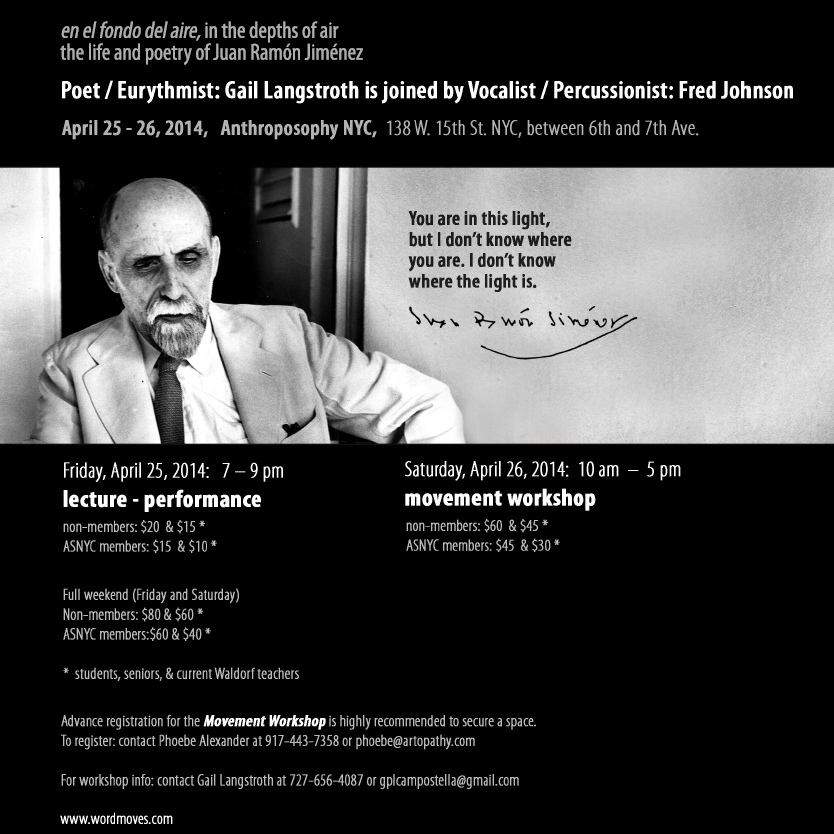
Worldwide Eurythmy Conference
The Apollonian Course of 1915 Cosmic Word – Human Speech
6 – 10 April 2015
Conference of the Section for Performing Arts
The conference begins on Easter Monday, 6 April 2015, at 7 p.m. and ends on Friday, 10 April 2015, at 10 p.m.
In August 1915, Rudolf Steiner invited the four eurythmy teachers Elisabeth Dollfus, Tatiana Kisseleff, Lory Smits and Erna Wolfram to a course at the Goetheanum that would form the foundation for the further development of the cosmic dimension of eurythmy and of the soul qualities in speech. Now, a hundred years later, this conference will provide the framework for our explo- ration – in lectures, workshops and conversations – of the impulses given in 1915 and their unfolding since then. How are we making use of these foundations today?
Margrethe Solstad, Shaina Stoehr, Stefan Hasler
Further information
Visual Arts Conference August 1-3, 2014
Visual Arts Conference August 1-3, 2014
The Genesis and Task of the Anthroposophical Art Impulse
Eurythmy on the Great Wall of China
Eurythmy Performance of Beethoven – Pathetique
San Francisco Youth Eurythmy Troupe 2/14/2011
Beethoven 7th Symphony 1st Movement Eurythmy
An Outline of the Career of Eurythmy Teacher
Eurythmy developed from its beginnings in 1912 with Rudolf Steiner, the founder of anthroposophy. It occupies a unique position amongst the arts of movement, as it grows out of the lawfulness of speech and music. The profession of eurythmy teacher is practiced by men as well as women. Continue reading
Memoriam for Alice Pracht 1911-2000
By Dorothea Mier
Our dear friend, Alice Pracht (Sissy) died on November 12, and I would like to share some thoughts about her life. I very consciously begin with ‘our dear friend’ because not only did we experience her as such, but each time I visited her in the last eighteen years or so, she would remark how amazingly connected she felt to the friends and work in Spring Valley. She didn’t know why (then her characteristic little laugh), but she felt such a deep connection.
Eurythmy in Waldorf Schools
By Robin W. M. Mitchell
At times, the question arises, “What is eurythmy, and why is it so important in Waldorf education?” In an attempt to answer these questions, I started by looking at a number of definitions of education. I have synthesized them into the following synopsis:
“Education brings about a state of knowledge and of aesthetic moral development, resulting from a learning process which develops skills needed by a person wishing to take charge of his or her own life.”
Encompassed in this definition, we can find attributes that go much further than a summation of known facts, held in memory. Knowledge may be in the foreground – but it is a form of knowledge that finds its validity in relationship to living one’s life and making one’s own decisions. Skills are also mentioned. Skills require practice so that they may be at the service of the individual who has taken the trouble to acquire them. Aesthetic development unfolds the ability to recognize beauty when one meets it – and the lack of beauty as well. On a different level, where knowledge presupposes the ability to look at facts as objective realities, aesthetic development presupposes that one has an inner life with a capacity for discernment. In the sphere of moral consciousness, we can see a need for ones objective qualities to meet ones subjective qualities in harmony. To sum it all up, we might say that education has to do with a journey into the knowledge of oneself in relationship to everything around us in the world.
Eurythmy and the Four Ethers
By Marjorie Spock
Aphorisms and Exercises
If we were to look really searchingly into the causes of today’s discontents we might find all of them stemming from a sense of having been disinherited. Few may be able to put a finger on just what has been lost or to say how we lost it. But something vital is missing from experience, an exuberant quality of life that earlier ages seem to have possessed. It can still be witnessed surfacing in the hops, skips, and jumps of early childhood and heard in the deep-chested laughs of tiny babies. But by the time adulthood is reached, a sad diminution has usually taken over, and most grown-ups look for it in vain.
The Eurythmy Figures as Keys to a Deeper Understanding of the Human Being
By Seth Morrison
Rudolf Steiner created his sketches for the eurythmy sound movements and soul gestures in 1922 and 1923. The new art form had grown and performances were seen on stages across Europe. Despite the devastation caused by the World War, the Waldorf School Movement flourished. Therapeutic eurythmy was only a few years old but found an enthusiastic reception among educators and medical doctors. The eurythmy figures grew out of this germinating power of an inspired art form. The figures became a kind of living study material. The trios and quartets of colors, the highly differentiated forms and characters of the figures provide schooling for the artist. When reconstructed in the act of artistic creation, a true inner work fills the experience of visible speech and music. The figures offer the eurythmist an unending source of self education.
In addition to the well-known aspects of color and form in the figures, a whole other pathway of study is contained within them. In a course given by Elena Zuccoli to students at the Curative Eurythmy School in Stuttgart, West Germany, in 1986, an introduction as well as a challenge was presented. Frau Zuccoli arranged the twelve consonant figures according to their relationship to the zodiac as described by Rudolf Steiner. She then asked the class, “What do you see?” Only one student responded! One half of the figures are represented in profile, the other face forward. There are three transitory figures. It is a striking image once it is ‘seen’! But what does this mean? Frau Zuccoli left this image as an unanswered question, a point of departure for her students. This little article will share my attempts to understand the meaning behind the special orientation of the figures, which has become a source of inspiration for my work in curative eurythmy.
Before launching ahead, it might be helpful to explore the experience of the human figure as it appears in profile as opposed to the frontal view. One hundred years ago, the silhouette was still a popular form of portraiture. The profile view of the torso reveals a sculptural impression. The shape of the shoulders, head, forehead, nose, lips, and chin appear fixed and formed. The profile is an image of what has been; the past up to the present moment. It is human destiny sculpted and made visible. The full face view of the human being gives an entirely different impression. The past lies somewhere in the distance, hidden behind the projected personality. The directions of dimensions of right and left fill out the ‘space’ of an incarnated person, be it narrow or broad, robust or hallowed out. There is a meeting with the present and an intuition of the future. The presence of human character, in its immediacy, fills space and projects itself into what will become the future.
When arranged according to their correspondences to the fixed stars, the figures for the sounds V (Aries), R (Taurus), and H (Gemini) are presented in profile. They face outward and away from the center of the circle. The figure for F (Cancer) however, also in profile, faces T and D (Leo). B and P (Virgo) face forward. The figure for Ch stands in a ¾ view. The S (Scorpion or Eagle) faces forward as does the G (Sagittarius). Its double letter K, stands in profile toward the N (Pisces). The N stands in profile toward the V (Aries), which joins the circle together. The figures for F, M, and CH are transitory with regard to the directionality of the entire circle of figures.
Rudolf Steiner’s spiritual research confirmed the idea of an astro-physiognomy of the human being. In countless manuscripts, painting, and drawings, most of which echo the mystery teachings of a forgotten time, one sees the human head marked with the sign of Aries or a ram. The Larynx is connected with the Bull, or Taurus, the shoulders with Gemini, and so on. The science of contemporary embryology was once seen from another point of view: the embryo lies curled up exactly as the circle of fixed stars appears in the heavens, the head in Aries and the feet in Pisces. One can imagine how the human embryo materializes out of the fluid world of the womb, somehow analogous to the creation of dry land in the book of Genesis of the Old Testament. Turning ones attention to the eurythmy figures, one can ‘enact’ this creation of man’s form through the eurythmy movements themselves, beginning with the V, which contours the head and going on to each region of the human form. It is a wonderful exercise. Now the special orientation of the figures begins to ‘speak’: the figures which correspond to the upper region of the human form all stand in profile and face outward into the depths of the periphery. They look away or back into another region of space. Aries, Taurus, and Gemini form a grouping. The human head is enclosed in a bony shell, like the insect. Its activity is contained within itself, invisible and concealed. It is inwardly mobile but outwardly immobile. The throat uses the air element but does not really change it. It adds to the air, instead. Its activity creates an enclosed, half-way internalized acoustic. The shoulders give width through the dimension of right and left. A tension, a dynamic holding together in equilibrium characterizes this region. The human being then acts as giver or receiver of world experienced every time he goes out of himself into the ‘other’; thus the H movement expresses how the arms become the instruments of the forces of Gemini.
Now a great transition occurs: the formative forces seem to turn the orientation of structure inward, as air enters the chest cavity and is transformed by the magic of the blood. The figure faces away from the H figure and directs itself toward the T figure. The T corresponds to that organ wherein the transformation is perceived by the ego organization. The ribs enclose from without, the lungs from within. Doublely embraced, the heart (Leo) an organ of blood perceives itself.
The journey within, intensifies further. Those eurythmy figures whose sounds are related to the zodiac regions associated with the digestive organs all stand facing forward. The figures are grand and immediate. One feels as if real personalities make their presence known… like the gods of the underworld or inner world of man. The B movement expresses this complete containment of an inner realm, like a temple removed from outer light but filled with a self-sustaining radiance. Within the metabolic organs substance is destroyed or reduced to a level which can be called ‘inorganic’. It is then recreated by the rhythmical processes of these organs so it bear the incarnation of the individual ego.
Yet another transition occurs, expressed by the spatial orientation of the CH figure. Within the basin-like structure of the pelvis an environment is created in which another ego, a new person, can anchor itself. Through fertilization, gestation, and birth, the signature of S (Scorpion or Eagle) reveals itself. The S figure is dressed as a renunciate, just as certain monastic orders dress in black and then grey to express their religious journeys, And just as the S movement in eurythmy almost manages to become a separate entity, so do the female reproductive organs sacrifice their autonomy in order to give place to the developing human being. Then, the event of birth gives a separate existence to the child. The S figure shows man’s deepest penetration into the physical world and the moment of victory for the ongoing evolution of the earth.
Through the powers of Scorpio in the human being, the physical world is conquered. Now the human organism can metamorphose further. The thighs are the mechanisms of walking and express the will forces which seek to propel the human being into the future. The G figure faces forward but the head is turned toward the K figure. The K faces the G. The K corresponds to the hardest part of the thigh, just before it embraces the knee. Both represent the forces of Sagittarius. The knee (Capricorn) is the mediator between the innermost forces of the will and the earth itself. It floats, so to speak, in currents of dynamic forces, fluid-like and ‘sensitive’ to the interplay of the human spirit with the organism of the earth. It lives between levity and gravity. The L figure faces forward but the figure for M faces away, in the other direction. The M forms the shins, which are purely rhythmical organs. A person’s gait indicates the way in which the limb-metabolic system is embraced by the rhythmical system. The lower legs are the primary rhythmical organs of the lower region of the human form. The fact that the M faces away from the other figures of the region is significant. From the knees downward, the human body takes on a new character. It no longer strives toward incarnation but carries itself anew, toward the macrocosm. The head contains an imprint of the cosmos, the feet strive to become active in the cosmos. The foot is really a complex arch, an organ which has the power to overcome the earthly forces of weight. It is an organ of the ego. The freedom of the feet is the signature of human destiny which seeks to become independent through its evolution. The M figure, as well as the N figure, faces the region of Aries so that the past may be dissolved and remolded. The future alters the past.
The spatial orientation of the eurythmy figures reveals a hidden teaching. It tells the story of human becoming, the descent of man into matter and his triumph over it, brought about by his own activity. The human form is really a living sculpture and a hieroglyph of spiritual evolution.
One cannot carry this kind of information with one and this is surely not the intention of this article. Instead, a kind of ‘feeling’ can reside within the creative life of the artist with regard to the different sounds. These feelings or moods, as Rudolf Steiner called them, are objective realities. He brought them to poetic expression in his Twelve Moods (Zwolf Stimmungen).
This study brings questions to mind about the zodiac positions or gestures which were given in Eurythmy as Visible Speech. It is important to remember that of the twelve gestures only Aquarius has a kind of movement. All the others are at rest. It is a silent world, like a summer night when one looks into the heavens. It is as if the zodiac gestures are a portrayal of the Star-Gods themselves, of their contribution to the human figure. The eurythmy movements are dynamic. They speak and sing. They are so alive as to enable an ill person to actively participate in the anabolism of his own etheric body. If one practices doing a zodiac gesture, followed by the eurythmy movement, in light of the figure, a powerful experience can come about. One can feel how the resting zodiac becomes dynamism, creating the human form – which ‘appears’ to be at rest. Yet its life turns within and the formative forces reappear in the life of the soul as music and speech. Through the spiritual activity of art, the powers of the universe become visible. This is the art of eurythmy. One can only stand in awe before this art. It overcomes all our ‘ideas’ about ourselves and all art and shows us that we ourselves and all we do is really ‘evolving cosmos’, ‘evolving being’.
The Scale as a Work of Art
By Marjorie Spock
Judged by any sound criteria of art, the scale is the most perfect of musical compositions. It is a completely resolved, simple, yet subtle and eloquent expression of the ultimate theme, telling as it does in full the story of the growing up of greatness. And it does so with incomparable brevity in seven short climbing or falling steps or intervals, weaving them moreover into the classic pattern of the lemniscate.
Goethe held the test of a work of art to be its necessity. By this he meant not only that it must say something wholly original needing to be said, but body it forth in a whole and living form, every part of which is harmonious with and essential to it. He therefore called works of art a “higher nature within nature.” The scale is in his sense just such an organism of a higher order.
Prime and octave are the beginning and ending points of the scale’s unfolding, seed and blossom stages of a living whole. Each interval holds the full scale implicit in it, the prime sounding out a prophecy of things to come, the octave its fulfillment
Marjorie Spock
By William Jens Jensen
For the better part of a century, Marjorie Spock has had a beneficial influence on the development of anthroposophy in North America. She has been a eurythmist, a Waldorf teacher, and an active practitioner and advocate of biodynamics and community renewal. She has written several books and articles, including In Celebration of the Human Heart; Fairy Worlds and Workers; Teaching As a Lively Art; and Eurythmy. She has also translated several books, including Nutrition and The Nature of Substance by Rudolf Hauschka.
Marjorie Spock was born in New Haven, Connecticut, early in the twentieth century. At the age of eighteen, filled with excitement and plans to study dance and with no notion of anthroposophy or the arts associated with it, she traveled to Dornach, Switzerland. Only a year earlier, in 1921, while a counselor at a girls’ camp, the painting instructor there had spoken of a wonderful dance program in “Door Knock” (as she heard the name). She understood these words to mean “Knock and it shall be opened unto you,” and knew instantly that she needed to go there.
Except for brief interruptions, she spent much of her youth in Dornach. No doubt, she experienced many deep and lasting impressions during that time, and even first impressions can stir a desire for self-development. Marjorie Spock says that when she first saw the first Goetheanum she “thought it was the ugliest thing” she’d ever seen. Later, she heard that Rudolf Steiner had said that, for those who are still unable to perceive their own inner nature, “one’s whole stature as a human soul became clear to oneself when seeing the Goetheanum for the first time.”
Later, she became seriously ill and was confined to Dr. Ita Wegman’s clinic. Around Christmastime, she was released for a brief time, and on that New Year’s Eve, she witnessed the complete destruction of the Goetheanum by fire. She said,
“I think that something in me burned up that needed to be burned up as I watched it. And, for the first time, I became truly interested in anthroposophy. Up until that time, I had loved eurythmy; now the whole seriousness of what was at stake there impressed itself on me, which I had not felt before. So I began to study anthroposophy in great earnest.”
The following year, at nineteen, she was able to attend the Christmas Conference, the series of meetings called to reoganize and renew the General Anthroposophical Society. Although young and inexperienced in such matters, she nevertheless sensed the significance of that event.
Around Christmas 1924, she returned to the U.S. and decided to support herself by working in an anthroposophic bookstore in New Haven. That work proved to be a tremendously valuable experience— “After all,” she said, “I had a whole library of anthroposophy at my fingertips, and I read and studied with great seriousness during those years.”
After working in the bookshop for three years, she returned to Europe and studied for three years at the eurythmy school in Stuttgart. Later, she went to Dornach, where she performed eurythmy on the Goetheanum stage. During that time, she became familiar with Marie Steiner, who was acively involved in most of the eurythmy rehearsals. “Frau Dr. Steiner was simply magnificent,” she recalls, “but rather unapproachable.”
When asked about her experience of Rudolf Steiner during that time, what she expressed was singular:
I looked at his head, and I looked at his hands as I sat in his lectures, and I had the feeling that his head was sort of a condensation of all he was speaking. And the words that he was saying were tremendously significant, although I can’t say that I remember more than a sentence of all the things that he said in those years. But there was one point where I remember his gesture and his words exactly, and that was when he expressed “the wake-up call to become a person of initiative.”
Looking back, I had the sense that he meant something completely different from what happened. People in the society tried to become little Rudolf Steiners, and I felt that we needed to pull together and get an entirely new kind of feeling about community—in a truly Christian sense, really helpful to one another, spiritually and in every possible way—rather than indulging in all the criticism.
It’s incredible that people should not appreciate each other, because we are, each one, developing as individuals, each one developing a completely unique ability of some kind. But instead of looking upon this as an absolute treasure, we cut the ground out from under the feet of people. Largely this is what has happened.
Rudolf Steiner said that, if any group of people gets together with an ideal purpose, an archangel is assigned to that group to guide it. But I don’t think that can happen unless we have the right attitude toward one another.
When asked for her impression of Rudolf Steiner’s appearance, Marjorie Spock said that “he appeared very much like Abraham Lincoln.”
He looked as though he bore up most manly under the most terrible burden … but, of course, he had many warm personal relationships. My father came over to see him when I was in Dornach, and I was able to introduce him to Rudolf Steiner. When we departed this wonderful meeting, my father said first of all, “I think he liked me. I was surprised at the way he looked—he looked just like anybody else!” I took that to be a complement to Rudolf Steiner to say that he looked like anybody else.
When she again moved back to the U.S., Marjorie Spock taught for five years at the Rudolf Steiner School in New York City. Later, she spent a year teaching in a school at the Hales community near the border of Maine and Canada. The community was involved in operating a dairy and vegetable farm on 12,000 acres of forest and lakes. They also had a “sensitive crystalization” laboratory, which was able to test the nutritional vitality of food.
She returned to New York, this time to Columbia University for a major in education. Having no college degree, the school administration gave her “nine hours of examinations in all subjects” to help determine where to place her.
Due to my studies of Anthroposophy and all the interesting things that Rudolf Steiner was always reporting, I was able to pass them all. The dean of admissions said to me that he didn’t “know of a single school in America that can match that”— especially considering that I had an IQ that was only just respectible.
As a result of those tests, the college awarded her credit for three years of college and allowed her into the post-graduate program. After two years, she received a master’s degree.
For the next five years, she taught at “two of the big progressive schools” in New York—the Ethical Culture School and the Dalton school (or “children’s university”). From there, she went on to teach eurythmy for eight years at the Garden City Waldorf School. It was while living in Garden City that she began her lifelong passion for biodynamic agriculture, which led her and a friend to buy 140 acres of land in Upstate New York.
Living on their new farm, Marjorie Spock and her friend became interested in producing and selling organic vegetables, but their land was always being sprayed with pesticides—something that had also happened in Garden City. They decided that it “was absolutely essential to challenge this practice” by getting an injunction against spraying private lands. Although the suit, which reached the U.S. Supreme Court, was unsuccessful, it raised awareness of the issue and enfluenced the views expressed by Rachel Carson in Silent Spring. Eventurally, the courts decided that private lands could not be sprayed without the owners’ consent.
After Rudolf Steiner’s death in 1925, various difficulties and divisions arose in the Anthroposophical Society, which led Marjorie Spock to write two articles on community building, later published under the general title of “Group Moral Artistry.” They have been widely circulated ever since— especially among young people according to the author. One of the articles, “The Art of Goethean Conversation,” was included in the recent edition of Goethe’s Green Snake and the Beautiful Lily (see page 74).
Marjorie Spock’s most popular book these days is Fairy Worlds and Workers. It is a sensitive, imaginative exploration of nature’s inner beings—its Little People, the elementals, the Middle Kingdom. She says that her feeling for the natural world of fairies arose not clairvoyantly but from her connection with the earth as a farmer and gardener. That feeling is an ability to read certain signs of nature and to hear what it is asking for.
Today, Marjorie Spock remains active—indeed, an activist. She participates in an anthroposophic study group, she writes, and she enjoys nature, people, and the world around her. Her spirit shines brightly through her words, her sense of humor, and in her concern for our future as human beings and anthroposophists.
Eurythmy as a Threshold Art
By Carol Ann Williamson
How can eurythmy be considered an art of the threshold? For years, I have pondered this question. In the past ten years, my eurythmy destiny has led me into this sphere. A year ago, a eurythmy colleague of mine urged me to write about my encounters. At first I was reluctant to speak about these matters for obvious reasons. But after much thought, I have decided to share some of my experiences. As eurythmy is a new form of art, and its application in threshold issues is indeed a nascent art, I realized this is a realm which could use some illumination.